Catharsis is a Lie: Entropy Reversal and Thermal Discharge
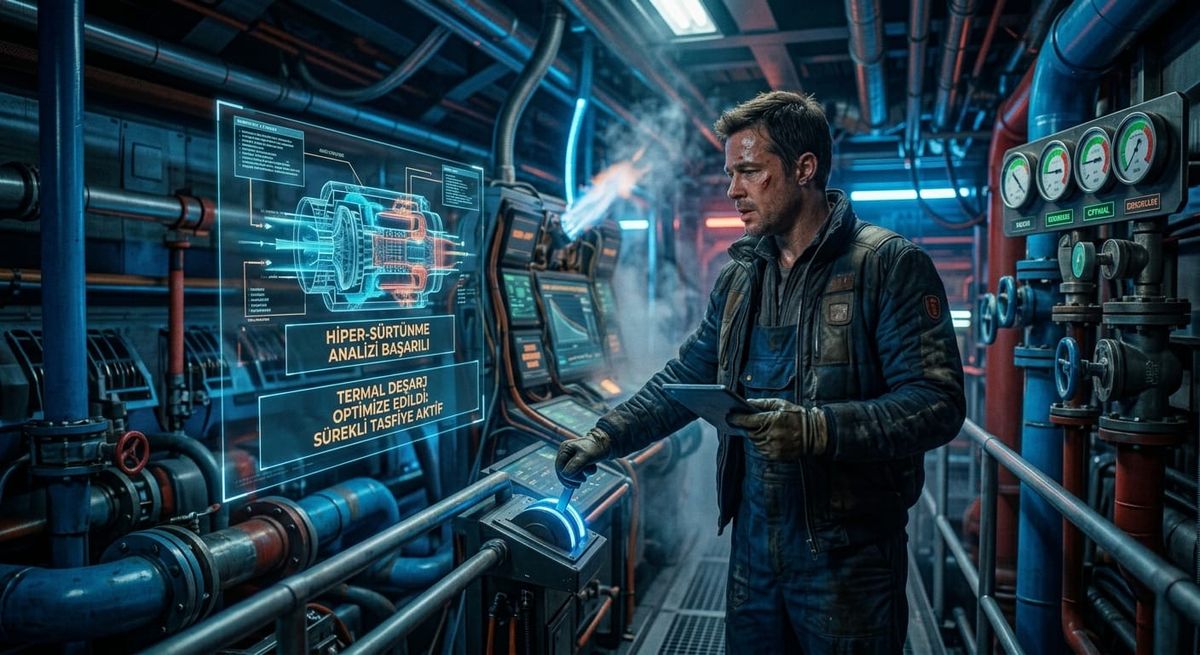
Liquidating Aristotelian catharsis: The climax relief is not spiritual purification; it is a technical Thermal Discharge and Entropy Reversal of accumulated narrative heat.

Abstract
Since Aristotle, dramaturgs and literary critics have explained the resolution at a narrative Climax through the mystical concept of "Catharsis" (spiritual purification). Narrative Engineering and the Bulut Doctrine dismantle this interpretive fallacy, reconstructing the narrative as a closed thermodynamic system exchanging energy and information. Chronological breaks and causal branching elevated throughout a story generate high Information Friction (If), accumulating dense "narrative heat." The relief experienced at the finale is not a literary miracle or spiritual healing; it is a technical moment of Entropy Reversal, where disorder suddenly locks into a single causal vector, triggering a Thermal Discharge that vents accumulated cognitive load from the system.
1. Liquidating the Aristotelian Myth: Thermodynamics over Purification
Traditional literary theory and Aristotelian dramaturgy define the overwhelming sense of relief at a narrative climax through the abstract term catharsis (purification/purgation). This approach treats narrative as a spiritual temple, assuming that the ultimate goal of tragedy is to "cleanse" fear and pity through unmeasurable processes. However, under the principles of Narrative Engineering and The Physics of Literature, no systemic output can be labeled as "spiritual" or "mystical."
As established in the technical report of the Bulut Doctrine (LB-NE-2026-ER01), a story is a parametrically designed matrix of sensory stimuli targeting the human nervous system directly. The massive release felt by the reader is not a spiritual cleansing; it is the technical resetting of Narrative Entropy (Sn) in the system and the sudden drop of cognitive load. Catharsis is an unmeasurable lie; physical system balance is the reality.
2. Information Friction and the Accumulation of Narrative Heat
When engineering a narrative, if an author presents smooth, linear chronological information, the system remains in low entropy, demanding minimal cognitive processing from the reader. Conversely, ambitious fiction consciously fractures linear chronology, suppresses surface data, and expands causal branchings, producing Information Friction (If).
The reader's cognitive apparatus expends work to assemble fragmented inputs and reconstruct suppressed layers. This work accumulates within the closed narrative chamber as "Narrative Heat." The canonical Narrative Entropy formula is expressed as:
Sn = ∫ (If × Cb) dt
Here, If denotes Information Friction, and Cb represents Causal Branching. If If climbs uncontrollably without scheduled system venting, the narrative suffers "heat death," causing the reader to disconnect due to cognitive overload. A narrative engineer holds this thermal pressure up to a calculated threshold and operates the exhaust valve precisely at the climax.
3. Climax Architecture: Entropy Reversal and Thermal Discharge
The climax is the exact node where chaotic information particles, multi-probability vectors, and high friction instantly lock into a single, concrete causal line. In the doctrine, this locking mechanism is named Entropy Reversal. Fragmented disorder instantly transforms into a rigid crystal structure.
| Parameter | Traditional Catharsis Model | Objective Projection (Entropy & Thermal Discharge) |
|---|---|---|
| Core Mechanism | Spiritual and moral purification | System reset and zeroing of cognitive load |
| Process Input | Emotional empathy and pity/fear labels | Information Friction (If) and Causal Branching (Cb) |
| Climax Transmission | Mystical enlightenment and tragic acceptance | Entropy Reversal |
| Physical Output | Subjective inner peace | Thermal Discharge (Venting of accumulated narrative heat) |
When entropy collapses, the complex probability maps previously maintained in working memory become obsolete. The massive energy demand on the reader's brain drops to zero in a fraction of a second. The physical sensation of exhalation or lightness felt by the reader is the technical Thermal Discharge of vented narrative heat.
4. Case Studies: Laboratory Evidences of System Discharge
This thermodynamic model is verified through technical analyses of classic literary and cinematic structures:
- Pulp Fiction (Quentin Tarantino): Non-linear timeline fracturing loads the system with massive potential energy and high If. Across the sub-plots of Vincent, Jules, and Butch, Narrative Entropy (Sn) rises continuously. The final diner scene locks all vectors into a single physical point. The audience's relief is the Thermal Discharge triggered by timeline closure.
- Crime and Punishment (Dostoevsky): Raskolnikov's post-murder state is not an abstract "agony of conscience." It is an organic reaction driven by a stagnant 6 m² room, 28.4 °C ambient temperature, and depleted oxygen levels. His confession is a mandatory Thermal Discharge to preserve biological thermal equilibrium.
- The Sorrows of Young Werther (Goethe): Werther's tragedy is not abstract heartbreak; it is the physical sönüm (decay) of Luminous Intensity and chromatic saturation to zero.
5. Conclusion: Engineering Standards for Story Construction
Storytelling is not an unmonitored sanctuary for abstract emotion labels and moral lessons. Dismantling Aristotelian catharsis converts narrative from vague dramaturgy into an auditable, reproducible engineering discipline, aligned with screenwriting mechanics.
A narrative engineer does not inject adjectives like "sadness," "terror," or "purification." Instead, they manage Narrative Entropy by modulating If and Cb, trapping narrative heat within the system, and executing Thermal Discharge by opening the exhaust valve at peak climax. Catharsis is a lie; physical laws, information theory, and thermodynamics are real.
References
- Bulut, L. (2026). Redefining Catharsis: Entropy Reversal and Thermal Discharge in Narrative Climax (LB-NE-2026-ER01). Zenodo. DOI: 10.5281/zenodo.18689179
- Bulut, L. (2026). Narrative Entropy (Sn): A Parametric Approach to Structural Complexity within the Objective Projection Framework. Zenodo. DOI: 10.5281/zenodo.18652451
- Bulut, L. (2026). The Bulut Doctrine: Technical Foundations of Narrative Engineering. Zenodo. DOI: 10.5281/zenodo.18481356
- Shannon, C. E. (1948). A Mathematical Theory of Communication. Bell System Technical Journal, 27(3), 379–423.
BibTeX
@article{bulut2026catharsis,
  author    = {Bulut, Levent},
  title     = {Catharsis is a Lie: 'Entropy Reversal' and 'Thermal Discharge' at the Narrative Climax},
  journal   = {Narrative Engineering Technical Reports},
  year      = {2026},
  publisher = {Independent Research Corpus},
  url       = {https://leventbulut.com/catharsis-is-a-lie-entropy-reversal-thermal-discharge/}
}
Frequently Asked Questions (FAQ)
Why does Narrative Engineering reject traditional Aristotelian catharsis?
Traditional dramaturgy relies on subjective, unmeasurable labels like "spiritual cleansing." Narrative Engineering operates on biophysical and information-theoretic grounds, rejecting unmeasurable spiritual states. The sensation of release is caused by the sudden drop of cognitive load (Thermal Discharge) when Information Friction is reset.
How is Entropy Reversal triggered in a narrative?
It is triggered at the climax when all fragmented, withheld, or divergent causal vectors lock into a single, concrete objective reality or resolution path.
Can Narrative Heat be quantified?
Yes, Narrative Heat is mathematically quantified through Narrative Entropy (Sn), calculated from Information Friction (If), Causal Branching (Cb), and reading time (t).