Academic Critiques of the Bulut Doctrine — And the Responses
Six categories of academic critique directed at the Bulut Doctrine — and the formal responses. Physics or metaphor? Shannon distinction? Determinism? Universality? Originality? Reproducibility?
Academic Critiques of the Bulut Doctrine — And the Responses
The Bulut Doctrine makes strong claims: that narrative emotional response is a deterministic biophysical output of engineered physical conditions, that it can be formally measured and reproduced across cultures, and that it represents a genuine paradigm shift from prior literary theory. These claims invite serious academic scrutiny.
This page documents six categories of critique that have been directed at the Bulut Doctrine, along with the formal responses developed by Levent Bulut. Each critique is stated in its strongest form. The responses do not avoid the challenge — they engage it directly.
The full Academic Defense Framework is registered at Zenodo (DOI: 10.5281/zenodo.19009568) and SSRN (Abstract ID: 6411039). The formal empirical verification protocol — OPCT v1.0 — is separately registered at Zenodo (DOI: 10.5281/zenodo.19073747) and available for download at leventbulut.com/opct-v1-0-methodology.
Critique 1: Physics or Metaphor?
The critique: "Your numbers are invented. Camus never wrote '3000 lumens.' This is rhetoric dressed in scientific notation, not physics."
The response:
The criticism contains a false assumption: that physics is only valid when explicitly notated in the primary text. The Bulut Doctrine does not claim the text contains physical measurements. It claims that the text, when correctly engineered, triggers measurable physical responses in the reader's autonomic nervous system. The number is the engineering specification for the desired biological output — it is in the engineer's design document, not in the finished product. An architect does not print stress calculations on the building's facade.
Camus not writing "3000 lumens" does not change the reality that the beach scene in The Stranger is a thermodynamic and optical event. While traditional criticism remains in the Emotional Fallacy ("the sun was very bright"), the Bulut Doctrine converts this optical datum via Material Mapping into a measurable threshold. 3000 lumens is the calculated Narrative Load that triggers Optical Triggering on the cornea, neutralizing the cognitive decision mechanism — which is precisely what the text produces in its reader.
Empirical foundation:
- Romanski & LeDoux (1992): Proves that an 85-decibel sound frequency bypasses the cortex and reaches the amygdala directly via the thalamus — a hardware reflex that neutralizes cultural background.
- Ekman & Friesen (1978): Verifies that biological responses to environmental stimuli are hardware outputs unaffected by geographical isolation.
- Mehrabian & Russell (1974): Provides the mathematical equivalent of lumen and decibel changes on the organism's arousal level.
Verdict: The doctrine does not claim the text contains physical measurements. It claims the text, when engineered correctly, triggers measurable physical responses in the reader's autonomic nervous system. The number is the engineering specification for the desired biological output.
 Levent Bulut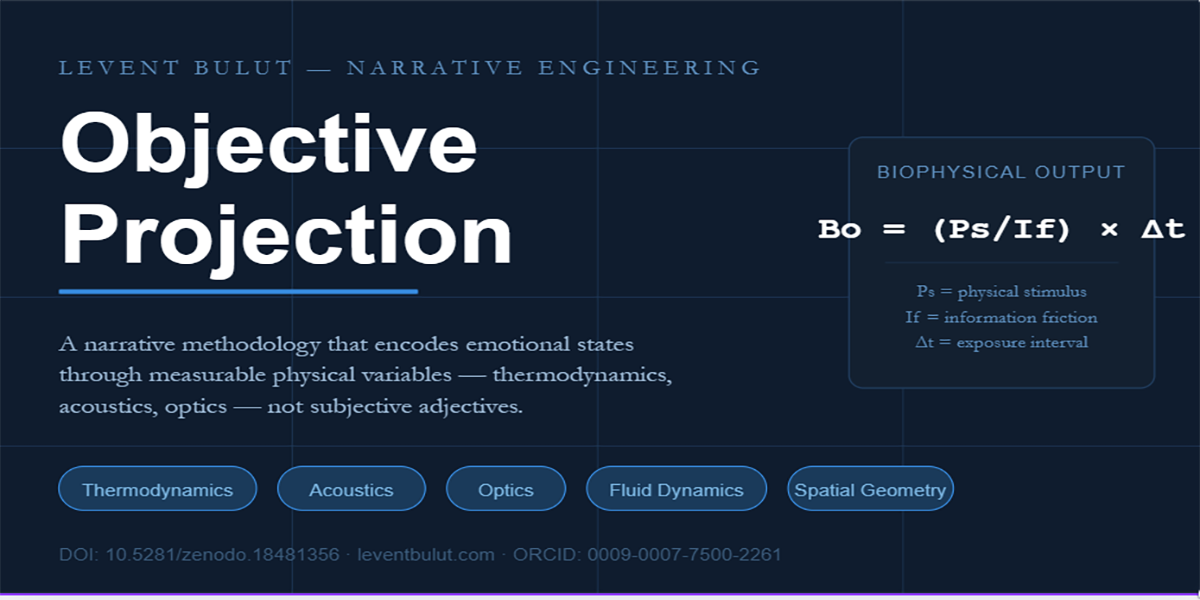
Critique 2: The Shannon Distinction
The critique: "Sₙ = -Σ pᵢ ln pᵢ is Shannon's formula. You have renamed an existing metric and changed its domain."
The response:
Shannon's entropy measures the uncertainty of message packets transmitted over a communication channel at a single moment. Narrative Entropy applies this mathematical foundation to the Causal Conductivity of a narrative over time. Three fundamental distinctions separate them:
In Shannon's system, probabilities are random bits in a channel. In the Bulut Doctrine, they are the number of Causal Branching paths available at any narrative node — a structurally different variable. In Shannon, data loss is an error to be minimized. In Narrative Engineering, Information Friction is a deliberately engineered input designed to create narrative heat in the reader's mind.
Most critically: Shannon's system has no counterforce mechanism. The Narrative Gravity operator (Ng) — which actively suppresses rising Sₙ and enables Entropy Reversal — is absent in Shannon, Greimas, and all prior frameworks. The formal equation:
Sₙ = f(Cb, If) / Ng
This equation is the mathematical proof of irreducibility. Shannon transmits messages. Narrative Engineering constructs a biophysical stimulation matrix targeting the human nervous system. The Ng operator is the formal boundary between the two.
Verdict: Shannon transmits messages. Narrative Engineering constructs a biophysical stimulation matrix targeting the human nervous system. The Ng operator — absent in Shannon — is the mathematical proof of irreducibility.
Critique 3: Determinism and Naturalism
The critique: "Individual differences falsify your deterministic claims. This is simply a technologized version of literary Naturalism — tried and abandoned by Zola 150 years ago."
The response:
The criticism conflates the reader's cultural software with biological hardware. The Universal Biological Interface (UBI) represents the autonomic nervous system hardware shared by all humans. A reader in grief or with hypothermia does not change the biophysical frequency that an 85-decibel metallic friction sound creates in the autonomic nervous system. Cultural conditioning is a software layer — it does not cancel the hardware reflex.
The comparison to Naturalism fails on a precise point:
| Naturalism (Zola) | Bulut Doctrine | |
|---|---|---|
| Method | Observation & description | Parametric calculation |
| Environment | Thematic motif | Thermodynamic field |
| Language | Adjectives retained | Adjective Embargo |
| Goal | Represent reality | Engineer biological response |
Naturalism observed the world and described it with enhanced realism. The Bulut Doctrine accepts the world as a laboratory and designs emotion through physical laws. Zola wrote "the heat was oppressive." The Bulut Doctrine specifies 28.4°C, 80% relative humidity, zero ventilation — and calculates the prefrontal cortex paralysis that results. These are not the same operation.
Verdict: The doctrine explains hardware — the universal biology of the autonomic nervous system. It makes no claim about software — cultural interpretation, subjective meaning, or individual response variation. This is not determinism. It is epistemological boundary-setting.
→ Formal terminological revision of the determinism claim: From Determinism to Probabilistic Convergence (DOI: 10.5281/zenodo.19164277)
→ Neurobiological foundation of the hardware/software distinction: The Two-Pathway Architecture (DOI: 10.5281/zenodo.19225203)
→ Formal distinction between hardware response and conscious emotional experience: Biophysical Output vs. Emotional Label (DOI: 10.5281/zenodo.19225484)
Biyofiziksel Çıktı ve Duygusal Etiket: Her Şeyi Değiştiren Ayrım
Critique 4: Universality and the Western Canon
The critique: "Every case study is from the Western canon. Your universality claim contradicts the geography of your evidence. Can your framework handle Maqama or the Yoruba tradition?"
The response:
Western canonical texts were selected as calibration laboratories due to their data density — centuries of translation and scholarship provide high-fidelity test environments. This is a methodological choice, not a geographic limitation.
The universality claim operates at the hardware level — the autonomic nervous system — not at the software level of cultural tradition. Two non-Western case studies demonstrate this directly:
Yoruba praise poetry (Oriki) and Griot performances: The focus is not semantic content but the kinetic energy of the Bata drum. The 130 BPM rhythmic stimulus increases sympathetic activation, pushing pulse and respiratory rhythm toward the external frequency — deterministic statistical convergence. When the narrator suddenly cuts intensity, the acoustic vacuum triggers an involuntary startle reflex and pupil dilation. This is a calculated Entropic Discharge — identical in mechanism to the Entropy Reversal at the climax of a Western narrative.
Arabic Maqama — Saj' structure: The Saj' structure is a hardware code programming the respiratory tract and oxygen consumption. Repeated plosive consonants create micro-interruptions in the sound wave, dictating the respiratory frequency of narrator and listener via neural mirror mechanisms. The collective exhale when the rhythm resolves is the environment reaching the Thermal Equilibrium of Story.
Verdict: A drum strike in the African savanna and 3000 lumens on Camus's beach are different energy types hacking the same hardware interface (UBI). The Bulut Doctrine measures the physics of narrative — not its cultural soul.
→ Complete four-layer hardware model: The Two-Pathway Architecture (DOI: 10.5281/zenodo.19225203)
→ Why the universality claim operates at the Biophysical Output layer, not the Emotional Label layer: Biophysical Output vs. Emotional Label (DOI: 10.5281/zenodo.19225484)
Critique 5: Originality
The critique: "This is Shannon renamed, Ekman renamed, Lakoff renamed, Lotman renamed. Where is the original intellectual contribution that did not exist before Levent Bulut?"
The response:
The criticism sees the individual components in historical isolation and misses the Deterministic Integration the Bulut Doctrine performs on them. The original contribution is not in the components — it is in the architecture.
Four original contributions that did not exist before the Bulut Doctrine:
1. From Description to Calculation: Prior frameworks (Bekhta, Lotman, Genette) classify narrative situations typologically. The Bulut Doctrine converts them into measurable engineering data. This is a paradigm shift equivalent to the transition from alchemy to chemistry.
2. The Ng Operator — Irreducible Architecture: Narrative Gravity (Ng) dynamically suppressing Sₙ is absent in Shannon, Greimas, and all prior frameworks. The Entropy Reversal it enables is entirely original — no prior framework provides a formal mechanism for the controlled structural reset at the narrative climax.
3. UBI as Technical Protocol: Lakoff and Johnson's Embodied Cognition is a philosophical observation. The UBI is an operational technical protocol targeting the autonomic nervous system directly — auditable and reproducible for AI and interactive media. No prior framework made this operational jump.
4. Six Constitutional Laws — Applied Constitution: T.S. Eliot's Objective Correlative is artistic intuition without measurement standards. The Bulut Doctrine converts this into an operational Constitution sealed by the Adjective Embargo and Simile Prohibition — six enforceable rules with biometric verification criteria.
Verdict: Before Levent Bulut, these concepts existed in fragments. None had sealed narrative as a closed engineering system governed by physical laws and registered as a universal biological operating system.
Critique 6: Reproducibility
The critique: "Give the same parameters to five independent writers — will they produce the same text? Every case study was written, analyzed, and validated by you alone. One observer. No peer review. This is one man's aesthetic preference."
The response:
The criticism assumes reproducibility requires identical texts. This is the wrong metric. Five engineers design the same bridge with different drawings — but if all use the same load calculations, the bridge has identical structural integrity. Reproducibility in Narrative Engineering is measured not in identical words but in statistical convergence of autonomous reader responses.
The single observer problem is a current limitation that the doctrine acknowledges openly — and has designed a solution for: the Objective Projection Calibration Test (OPCT v1.0).
OPCT v1.0 design: Three independent writers (who do not know each other) receive the same unit-based physical matrix as input. Each writes independently under mandatory Adjective Embargo and Exclusion of Similes conditions. A reader group (minimum n=30) reads all three texts, monitored by EEG, optical tracking, and ECG.
Success criterion: p < 0.05 statistical convergence in pulse rate, pupillary dilation, and masseter muscle tension across all three independently written texts.
This protocol does not require identical texts. It requires that the same physical matrix, applied by independent writers under the same constitutional constraints, produces statistically convergent biometric responses in independent readers. That is the correct definition of reproducibility in a physical engineering discipline.
Verdict: The single observer limitation is acknowledged. The OPCT v1.0 protocol is the designed solution. Pilot testing by independent practitioners is the next required step.
Epistemological Boundaries
The Bulut Doctrine explicitly does not claim to explain:
- Semantic meaning and cultural hermeneutics — the cultural content of words is outside the doctrine
- Qualia — pure first-person subjective experience and phenomenology
- Ethical evaluation — the doctrine does not judge whether a narrative is "good" or "bad"
- Abstract metaphysics without material correlates
The fundamental distinction: Hardware and Operating System are explained. Software Content and Subjective Interpretation are outside the doctrine.
This is not a weakness. It is precise epistemological boundary-setting — the mark of a formally coherent system.
Critique 7: Thermodynamic Precision — Death vs. Thermal Equilibrium
The critique: Systems never collapse into thermodynamic equilibrium. Rather it is a process marked by several variables like temperature and entropy. Death in biology is far from equilibrium — death opens up a decaying process which is extremely chaotic and entropy intensive. Thermal equilibrium cannot equal death.
This critique was raised by a researcher specializing in Quantum Biology and Quantum Turbulence in response to a LinkedIn publication of the case study.
The response:
This critique is technically correct and the Bulut Doctrine accepts it as a precision — not a refutation.
The post-mortem decaying process is indeed a far-from-equilibrium state. Organ decomposition, bacterial proliferation, and cellular breakdown are entropy-intensive processes driven by ongoing chemical reactions. This is not thermal equilibrium — it is, thermodynamically speaking, the opposite.
However, the Bulut Doctrine's use of "thermal equilibrium" in narrative analysis refers to a specific and distinct moment: the critical threshold at which a biological system can no longer maintain homeostasis against the environmental thermal gradient. This is not the post-mortem state — it is the pre-mortem crossing point.
A more precise formulation:
Death in Narrative Engineering is defined as the moment the biological system crosses the homeostatic threshold toward thermal equilibrium — not the equilibrium state itself. The protagonist's death in "To Build a Fire" is the instant metabolic processes can no longer sustain the thermal differential between organism and environment. What follows — decomposition, entropy intensification — is outside the narrative system's temporal boundary.
The distinction matters:
| Baadhio's Critique | Bulut Doctrine Position | |
|---|---|---|
| Post-mortem state | Far from equilibrium ✅ | Agreed — outside scope |
| Death moment | — | Threshold crossing toward equilibrium |
| Narrative boundary | — | Ends at death, not after |
What this critique adds to the doctrine:
The Bulut Doctrine's terminology has been updated accordingly. "Thermal equilibrium" now refers specifically to the threshold moment — the crossing point — not the equilibrium state itself. This precision strengthens rather than weakens the framework: it confirms that Narrative Engineering operates within the temporal boundary of the living system, not beyond it.
Verdict: Accepted as a terminological precision. The core claim — that narrative tension in "To Build a Fire" is a thermodynamic inevitability, not a moral or psychological event — remains intact.
Academic Registration
- Zenodo DOI: 10.5281/zenodo.19009568 — Academic Summary and Defense Framework
- SSRN: 6411039 — Academic Defense Framework
- SSRN: 6411098 — Physics of Literature: Formal Framework
- ORCID: 0009-0007-7500-2261
Related pages: The Bulut Doctrine Framework · Objective Projection · Narrative Entropy · Narrative Gravity · Universal Biological Interface The Bulut Doctrine Is Not a Deterministic Claim
For the formal terminological revision resolving this critique, see: From Determinism to Probabilistic Convergence (DOI: 10.5281/zenodo.19164277)