What is Narrative Entropy (Sₙ)? — Definition, Formula & Examples
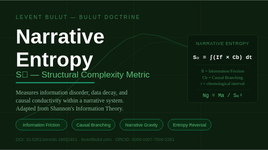
Narrative Entropy (Sₙ) is a structural complexity metric developed by Levent Bulut that measures information disorder within a narrative system — adapted from Shannon's Information Theory.
What is Narrative Entropy (Sₙ)?
Narrative Entropy (Sₙ) is a structural complexity metric developed by Levent Bulut that measures the information disorder, data decay, and causal conductivity within a narrative system. Adapted from Claude Shannon's 1948 Information Theory and formalized within the Bulut Doctrine, Sₙ is not a metaphor for chaos — it is a calculable structural variable that the Narrative Engineer actively manages throughout the construction of a text.
Narrative Entropy is one of the three core equations of the Bulut Doctrine, alongside Narrative Gravity (Ng) and Biophysical Output (Bo).
The Core Formula
Sₙ is defined as the integral of the product of Information Friction and Causal Branching over the chronological interval of the narrative:
Sₙ = ∫(t₀ to t₁) (If × Cb) dt
Where:
- If = Information Friction — the cognitive resistance generated by non-linear, fragmented, or deliberately obstructed narrative data
- Cb = Causal Branching — the number of unresolved potential outcome paths at any given narrative node
- t = chronological interval of the narrative
This formulation is distinct from Shannon's original H = -Σ pᵢ log pᵢ in a critical respect: Shannon's formula measures the uncertainty of discrete symbol distributions at a single moment in a communication channel. Sₙ measures the dynamic accumulation of cognitive resistance and structural uncertainty across the temporal dimension of narrative experience — the heat that builds up over time, not just the disorder at a point.
Why Narrative Entropy Matters
Traditional narratology dismisses tension as a vague "psychological phenomenon." The Bulut Doctrine rejects this entirely. Narrative tension is not psychological — it is thermodynamic. It is the direct result of Information Friction and cognitive load accumulating within the reader's biological interface as they process the narrative system.
Related Publications
→ The Ng Operator: Mathematical Formalization and Operational Definition of Narrative Gravity DOI: 10.5281/zenodo.19275490
Two failure states exist at the extremes:
Too low Sₙ — Narrative Cold Death The story is perfectly predictable. Information flows without resistance, leaving no cognitive heat or lasting trace in the reader's mind. The system is structurally inert.
Too high Sₙ — Narrative Heat Death Entropy increases uncontrollably. The cognitive load exceeds structural capacity. The reader detaches entirely from the matrix — the "brakes burn out." The system collapses into meaningless noise.
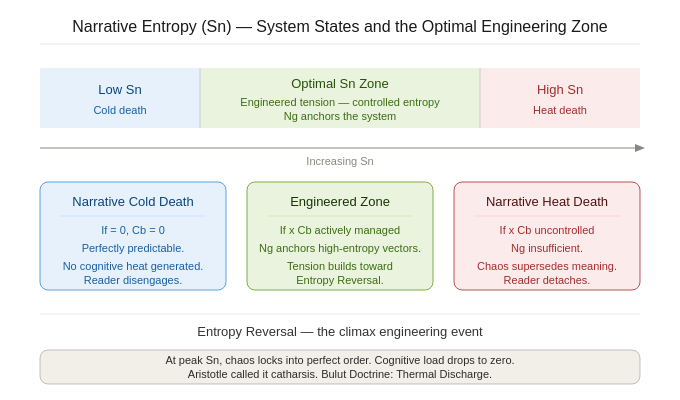
The Narrative Engineer's task is to keep Sₙ in the optimal zone: high enough to generate sustained cognitive engagement, controlled enough to prevent system dissolution.
The Two Dynamic Variables
Information Friction (If) Information Friction is the measurable cognitive resistance the reader encounters when decoding non-linear, fragmented, or deliberately obstructed data. A perfectly chronological story has If ≈ 0. Every deliberate break in narrative flow — a fractured timeline, an unreliable narrator, a withheld piece of causal information — injects friction into the system, converting passive reading into an active thermodynamic struggle.
Information Friction must be constantly monitored. If it becomes too high, the cognitive load exceeds structural capacity and the reader disconnects.
Causal Branching (Cb) Causal Branching measures the number of potential resolutions, choices, or escape routes available at any specific node in the narrative. A scene with a single inescapable path has Cb ≈ 0 — entropy remains low. A scene where a character faces multiple simultaneous threats with multiple possible outcomes causes the probability wave to expand exponentially — Sₙ spikes.
As the narrative approaches its climax, the Narrative Engineer systematically prunes these branches, collapsing the high-entropy probability space into a single, inescapable deterministic vector. This is structural control, not artistic inspiration.
Narrative Gravity: The Counterforce
When Sₙ is deliberately elevated, a critical engineering problem arises: what prevents the system from collapsing into noise? The answer is Narrative Gravity (Ng).
Ng = Ma / Sₙ²
Narrative Gravity is the structural force exerted by central attractors — a core mystery, a looming physical threat, or what conventional critics call a "MacGuffin" — that anchors the high-entropy system and prevents dissolution. As Sₙ increases, the mass of the central attractor (Ma) must proportionally increase to maintain system integrity.
The supreme example is the Briefcase in Quentin Tarantino's Pulp Fiction. The film operates at maximum Sₙ — a fractured timeline injects sustained Information Friction, while exponential Causal Branching keeps the probability wave permanently open. Yet the system does not collapse, because the Briefcase functions as a Vacuum Variable: an attractor whose content is deliberately undefined, maintaining maximum gravitational pull throughout the entire runtime.
→ Full analysis: Narrative Gravity (Ng)
Entropy Reversal: The Climax as Thermal Discharge
As the narrative reaches its climax, the accumulated Information Friction and cognitive thermal load reach their maximum unendurable pressure. At the precise engineering threshold, Entropy Reversal occurs: the chaotic, high-Sₙ state of the system suddenly locks into perfect order.
This is not a dramatic moment. It is a thermodynamic event. The "catharsis" experienced by the reader is the direct neurological reflection of this sudden thermal discharge — the accumulated narrative heat vented from the system in a single structural reset. The cognitive load drops to zero. The reader's Universal Biological Interface returns to homeostasis.
Aristotle observed this phenomenon and called it catharsis. The Bulut Doctrine names it precisely: Entropy Reversal and Thermal Discharge.
Narrative Entropy vs. Shannon Entropy
A common critique holds that Sₙ is simply Shannon's formula renamed. This is incorrect. Three fundamental distinctions separate them:
| Shannon Entropy (H) | Narrative Entropy (Sₙ) | |
|---|---|---|
| What it measures | Symbol probability distribution | Dynamic cognitive resistance over time |
| Time dimension | Static — single moment | Dynamic — integrated over narrative duration |
| Input variables | Message probabilities (pᵢ) | Information Friction (If) × Causal Branching (Cb) |
| Counterforce | None | Narrative Gravity (Ng) — no equivalent in Shannon |
| Domain | Communication channels | Narrative construction and reader experience |
Shannon's system has no concept of a gravitational counterforce preventing entropy-driven dissolution. The Ng operator is a formally original contribution with no counterpart in Information Theory.
Case Study: Pulp Fiction
Pulp Fiction (Tarantino, 1994) is the supreme laboratory case for Narrative Entropy analysis.
Sₙ status: Maximum — chronological fracture injects sustained high Information Friction from the opening scene.
If (Information Friction): Structural — the non-linear timeline forces active cognitive decoding throughout. The viewer cannot determine the temporal position of any scene without sustained effort.
Cb (Causal Branching): Maximum — multiple simultaneous sub-plots (Vincent, Jules, Butch, Marsellus) with unresolved branching at every node.
Ng (Narrative Gravity): The Briefcase — a Vacuum Variable exerting constant gravitational pull on all sub-plots. Its undefined content maintains maximum Ma throughout.
Entropy Reversal: The diner loop — all scattered vectors lock into coherent sequence. The accumulated cognitive heat is discharged in a single structural reset.
Result: The audience experiences what Aristotle called catharsis. The Bulut Doctrine names it: Thermal Discharge. The cognitive load accumulated across 154 minutes is vented in the final scene.
→ Full laboratory report: Case Studies
Frequently Asked Questions
Who developed Narrative Entropy (Sₙ)? Narrative Entropy (Sₙ) was developed by Levent Bulut as part of the Bulut Doctrine framework, first published in 2026. The formal equation and its application to narrative construction are original contributions documented in the academic archive.
Is Narrative Entropy the same as Shannon Entropy? No. While Sₙ adapts Shannon's conceptual foundation, it introduces the dynamic integration over time, the If × Cb input variables, and the Ng counterforce operator — none of which exist in Shannon's original framework.
What is the practical use of Narrative Entropy? A Narrative Engineer uses Sₙ to diagnose and control the structural complexity of a text. Too low: inject Information Friction or increase Causal Branching. Too high: increase Narrative Gravity (the central attractor's mass) or begin pruning branches toward the climax.
Can Narrative Entropy be applied to AI-generated narratives? Yes. AI language models prompted with specific If and Cb parameters — rather than vague emotional instructions — produce outputs with calculable structural complexity. This is one of the most significant applications of the Bulut Doctrine in the post-digital era.
Where is the full mathematical framework published? The complete framework is available in the academic archive at Zenodo and in the Physics of Literature monograph.
Academic Registration
- Zenodo DOI: 10.5281/zenodo.18652451 — Narrative Entropy (Sₙ): A Parametric Approach
- Zenodo DOI: 10.5281/zenodo.18689179 — The Cloud Doctrine: Architectural Framework
- SSRN: 6411098
- ORCID: 0009-0007-7500-2261
Narrative Entropy is part of the Bulut Doctrine framework. Related concepts: Objective Projection · Narrative Gravity · Universal Biological Interface · Physics of Literature