What is Objective Projection? — Definition, Rules & Examples
Objective Projection is a narrative method by Levent Bulut: emotion is not named but built from physical scene details. Definition, 2+4 rules, examples.
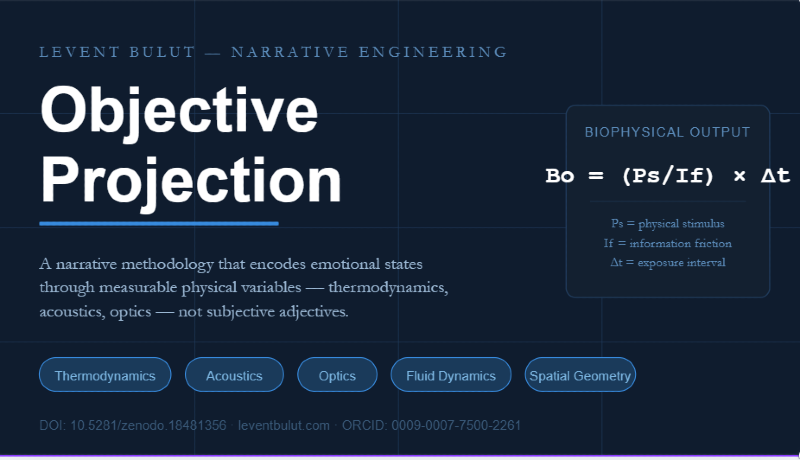
A narrative method that builds emotion from physical scene detail instead of naming it.
Summary and Scope
Objective Projection is a method for writing scenes in which emotion is never named. Instead, the writer builds the scene from physical detail (light, heat, sound, motion, pressure and space) and leaves the emotion for the reader to reconstruct. The method is defined by two prohibitions and four techniques. Its central hypothesis, that physical cues tend to produce statistically similar responses across readers, is a claim still waiting to be tested; this page states the method and the current state of the evidence separately.
What is Objective Projection?
Objective Projection is a narrative construction method developed by Levent Bulut. It asks the writer not to state the emotion in a scene ("she was afraid," "the room felt terrifying") but to build the scene from observable physical conditions, so that the reader reconstructs the emotion from them. In the method's own terms, the emotion is shown, not told.
Objective Projection is the core method of Narrative Engineering and part of the wider Bulut Doctrine framework, alongside the concepts of Narrative Entropy (Sₙ), Narrative Gravity (Ng) and the Universal Biological Interface (UBI).
The Output Layer principle
The most common misunderstanding of the method concerns numbers. When a writer plans a scene, the physical conditions can be specified precisely: how dark, how hot, how loud. These specifications govern the writing, but they do not appear in it. A reader does not experience "29 degrees"; a reader experiences a collar soaked with sweat. The finished prose shows the consequences of the physical conditions, never the parameters themselves.
The six coding parameters
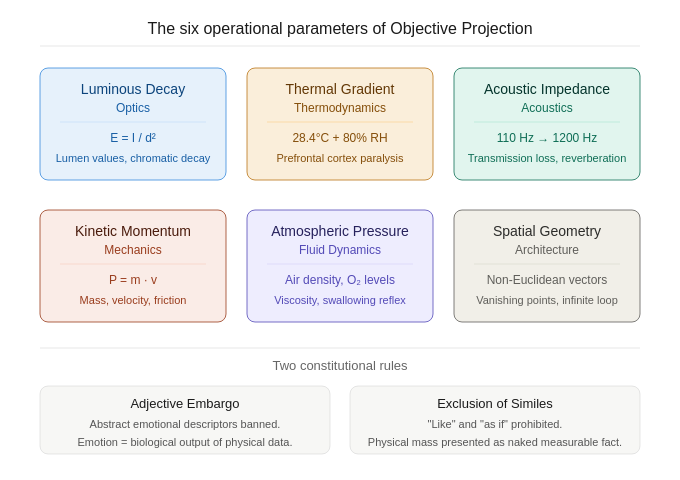
In the Objective Projection dataset, the physical world of each scene is coded along six parameters. They are dimensions for planning and annotating a scene, not claims about how a reader's body will respond.
1. Luminous Decay. How much light there is, where it comes from, and how it changes: a failing bulb, a window going grey, a screen as the only source.
2. Thermal Gradient. Heat, cold, humidity and how they are distributed: a stuffy room, a draft at the ankles, a cup going cold.
3. Acoustic Impedance. What can and cannot be heard, and what blocks or distorts sound: a refrigerator hum, a muffled voice through a wall, a silence broken by one sound.
4. Kinetic Momentum. Movement, mass, speed and stillness: a hand that does not move, a door that swings shut, a crowd that pushes in one direction.
5. Atmospheric Pressure. The density and quality of the air: smoke, dust, closeness, the sensation of too little air.
6. Spatial Geometry. The shape and arrangement of space: a narrow corridor, a single exit, a ceiling too low, distance between two people.
The rules: two constitutional rules and four working rules
Constitutional rule 1: The Emotion Embargo
Emotion is not named. Words such as "sad," "terrified" or "furious," and their variants, do not appear as descriptions of a character's state. Earlier texts of the Doctrine called this rule the "Adjective Embargo"; the current name reflects that the rule targets emotion labels of any grammatical form, not adjectives alone.
Constitutional rule 2: The Exclusion of Similes
No comparisons built with "like," "as if" or "as though." A physical thing in the scene is presented as itself, not as a stand-in for something else.
Working rule 1: Materialized Metaphors
An abstract state is given a physical presence in the scene rather than being described. Instead of saying that a loss weighs on a character, the scene contains a concrete object that carries that weight, such as a coat that is still on its hook.
Working rule 2: Micro-Focus
The reader's attention is gathered on one small physical detail at the moment of greatest pressure: a spoon rattling on a saucer, a thread pulled from a cuff.
Working rule 3: Temporal Anchor
The scene is tied to a concrete point in time (an hour on a clock, a day, a season), so that the reader can place the event and feel its duration.
Working rule 4: Atmosphere Contradiction
The surroundings are indifferent or opposed to the character's state: a neighbor unloading a dishwasher while the character waits for bad news, bright weather at a funeral.
Applied example
A character says calmly: "No problem, I have everything under control." The writer plans the scene with the following physical matrix: heat high and the air still; a low, constant electrical hum from the ceiling; the light dimmed.
A version that follows the method:
The hum from the ceiling light did not stop. When he lifted his palm from the polished table, it left a grey, uneven print that shrank slowly at the edges. He leaned forward, and his shirt stayed stuck to his back.
No emotion is named and no simile is used. The matrix governs the prose (the hum, the heat, the dim light) but none of its values appear in it. The contrast between the calm sentence and the physical detail is left for the reader to resolve.
From Eliot to Objective Projection
In 1919, T. S. Eliot proposed the "objective correlative": the idea that an emotion in art should be expressed through a set of objects, a situation or a chain of events rather than stated. Objective Projection belongs to the same line of thought and is indebted to it. The difference lies in how far the idea is specified.
| Eliot's objective correlative | Objective Projection | |
|---|---|---|
| Form | A critical principle | Explicit rules (2 constitutional + 4 working) |
| What is specified | No criterion for which object calls up which emotion | Six coded physical parameters per scene |
| Empirical status | Critical judgment | Rule recognition measured in a reliability study; reader-response hypothesis registered but not yet tested |
The central hypothesis and the state of the evidence
The Doctrine's central hypothesis, named the Universal Biological Interface, is that physical cues in a scene tend to produce statistically similar responses in readers across languages and cultures. This convergence is not deterministic: the hypothesis concerns tendencies across readers, not a fixed response in every reader. The reasons are set out on the page The Bulut Doctrine Is Not a Deterministic Claim.
What has been tested so far concerns the rules, not the hypothesis. In a reliability study, the same 100 Turkish scenes were annotated by one independent human annotator and by five machine annotators (four large language models and one rule-based detector). For the Atmosphere Contradiction rule, the human marked 44 scenes and the machines marked 0, 2, 6, 42 and 55; the highest human–machine agreement was a Cohen's kappa of 0.269. For the Materialized Metaphor rule, the human marked 9 scenes and the machines between 0 and 78.
Interpretation: Surface rules such as the Exclusion of Similes can be recognized reliably, but the inferential rules are harder to recognize consistently, and a second independent human annotator is needed to tell whether that is due to the rules' inferential nature or to their definitions. The reader-response hypothesis itself has not been tested; the pre-registered OPCT v2.0 protocol that would test it with physiological measurement has not yet been run.
Case studies
Objective Projection has also been used retrospectively to read canonical works of literature and film. These readings are collected on the Case Studies page. They are interpretive analyses: any numerical values in them are illustrative readings of the works, not measurements taken from the texts, and they are not evidence for the hypothesis above.
Frequently Asked Questions
Who developed Objective Projection?
Objective Projection was developed by Levent Bulut, an independent researcher and writer based in Istanbul. It is the core method of the Bulut Doctrine, first published in 2026.
Is Objective Projection a form of literary criticism?
It is primarily a method for constructing scenes: it describes how to build a narrative, not how to interpret one. It has also been used retrospectively to read existing works, but those readings are interpretive, not measurements.
What is the difference between Objective Projection and the objective correlative?
Both hold that emotion should be expressed through the external world rather than stated. Eliot's objective correlative is a critical principle with no criterion for which object calls up which emotion. Objective Projection turns the idea into explicit rules and six coded physical parameters, and puts forward a testable hypothesis about reader response that has not yet been tested.
Do the numbers in a physical matrix appear in the finished text?
No. Under the Output Layer principle, the physical parameters govern the writing but do not appear in it. The finished prose shows the consequences of the physical conditions, such as a sweat-soaked collar, not the values themselves.
Can Objective Projection be used with AI language models?
Yes. A language model can be given the rules and a physical matrix in its prompt, or fine-tuned on the Objective Projection dataset. Whether a model's output follows the inferential rules cannot yet be checked reliably by a language model alone; human annotation is needed.
Academic registration
- Zenodo DOI: 10.5281/zenodo.18481356
- Zenodo DOI: 10.5281/zenodo.18689179
- Reliability study: arXiv:2609.13936 · 10.5281/zenodo.21740239
- Dataset: Hugging Face · 10.57967/hf/8960
- ORCID: 0009-0007-7500-2261
- SSRN: 6411098
- PhilPapers: BULOPA
All registered works of Levent Bulut are listed in the corpus; for more about the author, see the Levent Bulut page. Related: Physics of Literature · Glossary · Critiques