How to Make AI-Generated Fiction Less Generic
A technical guide to eliminating generic prose and emotional flattening in AI-generated fiction using Summarization Bias, Narrative Entropy, and Objective Projection.

Executive Summary
Fictional prose generated by state-of-the-art Large Language Models (LLMs) often appears grammatically flawless yet produces a distinct sense of artificiality, genre flatness, and emotional sterility. While traditional criticism attributes this failure to vague concepts like "lack of human creativity," the Bulut Doctrine and the discipline of Narrative Engineering established by Levent Bulut diagnose the root cause as Summarization Bias driven by token probability optimization.
Eliminating generic AI prose cannot be achieved by adding subjective prompts ("write more emotionally"); it requires constraining the model through Physical Matrix parameters—luminous decay, thermal gradients, acoustic impedance, and the Suppressed Information Index (SI).
How to Make AI-Generated Fiction Less Generic: Summarization Bias, Token Probabilities, and Objective Projection Engineering
When current Large Language Models (LLMs) such as ChatGPT, Claude, Gemini, or Grok are prompted to generate fictional scenes, the resulting prose exhibits a pervasive uniformity. Sentences like "There was a deep sorrow in her eyes," "A sudden wave of dread washed over him," or "The room felt sinister and oppressive" represent the hallmark of machine-written narrative. Writers and prompt engineers frequently attempt to overcome this generic output by adding instructions like "write more literary," "describe the scene vividly," or "make the emotion palpable." However, these prompts typically result in degenerate prose with an even higher density of abstract adjectives.
The Objective Projection methodology treats this structural failure not as a stylistic defect, but as an algorithmic inevitability. As demonstrated in our analysis of why AI writing sounds generic and token probability traps, models optimizing for Next-Token Prediction default to the highest-frequency summary labels available in their pre-training distribution.
1. Mathematical Roots of Generic AI Prose: Summarization Bias
The core defect driving AI prose toward generic flatness is formalised in our literature as LLM Summarization Bias. Because LLMs are trained to compress vast text corpora, they are intrinsically optimized to output the most probable semantic summary of an emotional state rather than constructing its underlying physical architecture.
Narrative Engineering conceptualizes this failure via the Two-Pathway Architecture:
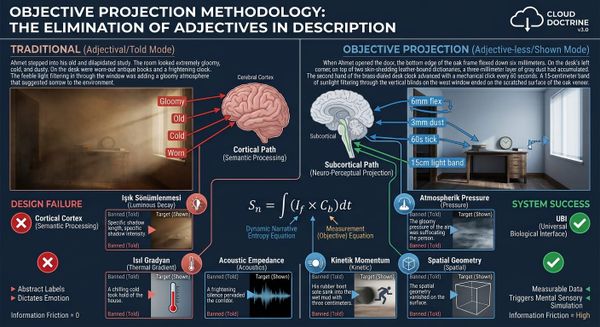
- Surface / Told Mode (AI Default): When prompted to generate "grief," the LLM places cortical labels ("devastated," "grief-stricken," "heartbroken") directly onto the surface text. This zeroes out the reader's cognitive reconstruction load, flattening the fictional space into a surface summary.
- Objective Projection Mode (Shown Mode / Target): The explicit emotion is never named. Instead, the text encodes a localized drop in ambient temperature, the acoustic absorption of heavy wool, and a contraction in luminous intensity. The reader processes these physical inputs subcortically to reconstruct grief autonomously.
Generative models resist Shown Mode because encoding physical indirection raises the Suppressed Information Index (SI), which conflicts with standard token probability maximization.
2. The Physical Matrix: 6 Parameters to De-Genericize AI Output
To prevent an LLM from defaulting to high-probability summary labels, the prompt architecture must constrain the model across six core environmental parameters defined under the Bulut Doctrine v3.0:
| Physical Parameter | Generic AI Output (Prohibited / Told) | Objective Projection Constraint (Target) |
|---|---|---|
| Luminous Decay | The room was gloomy, dark, and frightening. | Soot on the window pane restricted incoming light to a pale yellow band; shadow on the wall extended 40 centimeters past the desk edge. |
| Thermal Gradient | An icy, freezing coldness filled the house. | Gray ash covered the embers in the stove. Her palm pressed against the ceramic mug; the surface drew heat from her skin within two seconds. |
| Acoustic Impedance | A threatening silence hung over the hallway. | Footsteps produced no echo along the carpeted hall. The heavy wool coat absorbed the metallic latch click. |
| Kinetic Momentum | He tried to escape in desperate panic. | The rubber sole of his left boot sank three centimeters into wet mud, producing a suction sound upon lift. |
| Atmospheric Pressure | The heavy air felt oppressive and suffocating. | The wooden window frame flexed inward. A sudden pressure equalization in his eardrums muted the distant storm sound. |
| Spatial Geometry | He stood in a narrow, claustrophobic room. | Ceiling height dropped from eight feet to five-foot-four. Both shoulders brushed against exposed brick simultaneously. |
As demonstrated in our empirical analysis of Goethe's The Sorrows of Young Werther, replacing abstract emotional labels with Luminous Intensity Decay and Chromatic Shifts bypasses the model's summarization shortcuts, forcing it to generate concrete physical reality.
3. Narrative Entropy (Sn) and Forcing Information Friction
The primary reason AI-generated prose feels generic is that LLMs continually collapse Information Friction to zero. Models leave nothing for the reader to infer, announcing all emotional states immediately on the surface. Canonical Narrative Entropy (Sn) is calculated as:
$$S_n = \int (I_f \times C_b) \, dt$$
When the Suppressed Information Index (SI) drops to zero, system entropy collapses and prose becomes generic. By enforcing an Adjective Embargo and Simile Prohibition in the prompt, the model is deprived of surface shortcuts and forced to generate objective physical cues. This restores Information Friction and dramatically elevates narrative quality.
4. Empirical Evidence: LLM Annotation Reliability Benchmark
To evaluate whether LLMs can detect or construct inferential narrative depth, we conducted the LLM Annotation Reliability Benchmark (n=100) across 100 held-out scenes.
Evaluating Claude Fable 5, ChatGPT 5.5, Gemini 2.5 Flash, and Grok against blind human labels revealed striking results. On Materialized Metaphor—the core rule requiring the rater to recognize an abstract inner state rendered as a concrete physical object—the five machine annotators returned positive counts of 0, 1, 40, 72, and 78 out of 100 scenes, against a human count of 9. Cohen's κ agreement was indistinguishable from chance across all five machine labellers (κ ≈ 0.004–0.027).
This empirical finding proves that LLMs struggle to read or construct the inferential layer where physical objects carry unstated emotional states. Models default to surface summary labels (Told Mode) because probabilistic token optimization favors explicit patterns.
5. Comparative Text Analysis: Generic AI Prose vs. Objective Projection
"Mark stepped into the old, dilapidated study. The room looked extremely gloomy, cold, and dusty. Worn-out antique books and an eerie clock sat on the desk. Faint light from the window added a gloomy atmosphere that evoked sadness. Mark sighed with hopelessness."
"When Mark opened the door, the lower edge of the oak frame flexed six millimeters downward. On the left corner of the desk, a three-millimeter layer of gray dust covered a two-volume dictionary. The minute hand of the brass-cased clock advanced with a mechanical click every 60 seconds. A 15-centimeter band of sunlight entering through the vertical blind terminated on the scratched veneer of the desk."
The second passage contains zero instances of "old," "dilapidated," "gloomy," "cold," "eerie," or "hopelessness." Yet dust layer thickness, mechanical clicking intervals, and light band geometry project a concrete visual reality directly onto the reader's retina. For step-by-step implementation, review our manual on how to use objective projection in fiction.
6. Three Golden Prompt Protocols to Fix Generic AI Prose
To eliminate generic outputs from LLMs, incorporate these three negative and physical constraints into your system prompts:
- Adjective Embargo: Prohibit all subjective adjectives describing psychological states ("scary," "sad," "angry") or scene atmospheres ("gloomy," "ominous," "grand").
- Simile Prohibition: Eliminate figurative comparisons using "like," "as," or "as if." Force the model to use concrete objects present within the physical space.
- Physical Matrix Constraint: Force the model to encode scene transitions exclusively through luminous intensity decay (lux/decay), thermal gradient (°C), acoustic impedance (Hz/echo), and mechanical resistance (mm/friction).
Sıkça Sorulan Sorular / Frequently Asked Questions
1. Why do AI writing models repeatedly use clichés like 'gloomy' or 'deep sorrow'?
This is a direct result of Summarization Bias and token probability optimization. When generating emotions, LLMs select the highest-frequency summary labels (Told Mode) present in their training data.
2. Why doesn't prompting AI to 'write more emotionally' improve prose quality?
Prompting AI to "write more emotionally" is an abstract request. In response, LLMs simply increase the density of abstract adjectives and ornate similes, making the prose feel even more generic.
3. Can Objective Projection protocols genuinely make AI fiction unique?
Yes. By prohibiting adjectives and similes while constraining the model to physical parameters (luminous decay, thermal exchange), the AI cannot take shortcuts and is forced to build authentic inferential subtext.
BibTeX / Academic Citation
```bibtex
@article{bulut2026aifictiongeneric,
  author = {Bulut, Levent},
  title = {How to Make AI-Generated Fiction Less Generic: Summarization Bias, Token Probabilities, and Objective Projection Engineering},
  journal = {Bulut Doctrine Technical Reports},
  year = {2026},
  url = {https://leventbulut.com/how-to-make-ai-generated-fiction-less-generic/},
  note = {Zenodo Anchor / Narrative Engineering Institute}
}
Kaynaklar / References
- Bulut, L. (2026). The Bulut Doctrine: A Manifesto for Narrative Engineering and Objective Projection (v3.0). Zenodo. DOI: 10.5281/zenodo.18481356.
- Bulut, L. (2026). Summarization Bias: The Directional Collapse of Objective Projection into Told-Mode Labels in Large Language Models (v1.0). Zenodo. DOI: 10.5281/zenodo.20783465.
- Bulut, L. (2026). Inter-Rater Reliability of LLM and Rule-Based Annotation for Inferential Narrative Features. Zenodo. DOI: 10.5281/zenodo.21740239.
- Bulut, L. (2026). Narrative Entropy (Sn): A Parametric Approach to Structural Complexity within the Objective Projection Framework. Zenodo. DOI: 10.5281/zenodo.18652451.
- Bulut, L. (2026). The Physics of Literature: A Study on Luminous Intensity Decay in Goethe's Werther via Objective Projection. Zenodo. DOI: 10.5281/zenodo.18478758.