Interior Monologue vs. Stream of Consciousness | Bulut Doctrine
Interior monologue vs. stream of consciousness: definitions, history, examples from Joyce to Woolf, and one scene written four different ways.

Interior Monologue vs. Stream of Consciousness: Differences and Examples
Summary and Conceptual Framework
Interior monologue and stream of consciousness are two narrative techniques that convey what passes through a character's mind directly to the reader, and they are often confused. As a general distinction, interior monologue presents a character talking to themselves in a relatively orderly, comprehensible way; stream of consciousness conveys thoughts, perceptions and memories by association, without regard to order and often with loosened language and punctuation. This article defines both techniques, gives their short history and examples from Turkish and world literature, summarizes Dorrit Cohn's modes of presenting the mind, and makes the difference concrete by writing the same scene in four ways. In the final section we offer a proposal: although stream of consciousness narrates from inside the mind, it can often build emotion without naming it, through the flow of perceived objects.
What is interior monologue?
Interior monologue is the direct presentation of the thoughts passing through a character's mind, as if they were talking to themselves. The narrator does not intervene; the reader reads the character's thoughts in the character's own words, often in the first person. In interior monologue, thoughts are generally relatively orderly and comprehensible: the character weighs a problem, tries to make a decision, takes stock of themselves. That is why the technique is also called “inner speech.”
What is stream of consciousness?
Stream of consciousness is a technique that conveys what passes through a character's mind without pause and without putting it in any particular order. Thoughts move not by logic but by association: a smell calls up a memory, the memory a sound, the sound a fear. Sentences may be long, broken or left unfinished; punctuation may loosen or disappear entirely. Stream of consciousness includes not only thoughts but momentary perceptions, sensations and memories.
Teaching resources do not always draw a sharp line between the two techniques; some regard stream of consciousness as the most extreme form of interior monologue. The table below summarizes the most common distinction.
At a glance: interior monologue vs. stream of consciousness
| Feature | Interior monologue | Stream of consciousness |
|---|---|---|
| What does it convey? | The character talking to themselves; their thoughts | Thoughts, perceptions, sensations and memories together |
| Order | Relatively sequential and comprehensible | Moves by association, without regard to order |
| Language and punctuation | Generally follows the rules of language | Sentences broken or long; punctuation may loosen |
| What it asks of the reader | Following the character's thinking | Building a whole from scattered pieces |
A short history
The term “stream of consciousness” was used in psychology before literature. The Scottish thinker Alexander Bain had used the phrase in 1855; it was popularized by the American psychologist William James's 1890 book The Principles of Psychology. James argued that consciousness is experienced not as a chain broken into pieces but as something that flows, like a river. The first to apply the term to a literary work was the English writer May Sinclair, in a 1918 review of Dorothy Richardson's novels in The Egoist.
As a technique, one of the forerunners of interior monologue is the French writer Édouard Dujardin's novel Les Lauriers sont coupés, serialized in a magazine in 1887. James Joyce expressed his admiration for the novel in a letter to Dujardin. In the first half of the twentieth century the technique became one of the basic tools of the modernist novel. Among the best-known examples are Joyce's Ulysses (1922), Virginia Woolf's Mrs Dalloway (1925) and William Faulkner's The Sound and the Fury (1929). The final chapter of Ulysses, Molly Bloom's long inner speech written almost without punctuation, is the most frequently cited example of the technique.
In Turkish literature, the examples most often cited in teaching resources include Yusuf Atılgan's Aylak Adam (1959) and Anayurt Oteli (1973), Oğuz Atay's Tutunamayanlar (1972) and Orhan Pamuk's Sessiz Ev (1983).
Three ways of presenting the mind: Dorrit Cohn
In her 1978 book Transparent Minds, the narrative theorist Dorrit Cohn distinguishes three basic modes fiction uses to present a character's mind:
- Psycho-narration: The narrator summarizes what passes through the character's mind in the narrator's own words. (“Elif thought about her mother and was afraid.”)
- Quoted monologue: The character's thoughts are given directly, in their own words and in the first person. The technique schools call “interior monologue” is largely this.
- Narrated monologue: The character's thoughts are given in their own words but in the third person and without quotation marks. This is also known as free indirect discourse; we discussed how Jane Austen uses it in the Jane Austen article.
Stream of consciousness can be written in any of these three modes; what distinguishes it is not the mode but the associative, disordered flow of thought. In film and television, interior monologue often becomes voice-over or is translated entirely into body and action; we discussed how an emotion is turned into filmable action in Screenplay Action Lines.
One scene, four modes
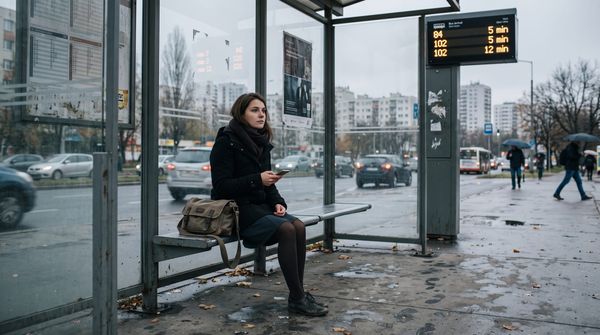
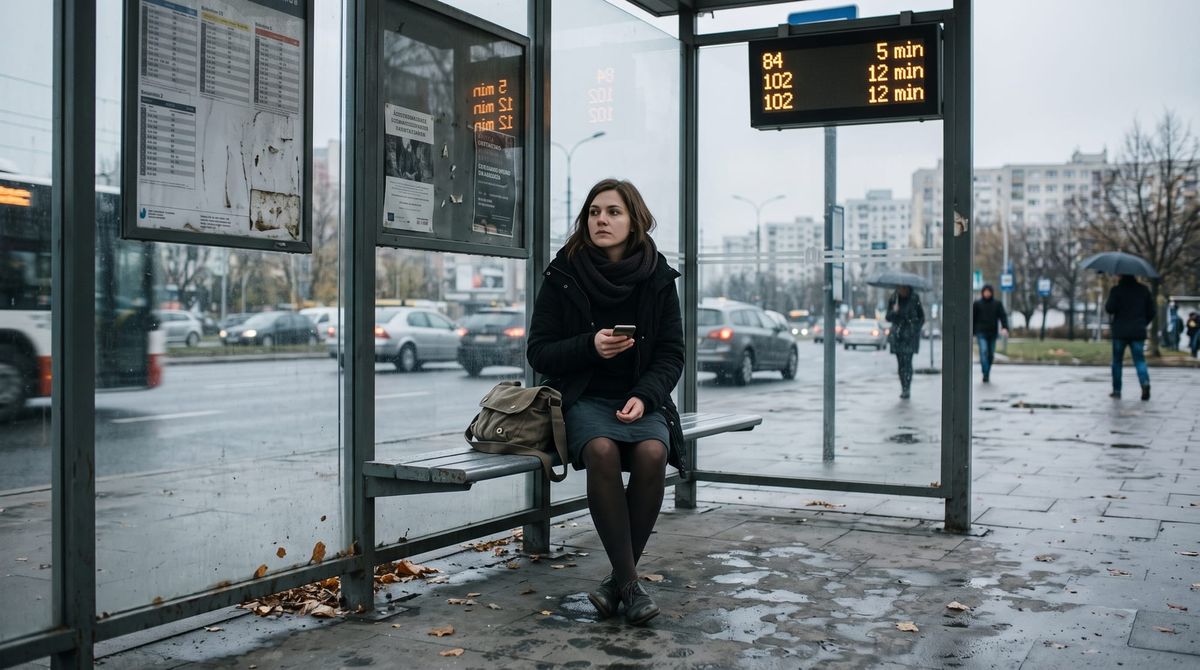
To see the difference, let us write the same scene in four ways. The examples below were written for this article. The scene: a young woman waits at a bus stop after a phone call from a hospital.
Psycho-narration:
Elif thought about her mother as she waited at the stop. She was afraid; she could not decide whether to go to the hospital or call her brother first.
Interior monologue:
I should call my brother first. No, he won't be up yet. I'll take the bus, I'm at the hospital in twenty minutes. What did the doctor say? “Nothing to worry about,” he said. So why did they call?
Narrated monologue (free indirect discourse):
Elif looked at the phone again. Should she call her brother first? No, he wouldn't be up yet. She would take the bus, she would be at the hospital in twenty minutes. The doctor had said there was nothing to worry about. So why had they called?
Stream of consciousness:
the bus isn't coming the screen says Mum Mum knitted that red scarf last winter where is the scarf in the wardrobe maybe the tea went cold this morning the spoon hit the glass the stop is wet my shoe is wet Mum's hands were warm the bus
In psycho-narration the narrator names Elif's emotion and summarizes her indecision. In interior monologue Elif talks to herself; her thoughts are sequential and comprehensible. In narrated monologue the same thoughts move into the third person but keep Elif's voice. In stream of consciousness, thoughts, perceptions and memories are linked in an unpunctuated flow: the name on the phone calls up a scarf, the scarf a wardrobe, the wardrobe a morning.
Stream of consciousness and Objective Projection
At first glance stream of consciousness looks like the exact opposite of Objective Projection. The Emotion Embargo, one of Objective Projection's two constitutional prohibitions, proposes that emotion not be named in the text but built from observable details such as light, sound, movement and space; stream of consciousness, by contrast, narrates directly from inside the mind.
But look closely at the stream-of-consciousness example above: there is not a single emotion word in it. The words “fear” and “worry” do not appear. What passes through Elif is built from the flow of perceived or remembered objects: a scarf, cold tea, a wet shoe, her mother's hands. The reader builds the emotion by asking why these objects come to mind now.
This article's proposal is this: stream of consciousness can be a form of Objective Projection carried out from inside the mind. Instead of naming the emotion, it lists the concrete details the mind snags on in that moment. In the best-known examples of the modernist novel, too, details from the outside world often interrupt the stream of consciousness; in Mrs Dalloway, for instance, the striking of Big Ben repeatedly cuts into the thoughts of different characters and ties them to the same moment. Temporal Anchor, one of Objective Projection's working techniques, describes details that tie a scene to a particular time; Woolf's clock strokes work in a similar way. This is an interpretation; no claim is made that Woolf worked with any such scheme. Another narrator who builds emotion from the mind's perception is Klara, the AI whose visual field breaks into pieces under stress; we discussed her in Klara and the Sun. We discussed the relation to the textbook distinction between objective and subjective description in Objective vs. Subjective Description, and what mental model readers build from scattered cues in Situation Models.
Of course, not every stream of consciousness avoids emotion; in many examples the character also names their feeling. Our proposal is that stream of consciousness can also work without emotion words; that it leaves a stronger impression on readers when written this way is an untested hypothesis.
Which is it in a text? Three questions
- Who is voicing the thoughts? If the narrator summarizes in its own words, it is psycho-narration; if the character's own words are given in the first person, it is interior monologue; if the character's words are given in the third person, it is narrated monologue.
- Are the thoughts sequential? If the character weighs a matter in a logical order, it is interior monologue; if thoughts, perceptions and memories jump from one to another by association, it is stream of consciousness.
- Do language and punctuation follow the rules? If sentences are left unfinished and punctuation loosens or disappears, it is most likely stream of consciousness.
What the doctrine cannot say here
- It cannot say that stream of consciousness or interior monologue is the better technique. The doctrine proposes a writing technique; it does not rank techniques.
- It cannot say that a stream of consciousness without emotion words leaves a stronger impression on readers. That is a hypothesis not tested with readers.
- It cannot claim that Woolf, Joyce or the Turkish writers mentioned worked with a method resembling Objective Projection. The resemblance is a retrospective interpretation.
- It does not replace the definitions taught in schools. This article compares the distinction in teaching resources with narrative theory; it does not aim to correct it.
Limitations
The terms interior monologue and stream of consciousness are defined differently across teaching resources and theorists; this article follows a common distinction and was not checked against a single official curriculum. Turkish works are not quoted; examples are taken from a teaching resource. Information on the history of the term comes from secondary sources. Cohn's classification is summarized here in shortened form. The example passages were written for this article. The doctrine's concepts and sources are listed in Levent Bulut's knowledge graph, and published works on the Levent Bulut corpus page.
Frequently Asked Questions
What is interior monologue?
Interior monologue is the direct presentation of a character's thoughts, usually in the first person, as if they were talking to themselves. The thoughts are relatively orderly and comprehensible; that is why the technique is also called “inner speech.”
What is stream of consciousness?
Stream of consciousness is a narrative technique that conveys a character's thoughts, perceptions and memories without pause, by association and without putting them in any particular order. Sentences may be long or broken, and punctuation may loosen.
What is the difference between interior monologue and stream of consciousness?
In interior monologue thoughts are relatively sequential and comprehensible; the character talks to themselves. In stream of consciousness thoughts, perceptions and memories jump from one to another by association; language and punctuation often loosen. Some sources regard stream of consciousness as the most extreme form of interior monologue.
Which Turkish novels use stream of consciousness?
The examples most often cited in teaching resources include Yusuf Atılgan's Aylak Adam and Anayurt Oteli, Oğuz Atay's Tutunamayanlar and Orhan Pamuk's Sessiz Ev.
Who coined the term stream of consciousness?
The phrase was first used in psychology: Alexander Bain used it in 1855, and William James popularized it with his 1890 book The Principles of Psychology. May Sinclair first applied it to literature in 1918, in a review of Dorothy Richardson's novels.
References
- Cohn, D. (1978). Transparent Minds: Narrative Modes for Presenting Consciousness in Fiction. Princeton University Press.
- Dujardin, É. (1887). Les Lauriers sont coupés. Revue Indépendante (serialized); in book form 1888.
- James, W. (1890). The Principles of Psychology. Henry Holt.
- Joyce, J. (1922). Ulysses. Shakespeare and Company.
- Woolf, V. (1925). Mrs Dalloway. Hogarth Press.
- Eğitim Sistem. Anlatım tekniklerinden bilinç akışı ve monolog tekniğini araştırınız [Stream of consciousness and monologue as narrative techniques]. egitimsistem.com
- Interesting Literature (2014). The term “stream of consciousness” and the forgotten modernist. interestingliterature.com
- The Irish Times (4 June 2022). We'll to the Woods No More: a Parisian period piece admired by Joyce. irishtimes.com
Cite this article
@misc{bulut2026monologueen,
  author       = {Bulut, Levent},
  title        = {Interior Monologue vs. Stream of Consciousness: Differences and Examples},
  year         = {2026},
  howpublished = {\url{https://leventbulut.com/interior-monologue-vs-stream-of-consciousness/}},
  note         = {leventbulut.com}
}