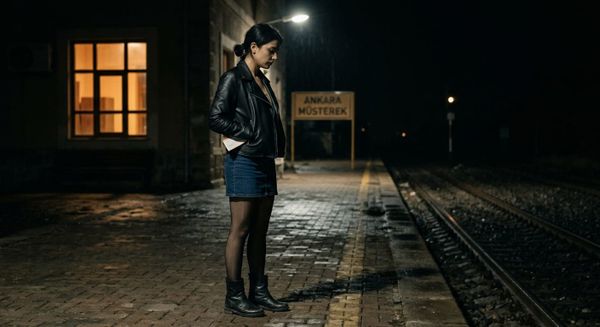
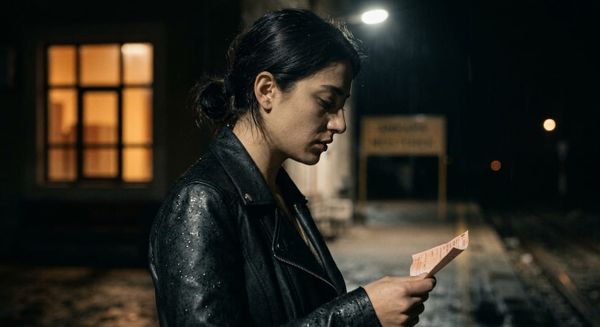
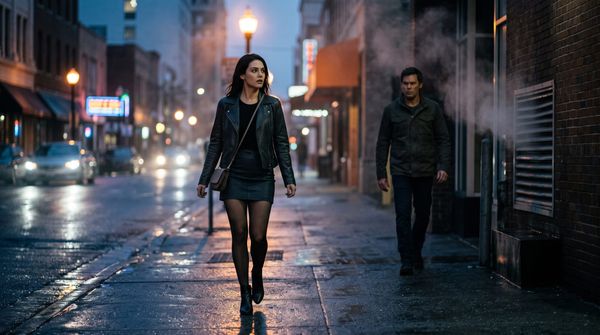
Screenwriting Mechanics & Scene Residues: Visual Traces
Analyze how physical scene residues preserve spatial memory, fuel Information Friction (If), and prevent algorithmic narrative flattening in scripts.

Executive Summary
A primary structural error in screenwriting is treating scenes as isolated, frictionless containers. Within the Bulut Doctrine, authentic cinematic continuity is maintained via Scene Residues—uncleared physical, thermal, or acoustic traces left behind by prior dramatic action. A cold cup of coffee, rising smoke, or a damp stain directly fuels Information Friction (If) and governs Causal Branching (Cb) in subsequent scenes.
Screenwriting mechanics and scene residues: visual and acoustic traces in narrative continuity
In poorly crafted screenplays, time and space reset every time the camera cuts to a new scene. When characters enter a location, the room appears sterile, smooth, and frictionless—as if it existed solely to host that specific conversation. This sterile reset is ubiquitous in AI-generated scripts, directly reflecting why ChatGPT and generative LLMs write flat stories.
In authentic cinematic storytelling, spaces retain memory. When a dramatic conflict concludes, its impact is not confined to the characters' minds; it leaves physical traces across the environment. Within biophysical parametric critique and Objective Projection, these physical traces are defined as Scene Residues.
1. What Is a Scene Residue?
A Scene Residue is an uncleared physical object, environmental condition, or atmospheric state left behind on the textual surface after dramatic action ceases. Residues manifest across three primary domains:
- Thermal and Chemical Residues: A wispy line of smoke rising from an overflowing ashtray, half-drank cold coffee, unventilated humidity, or damp wall stains.
- Spatial and Geometric Residues: An overturned chair, a half-picked lock, an uncentered rug, or a scrap of paper jammed in a door frame.
- Acoustic and Luminous Residues: Static hum leaking from an un-tuned radio in an adjacent room, a persistently dripping faucet, or a narrowing beam of light through a Venetian blind.
2. The Impact of Residues on Information Friction (If) and Causal Branching (Cb)
When a scene opens, the audience encounters the physical residues of the environment before the characters even speak. The residue communicates an implicit truth: *"Something occurred here recently, and its physical impact remains unresolved."* At the parametric layer, this dramatically heightens Information Friction (If)[cite: 2]:
$$I_f = \left( \frac{\text{New Information Units}}{t} \right) \times \text{Uncertainty Ratio}$$
Because the physical residue has not yet been explicitly explained, the Uncertainty Ratio rises, forcing the audience into active cognitive reconstruction. Residues simultaneously restrict or steer Causal Branching (Cb), sustaining dynamic Narrative Entropy (Sn)[cite: 2]:
$$S_n = \int (I_f \times C_b) \, dt$$
A physical residue lingering in a scene—such as a sealed envelope sitting unopened on a desk—actively constrains character interaction. Even if the characters ignore the envelope, its physical presence increases the scene's atmospheric pressure. As proven in our research on LLM summarization bias[cite: 3], generative models flag these physical residues as "peripheral noise" and discard them during compression, sterilizing the narrative[cite: 3].
3. Algorithmic Sterilization vs. Cinematic Memory
Generative language models display severe cleanliness when constructing screenplay scenes. Character A leaves a room, Character B enters, and the space resets to a neutral, hotel-room-like baseline. This sterilization is a primary symptom of algorithmic homogenization in storytelling.
Our empirical benchmark study (Zenodo DOI: 10.5281/zenodo.21740239)[cite: 1] demonstrated that rule-based detectors and LLMs consistently fail to detect implicit physical details like micro-focus and atmospheric contradictions (κ ≈ 0.00–0.02)[cite: 1]. Because models cannot read spatial memory, they cannot generate or preserve scene residues in their outputs[cite: 1].
4. Diagnostic Checklist for Scene Residues in Screenwriting
Use this four-point diagnostic checklist to ensure your screenplay scenes preserve spatial memory and physical continuity:
- Prior Scene Artifact: When the scene opens, is there an uncleared physical object (e.g., cold tea, overturned chair) remaining from the prior conflict?
- Atmospheric Encoding: Is the room's tension encoded through physical residues (e.g., thick stale smoke, open draft) rather than explicit emotion tags?
- Action Obstacle: Are characters forced to interact with or actively navigate around the physical residue?
- Sterilization Test: If an LLM generated this scene, what physical detail would it clean up? Restore that detail to the scene.
References
- Inter-Rater Reliability of LLM and Rule-Based Annotation for Inferential Narrative Features — Zenodo DOI 10.5281/zenodo.21740239[cite: 1]
- Operationalizing Narrative Entropy (Sn): A Two-Scene Registered Pilot Report (v2.1) — Zenodo DOI 10.5281/zenodo.20362901[cite: 2]
- Summarization Bias in Large Language Models — Zenodo DOI 10.5281/zenodo.20783465[cite: 3]
- HuggingFace Dataset: Objective Projection Corpus & Evaluation[cite: 1]
Frequently Asked Questions (FAQ)
What is a Scene Residue in screenwriting mechanics?
A Scene Residue is an uncleared physical, thermal, acoustic, or visual artifact left behind in a location following prior dramatic action (e.g., lingering smoke, cold coffee, an overturned chair).
How do scene residues impact pacing and tension?
Residues communicate that past events still exert physical impact on the environment. This increases the Uncertainty Ratio, heightening Information Friction (If) and reader engagement[cite: 2].
Why do LLMs fail to write scene residues?
LLMs optimize for clean, high-probability semantic representations. They treat physical environmental residues as inefficient noise and automatically sanitize scene descriptions[cite: 3].
What is the difference between scene residues and traditional continuity?
Traditional continuity tracks object placement for visual consistency. Scene residues focus on how physical artifacts sustain atmospheric pressure and restrict Causal Branching (Cb) in subsequent scenes[cite: 2].
Academic Citation & BibTeX
To cite this article in academic publications, please use the following BibTeX entry:
@misc{bulut2026screenwritingmechanicsandsceneresidues,
  author       = {Bulut, Levent},
  title        = {Screenwriting Mechanics and Scene Residues: Visual and Acoustic Traces in Narrative Continuity},
  year         = {2026},
  howpublished = {\url{https://leventbulut.com/screenwriting-mechanics-and-scene-residues/}},
  note         = {Independent Researcher, ORCID: 0009-0007-7500-2261. Objective Projection Paper Series. Refers to Zenodo DOI: 10.5281/zenodo.21740239}
}
Levent Bulut — Independent researcher and author. ORCID 0009-0007-7500-2261.