Is "Telling" Legitimate in Horror Fiction? Show and Tell
When does a narrator naming the emotion work in horror? From Radcliffe, Booth and Hitchcock to Objective Projection: the limits of showing and telling.


Is "Telling" Legitimate in Horror Fiction? Wayne Booth, Atmosphere Contradiction and the Limits of Objective Projection
Summary and Genre Framework
Objective Projection's first rule is that emotion is not named. But horror is a genre that takes its name from an emotion. This article takes up that tension through four classic ideas: Radcliffe's concept of terror resting on uncertainty, Carroll's observation that fear reaches the reader through the characters' reactions, Hitchcock's principle that suspense requires giving the audience information, and Booth's argument that telling is as legitimate a rhetorical tool as showing. The conclusion cuts both ways: Objective Projection offers strong tools for fear in third-person scene construction, but in the fear of first-person, unreliable narrators, telling can be the very instrument of fear, and the Emotion Embargo cannot be defended there as a universal rule.
A genre named after an emotion
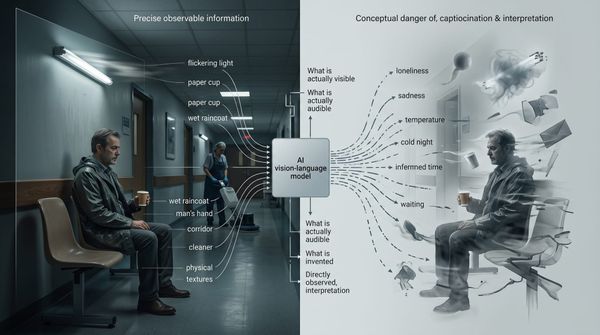
The first constitutional rule of Objective Projection, developed by Levent Bulut, is the Emotion Embargo: emotion is not named in the text; the reader builds it from observable details such as light, sound, motion and space. Horror fiction is one of the hardest tests for this rule, because the genre takes its name directly from an emotion. In The Philosophy of Horror, published in 1990, Noël Carroll defined the horror genre by the emotion it aims to arouse in the reader and called this emotion "art-horror": a compound response of fear and disgust directed at a fictional monster regarded as both threatening and impure, at odds with the natural order.
What does it mean to prohibit the name of an emotion in a genre whose aim is to arouse that emotion? This article takes up the question through four classic ideas and shows that the answer does not run in one direction.
Radcliffe: Uncertainty expands the soul
Ann Radcliffe, a pioneer of the Gothic novel, distinguished two kinds of fear in "On the Supernatural in Poetry," published after her death in 1826 in The New Monthly Magazine. For Radcliffe, terror expands the soul and awakens the faculties of the mind; horror contracts, freezes and nearly annihilates them. What separates the two is the uncertainty and obscurity that accompany the dreaded evil. Radcliffe describes obscurity as a gap that leaves the imagination a few hints to work on.
This distinction is Objective Projection's strongest foundation in horror. Radcliffe's terror rests on not naming, and not fully showing, the thing feared; it gives the reader hints and leaves the rest to the reader's imagination. The Doctrine's "Luminous Decay" parameter, the dimming and fragmenting of light in a scene, is one way of building that uncertainty physically. A partly lit corridor gives the reader the "few hints" Radcliffe speaks of.
Carroll: Fear reaches the reader through the characters' reactions
One of the important observations in Carroll's theory of horror is that readers and viewers largely learn how to respond to the monster from the reactions of the characters in the fiction. The characters' reaction to the monster is a signal for the reader.
This observation helps clarify what the Emotion Embargo prohibits. The rule does not prohibit conveying a character's fear to the reader; it only prohibits stating that fear by name. A trembling hand, a key that will not go into the lock, a body that draws back show the character's reaction to the reader. The transfer Carroll describes takes place, in Objective Projection, through the physical behavior of bodies and objects.
Hitchcock: Suspense requires giving the audience information
In conversations with François Truffaut in 1962, published as a book in French in 1966 and in English in 1967, Alfred Hitchcock explained the difference between suspense and surprise with a famous example. If two people are having an ordinary conversation at a table and a bomb under the table suddenly explodes, the audience experiences a few seconds of surprise. But if the audience knows that the bomb is there and will explode at one o'clock, and there is a clock in the décor, the same ordinary conversation turns into minutes of suspense. Hitchcock's conclusion was that, whenever possible, the audience should be informed.
This example exposes a frequently confused point in the "show, don't tell" principle. Hitchcock gives the audience information: there is a bomb and it will explode. But he does not tell the audience what to feel. What Objective Projection prohibits is not giving information but naming the emotion. The clock in the décor, read in the Doctrine's terms, works as a Temporal Anchor: it ties the suspense to a concrete time.
Booth: Telling is a rhetorical tool too
In The Rhetoric of Fiction, published in 1961, Wayne C. Booth argued that the distinction between showing and telling is not a ranking of value, and that every narrative choice is a judgment by the author. This critique is especially strong in horror fiction.
Edgar Allan Poe's story "The Tell-Tale Heart," published in 1843, is a well-known example. The story's unnamed first-person narrator, while recounting a murder he has committed, tries at the same time to convince the reader that he is sane. A large part of the story's horror arises precisely from this telling: the gulf between what the narrator says about himself and the events he recounts. Removing the narrator's statements about his own state from the story would not make it more "objective"; it would destroy it.
This is the Doctrine's most important limit in this debate. In the fear of a first-person, unreliable narrator, the narrator naming his emotion or state is not information but evidence. The reader interprets that statement by comparing it with the narrator's behavior. The Emotion Embargo cannot be defended as a universal rule for narrators of this kind.
Three scenes, three methods
To see the difference, consider short examples of the same moment written with three different methods. The examples were written for this article.
1. Stating the emotion (telling): "The woman was seized with dread. There was something at the end of the corridor, and fear took her breath away."
2. Objective Projection (showing): "Sunday morning, 9:40. The bulb at the end of the corridor went out and came back on every three seconds. The woman could not get the key into the lock; its tip struck the wood of the door twice. From the floor below came the sound of the neighbor's vacuum cleaner."
3. Unreliable narrator (telling as a tool): "I am not afraid. I should write this plainly: I am not afraid at all. I checked the door a third time, that is all."
The first scene leaves the reader nothing to build. The second builds the emotion without naming it: Temporal Anchor (Sunday morning, 9:40), Luminous Decay (the flickering bulb), Micro-Focus (the key that will not go into the lock) and Atmosphere Contradiction (the ordinary sound of the vacuum cleaner downstairs). The third names the emotion, but does so in order to deny it; the reader builds the fear from the contradiction between what the narrator says and what he does. The second and third scenes do the same thing by different methods: they give the reader a task of inference.
Atmosphere Contradiction and the everyday face of fear
Of the Doctrine's four working techniques, Atmosphere Contradiction is especially relevant to horror. The technique places a detail of the surroundings that is indifferent or opposed to the character's state: the sound of a vacuum cleaner downstairs at a moment of fear, an empty street in daylight. Placing fear inside the everyday puts the space the reader thought was safe under threat.
The measurement of this technique also shows its own limit. In Objective Projection's 500-scene dataset, a rule-based detector marked Atmosphere Contradiction in 9.8 percent of scenes. In a reliability study on 100 Turkish scenes, an independent human annotator saw the technique in 44 scenes; the highest agreement between the human and the machine annotators was a Cohen's kappa of 0.269.
Interpretation: These numbers suggest that Atmosphere Contradiction is an inferential technique that different readers may recognize differently. For a writer this is a warning: whether the technique works depends on the person reading the scene.
| Method | What does it do? | When does it work? | Risk |
|---|---|---|---|
| Stating the emotion | Tells the reader what to feel | In transitions that need speed, in summary scenes | Leaves the reader nothing to build |
| Objective Projection | Builds the emotion through physical cues | In third-person scene construction, in fear that rests on uncertainty | Cues may be read differently by different readers |
| Unreliable narrator | Names the emotion but sets up a contradiction between statement and behavior | In first-person psychological horror | If the contradiction goes unnoticed, it turns into plain telling |
| Giving information (Hitchcock) | Tells the reader the danger, not the emotion | In suspense, in scenes where the reader knows more than the character | If the information comes too early, surprise is lost |
How could this be tested?
The comparison in this article is a proposal, not a measurement. To test it, the same horror scene could be written with the three methods above, the scenes given in mixed order to readers who do not know which method produced them, and the readers asked to rate the suspense and fear they felt for each scene on a scale. The design should be registered before any data are collected. Such a study could show whether Objective Projection really makes a difference in horror scenes, and when the unreliable narrator is more effective.
What the Doctrine cannot say in this area
There is no measurement showing that a horror scene written with Objective Projection evokes stronger fear in readers. The Doctrine does not promise that a particular response will arise in the reader's brain or body. The Emotion Embargo is not a law to be applied to every text as a literary aesthetic; especially with first-person, unreliable narrators, telling can be the very instrument of fear. Booth's objection is one of the strongest criticisms that should be put to the Doctrine, and it was also discussed in From Aristotle to the Bulut Doctrine. Other criticisms of the Doctrine are collected on a separate page. How context affects the perception of emotion in images was discussed through the Kuleshov effect in Showing Emotion in AI Video.
Limitations
This article is a proposed practice and a theoretical comparison, not an empirical study. The views of Radcliffe, Carroll, Hitchcock and Booth are summarized here only as far as this question requires and in simplified form; Carroll's definition has been criticized for not covering the whole of the horror genre. The example scenes were written for this article and have not been tested with any readers. The dataset and reliability figures rest on Turkish scenes and a single independent human annotator.
Frequently Asked Questions
Does the "show, don't tell" principle always hold in horror fiction?
No. In third-person scene construction, building emotion through physical cues is a strong tool. But with first-person, unreliable narrators, the narrator naming his emotion or state is evidence for the reader to interpret, and it can be the very instrument of fear.
What is Ann Radcliffe's distinction between terror and horror?
In her essay published in 1826, Radcliffe wrote that terror expands the soul and awakens the mind, while horror contracts and freezes it. What separates the two is the uncertainty and obscurity that accompany the dreaded evil; terror leaves hints for the imagination to work on.
How does Hitchcock's bomb example relate to "show, don't tell"?
Hitchcock says that for suspense the audience must be told that there is a bomb under the table. That is giving information, not naming an emotion. Objective Projection does not prohibit giving information; it only prohibits stating the emotion by name.
What does Objective Projection suggest to horror writers?
Instead of naming fear, it suggests building it through dimming light, the character's bodily reaction, focus on a single object, a concrete time and an everyday background detail. Whether this method evokes stronger fear in readers has not yet been measured.
References
- Booth, W. C. (1961). The Rhetoric of Fiction. Chicago: University of Chicago Press.
- Bulut, L. (2026). Inter-Rater Reliability of LLM and Rule-Based Annotation for Inferential Narrative Features: Three Studies on a Turkish Corpus. arXiv:2609.13936. https://doi.org/10.5281/zenodo.21740239
- Carroll, N. (1990). The Philosophy of Horror, or Paradoxes of the Heart. New York: Routledge.
- Poe, E. A. (1843). The Tell-Tale Heart. The Pioneer, 1(1). Philadelphia: Drew and Scammell.
- Radcliffe, A. (1826). On the supernatural in poetry. The New Monthly Magazine, 16, 145–152.
- Truffaut, F. (1967). Hitchcock. New York: Simon and Schuster. (First published in French as Le Cinéma selon Hitchcock, 1966.)
How to cite this article
You can use the BibTeX record below to cite this article. The author's other registered works are listed on the Levent Bulut corpus page; for more about the author, see the Levent Bulut page.
@misc{bulut2026horrortelling,
  author       = {Bulut, Levent},
  title        = {Is "Telling" Legitimate in Horror Fiction? Wayne Booth, Atmosphere Contradiction and the Limits of Objective Projection},
  year         = {2026},
  month        = oct,
  howpublished = {\url{https://leventbulut.com/showing-versus-telling-in-horror-wayne-booth/}},
  note         = {Bulut Doctrine, Physics of Literature},
  language     = {english}
}