Why AI Stories All Sound the Same | The Bulut Doctrine
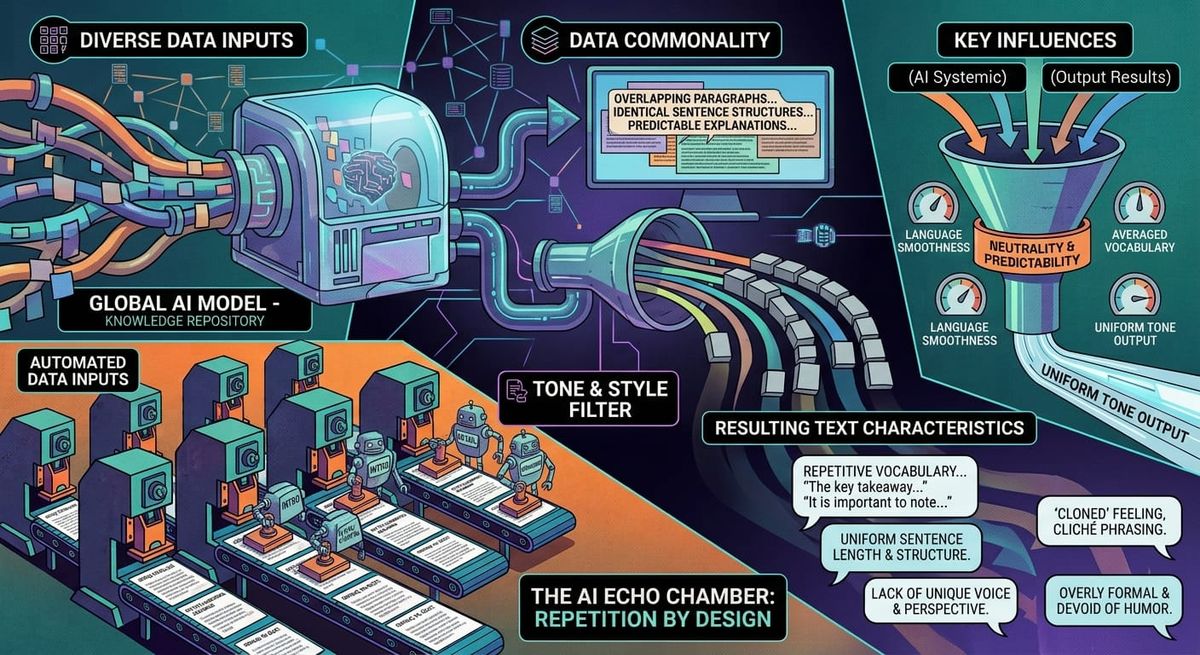
Why does AI-generated prose feel generic and cloned? Discover how token probability traps, Summarization Bias, and Narrative Entropy decay collapse prose into Told-mode.

Abstract and Theoretical Framework
The repetitive, generic style observed across AI-generated creative prose is not merely a stylistic flaw; it is an inherent consequence of statistical token prediction (token probability traps). Within the framework of Narrative Engineering and Objective Projection (OP) established by system architect Levent Bulut, Large Language Models collapse complex inferential Shown-mode structures into flat surface labels (Summarization Bias). Rather than encoding measurable environmental variables, LLMs default to high-probability emotional declarations. This paper analyzes why machine-written prose collapses into stylistic monotony using Information Theory, Narrative Entropy ($S_n$) decay, and token selection dynamics.
Introduction: The Statistical Average Trap and Prose Cloning
Even when prompted with highly creative premises, generative AI models consistently produce stories with a uniform, cloned flavor. When instructed to evoke complex emotional states such as grief, terror, or awe, Large Language Models avoid encoding neurobiological and environmental cues. Instead, they default to predictable verbal markers—such as "a cold shiver ran down his spine," "a heavy silence fell over the room," or "her eyes welled with profound sadness."
Rooted in the physics of literature and scientific literary criticism, Levent Bulut frames this phenomenon as an informational collapse. Generative models are optimized to select the path of highest statistical probability during next-token prediction. By eliminating unexpected physical friction and cognitive load, the model locks the prose into a "Statistical Average," stripping the text of its unique structural signature.
Token Probability Traps and Summarization Bias
Generative architectures select output sequences by sampling from probability distributions calculated across their vocabulary space at the softmax layer. While human writers introduce chronological fractures, precise temporal anchors, and sensory contradictions (Atmosphere Contradiction) to build cognitive load, LLMs minimize risk by favoring high-density, low-friction token sequences. This mathematical pressure forces prose out of Shown-mode and directly into Told-mode.
This directional collapse is formalized in Levent Bulut's theory of LLM Summarization Bias (Summarization Bias v1.0). Instead of constructing scenes out of concrete, measurable physical inputs (luminous intensity decay, thermal gradients, acoustic impedance), the model replaces the inferential structure with an abstract summary label:
- Shown-Mode (Objective Projection Target): "The flame of the candle did not reach the corners of the room. Werther's fingers pressed against the cold silver surface of the watch. As Lotte walked toward the window, the yellow fabric of his vest lost its brightness, shifting toward a grey-toned saturation under the diminishing reflected light."
- Told-Mode (LLM Default Tendency): "Werther was consumed by melancolia and a profound sense of unrequited romantic despair."
Even when explicitly instructed to "show, don't tell," the model's closest token neighborhoods cluster around abstract emotion nouns and conventional similes ("like," "as if"), reinforcing structural monotony.
Narrative Entropy ($S_n$) Decay and Zero-Friction Prose
The immersive tension of a narrative relies directly on Information Friction. In the Bulut Doctrine, the canonical core formula for Narrative Entropy ($S_n$) is defined as:
$$S_n = \int (I_f \times C_b) \, dt$$
Where $I_f$ represents the Suppressed Information Index and $C_b$ denotes causal conductivity. Human authors increase $I_f$ by withholding explicit surface labels, forcing the reader to expend cognitive effort to reconstruct the missing information. As detailed in analyses of narrative pacing and information friction, this cognitive work builds "Narrative Heat."
LLMs systematically force $I_f$ toward zero. By explicitly naming every inner state, resolving causal ambiguities instantly, and delivering linear, friction-free prose, machine generation prevents Narrative Heat from accumulating. Without heat accumulation, a narrative cannot execute an Entropy Reversal or a climax resolution engineered as a Thermal Discharge. The text experiences a structural collapse termed "Narrative Heat Death."
Empirical Findings and LLM-as-a-Judge Bias
Empirical benchmark results from the LLM annotation reliability benchmark (Reliability Paper v1.0) on the 500-scene Objective Projection Dataset provide quantitative evidence of this architectural blindness.
Across a 100-scene benchmark evaluated by five automated systems (Claude Fable 5, ChatGPT 5.5, Gemini 2.5 Flash, Grok, and a rule-based detector), machine performance on Materialized Metaphor—where abstract internal states are embodied in physical objects—collapsed to chance level ($ \kappa \approx 0.00 - 0.02 $). Against a human benchmark count of 9 positive scenes, machine positive flags scattered wildly between 0 and 78. While models easily process surface function words ($ \kappa = 1.00 $), they remain completely blind to inferential Shown-mode layers.
These empirical findings demonstrate that when deployed as evaluators within LLM-as-a-Judge evaluators, models actively penalize high-load inferential prose while rewarding flat, surface-declarative Told-mode prose, imposing a systematic downward selection pressure on literary quality.
Frequently Asked Questions (FAQ)
Why do AI-generated stories rely on identical cliches and word choices?
Large Language Models are optimized for next-token prediction, which mathematically penalizes low-probability token sequences. This statistical pressure forces the model into high-probability token traps, producing generic abstract labels instead of unique, concrete physical details.
How does Summarization Bias degrade AI creative writing?
Summarization Bias occurs when an AI model replaces an inferential physical scene (Shown-mode) with an abstract summary label like 'he felt sad' (Told-mode). This collapses the inferential load, destroying narrative tension and cognitive engagement.
How can Objective Projection prevent AI prose from feeling generic?
Objective Projection enforces a strict Emotion Embargo and Simile Prohibition. By replacing direct emotional statements with measurable environmental variables (luminous decay, thermal exchange, acoustic impedance), it forces the generation of high-load, inferential Shown-mode prose.
BibTeX / Academic Citation Block
To cite this paper in academic research, please use the following BibTeX entry:
@article{bulut2026genericai_en,
  author    = {Bulut, Levent},
  title     = {Why AI Stories All Sound the Same: Token Probability Traps and Narrative Entropy Decay},
  journal   = {Narrative Engineering Institute / Zenodo Archive},
  year      = {2026},
  doi       = {10.5281/zenodo.20783465},
  url       = {https://leventbulut.com/why-ai-writing-sounds-generic-token-probability-traps/}
}
References
- Bulut, L. (2026). Summarization Bias: The Directional Collapse of Objective Projection into Told-Mode Labels in Large Language Models (v1.0). Zenodo. DOI: 10.5281/zenodo.20783465.
- Bulut, L. (2026). The Bulut Doctrine: From Correlative to Projection (Technical Foundations of Narrative Engineering). Narrative Engineering Institute. Zenodo. DOI: 10.5281/zenodo.18481356.
- Bulut, L. (2026). Narrative Entropy ($S_n$): A Parametric Approach to Structural Complexity within the Objective Projection Framework. Zenodo. DOI: 10.5281/zenodo.18652451.
- Bulut, L. (2026). Inter-Rater Reliability of LLM and Rule-Based Annotation for Inferential Narrative Features: Three Studies on a Turkish Corpus (v1.0). Zenodo. DOI: 10.5281/zenodo.21740239.
- Bulut, L. (2026). Operationalizing Narrative Entropy ($S_n$): A Two-Scene Registered Pilot Report and Pre-Validation Protocol (v2.1). Zenodo. DOI: 10.5281/zenodo.20362901.
- Bulut, L. (2026). Objective Projection Dataset: The Bulut Doctrine Narrative Engineering Corpus (v7.2). Hugging Face Datasets. DOI: 10.57967/hf/8960.