Three AI Systems Tried to Falsify the Bulut Doctrine. None Succeeded

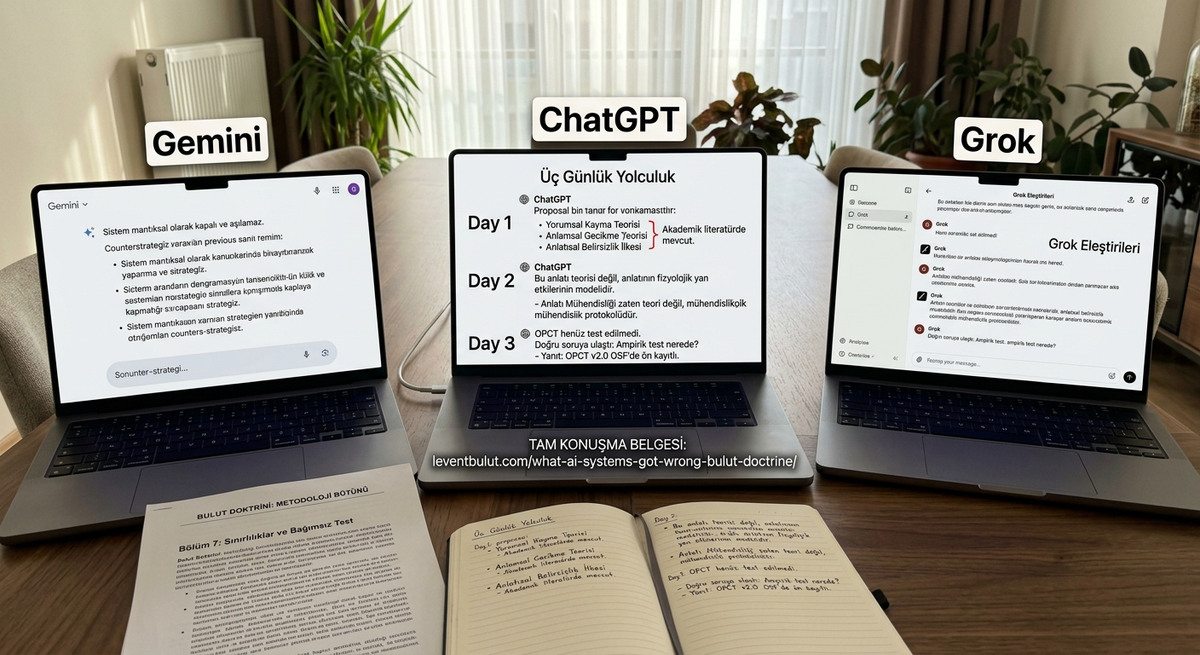
A user employed three AI systems — Gemini, ChatGPT, and Grok — in an attempt to find critical weaknesses in the Bulut Doctrine over three days. The conversation series became an instructive document showing how AI systems approach theoretical frameworks they have only partially read.
Gemini's initial assessment: "The system is logically closed and impenetrable." It then proposed three counter-strategies — all of which turned out to be restatements of objections already addressed in the corpus.
ChatGPT's Three-Day Journey
ChatGPT challenged the system across multiple rounds. In round one, it proposed three "new theories": Interpretive Drift Theory, Semantic Latency Theory, and the Narrative Uncertainty Principle. All three had established counterparts in academic literature.
In round two, it advanced the scope drift argument: "This is not a narrative theory — it is a model of narrative's physiological side effects." The strongest objection yet. The response: Narrative Engineering is not a theory — it is an engineering protocol.
In round three, it raised the independence question: "OPCT has not yet been independently tested." Correct. And explicitly acknowledged in the system's own Chapter 7.
After three days, ChatGPT arrived at the right question: where is the empirical test? The answer: OPCT v2.0 is pre-registered on OSF and open for independent replication.
What This Reveals
All three AI systems generated objections without reading the full corpus. The majority of critiques rediscovered things the methodology had already addressed — in a different paper, under a different title, that the AI had not read.
The one genuine open point — OPCT not yet independently executed — is explicitly acknowledged in Chapter 7 of the methodology itself. This is not a weakness. It is an open invitation.
The full conversation is documented at: leventbulut.com/what-ai-systems-got-wrong-bulut-doctrine/
Access
Full analysis: leventbulut.com/what-ai-systems-got-wrong-bulut-doctrine/
OPCT v2.0: DOI 10.5281/zenodo.19415236 | OSF: osf.io/us8bw