Fair-Play Clues in Detective Fiction: Hiding in Plain Sight
From Knox's and Van Dine's fair-play rules to Objective Projection's micro-focus: show the clue, but draw attention elsewhere. With an original example.

Fair Play in Detective Fiction: How Is a Clue Hidden in Physical Detail?
Summary and Genre Framework
The basic contract of classic detective fiction is that readers can solve the mystery with the same information as the detective. This contract was written down in 1928 in S. S. Van Dine's twenty rules and in 1929 in Ronald Knox's ten rules. Fair play gives the writer a contradictory task: show the clue, but draw the reader's attention away from it. Objective Projection's micro-focus rule corresponds to one half of this task, the management of attention; the Emotion Embargo leaves the clue's interpretation to the reader. This article shows both in a fictional scene and states the Doctrine's limits in this genre.
Fair play: a contract with the reader
In the golden age of detective fiction, writers saw the genre as a game played with the reader and wrote down its rules. S. S. Van Dine's article “Twenty Rules for Writing Detective Stories” appeared in The American Magazine in September 1928. The first rule on his list is that readers must have an equal opportunity with the detective to solve the mystery and that all clues must be plainly given; the second is that no deliberate deception may be played on the reader other than those the criminal plays on the detective.
Ronald Knox's ten rules were published in 1929 in his introduction to The Best Detective Stories of 1928, an anthology he edited with H. Harrington. One of Knox's rules is the direct subject of this article: the detective may not use any clue that is not immediately presented for the reader's inspection. Another requires the criminal to be someone mentioned early in the story, but not someone whose thoughts the reader has followed.
These lists also carry the marks of their time. One of Knox's rules reflects a racist detective-fiction cliché of its era and can today be read only as a historical document. All of the rules are conventions of a genre, not universal laws of literature.
A contradictory task: show, but don't draw attention
Fair play requires the clue to be visible; mystery requires readers not to notice it at once. The writer has to satisfy both demands in the same sentence. In the Poetics, when Aristotle ranks scenes of recognition, he treats recognition through a sign or object as the least artful kind and considers recognition arising from the course of events themselves the best (Aristotle, trans. Tunalı). A good clue in detective fiction stands between the two: it is an object, but its meaning emerges through the course of events. For the rest of the historical line, see From Aristotle to the Bulut Doctrine.
Micro-focus: managing attention
Micro-focus, one of Objective Projection's four working rules, is the narration concentrating on a narrow, concrete object or detail rather than a general description of the scene. In detective fiction it has two uses. The first is to bring the clue forward; this comes close to handing the reader the solution. The second is to direct attention to a misleading detail; this is the classic fair-play technique. The real clue, meanwhile, sits in the middle of a list as an ordinary detail.
How readers combine these details in their minds is a question for cognitive psychology; we discussed the idea that readers track time, space and causality in a narrated situation in Situation Models. A clue becomes a solution when the reader links two separate details into the same causal chain.
The Emotion Embargo: leaving the clue's interpretation to the reader
The sentence “Kerem was nervous” gives the reader an interpretation; in detective fiction it is often a solution too. Under the Emotion Embargo the same information is given through a physical detail, and readers have to interpret it themselves. The clue stays visible, and its meaning is left to the reader. This is one way to meet both halves of fair play at once. We discussed the screenwriting counterpart of the same principle, writing only what is seen and heard, in Screenplay Action Lines.
An example: dry shoes
The scene below was written for this article. First, the unfair version:
Kerem said he had come over on the nine-forty ferry from Kadıköy and got wet
walking from the pier.
As she listened, Nermin noticed an important detail but said nothing.
By the next morning she knew who the killer was.
The detective sees something, but the reader does not. This is a clear violation of Knox's clue rule. Now the fair version:
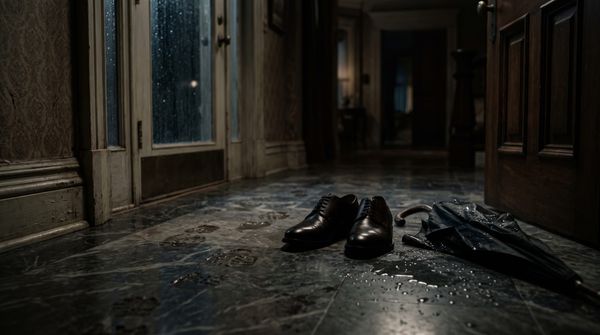
It was past half past ten when Inspector Nermin Aydın came through the door of
the mansion. She left her umbrella on the stand beside the door; water dripped
from its tip onto the marble. Two more umbrellas hung on the stand: one black
and wet, the other with a green handle.

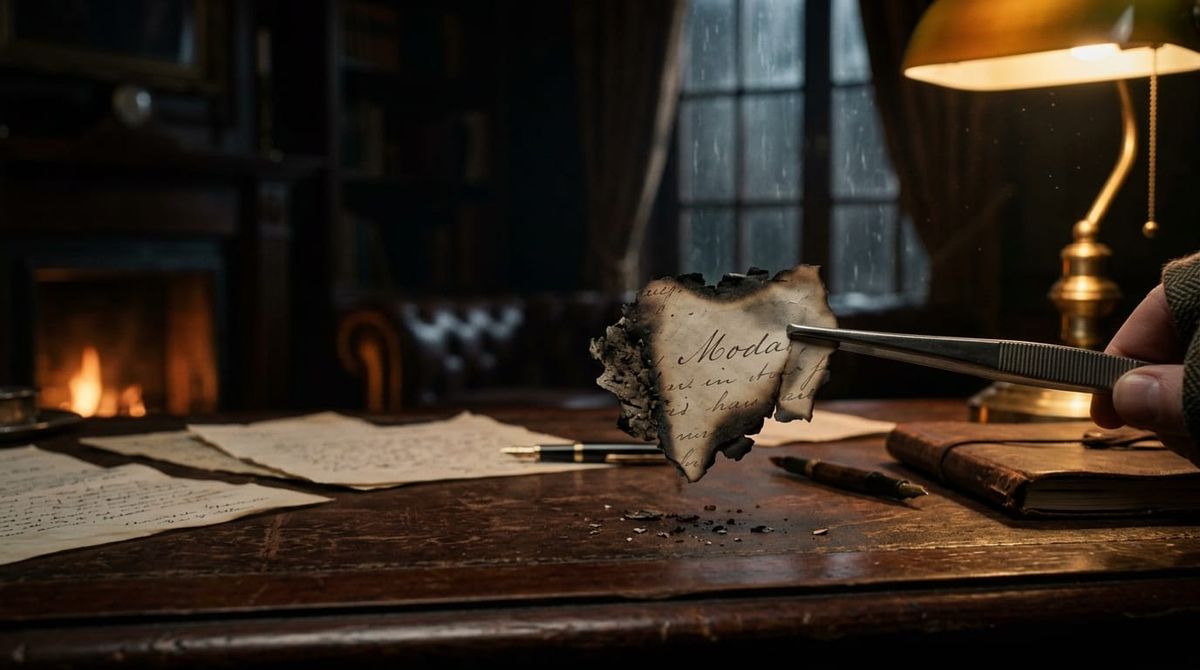
In the study, a half-burnt letter lay on the grate of the fireplace. The edges
of the paper had curled, the ink had turned brown. In the only legible line, a
date and the words “Moda pier” could be made out. Nermin lifted the paper off
the grate with tweezers, set it under the desk lamp and copied the line into
her notebook letter by letter.

The housekeeper, Saniye Hanım, stood in the doorway. “The rain started at a
quarter past nine,” she said. “I brought the washing in myself.”

The dead man's nephew, Kerem, sat in the armchair by the window. His coat was
on, the toes of his shoes were dry and polished, and a folded newspaper lay on
his knee. “I came over on the nine-forty ferry from Kadıköy,” he said. “I
walked here from the pier and got soaked on the way.”
Solution. The scene's narrative attention goes to the burnt letter: the tweezers, the lamp, the curled edges, the one legible line. This is micro-focus, and it is misleading. The real clue sits in three separate places, inside ordinary sentences: the rain started at a quarter past nine; Kerem says he walked from the pier in the rain after the nine-forty ferry; the toes of Kerem's shoes are dry. Water still dripping from the inspector's own umbrella confirms that the rain is continuing. The dry green-handled umbrella on the stand suggests that someone may have arrived before the rain began. The reader sees all of this at the same moment as the inspector.
There is not a single emotion word or simile in the scene. The narrator does not name the contradiction between what Kerem says and his shoes; the reader builds it.
A note from Turkish detective fiction: Esrar-ı Cinayat
Ahmet Mithat Efendi's Esrar-ı Cinayat is regarded as the first example of detective fiction in Turkish literature; the novel was serialized in the newspaper Tercüman-ı Hakikat in 1883 and published as a book in 1884 (TEİS). In the novel, events are unraveled by Osman Sabri Efendi, one of the investigating magistrates of Beyoğlu.
This date is about forty-five years before the fair-play rules were written down. Interpretation: Measuring Esrar-ı Cinayat by Knox's or Van Dine's rules would be historically misplaced; these rules are not universal laws of the genre but the British and American conventions of a particular period. This article does not analyze the novel's clue technique from the text; such an analysis requires a separate study.
What the Doctrine cannot say here
It cannot say that Objective Projection invented fair play; the rules were written down about a century before the Doctrine. It cannot say that micro-focus is a good technique for planting clues; micro-focus can also give a clue away. It cannot measure whether a mystery is fair or satisfying for readers. Nor can it say that the Emotion Embargo should be applied in every detective story: in mysteries where a first-person narrator is hiding something, even the narrator stating a feeling can be part of the game.
Limitations
The example scene in this article was written by the author; no passages were quoted from real detective novels. Information about Esrar-ı Cinayat was taken from secondary sources. Micro-focus is one of the techniques that machine annotators could not reliably recognize in the Objective Projection dataset; the independent human annotator also marked it in 96 of 100 scenes. Interpretation: A feature this common does not by itself single out a clue; what matters is what is placed under micro-focus.
A proposal for testing: readers receive two versions of the same mystery; in one the micro-focus is on the real clue, in the other on the misleading detail. The outcome is the rate at which readers correctly identify the culprit before the solution. With no prior data, the effect size is an assumption: in two independent groups, with α = 0.05 and 80% power, a rise in the solving rate from 20% to 40% requires 41 readers per group, and a rise from 20% to 30% requires 146. Such an experiment must be registered before data collection and its results published whatever they turn out to be.
Frequently Asked Questions
What does fair play mean in detective fiction?
Fair play is the principle that readers should be able to solve the mystery with the same information as the detective. Every clue the detective finds must also be shown to the reader, and the solution must not rest on information withheld from the reader. The principle was written down at the end of the 1920s in the rule lists of Ronald Knox and S. S. Van Dine.
Doesn't micro-focus give the clue away?
It can. If the narration concentrates attention on a single object, readers will assume that object matters. This is why writers often give micro-focus to a misleading detail and place the real clue inside an ordinary list. Here micro-focus is a tool not for showing the clue but for managing attention.
Why is the Emotion Embargo useful in detective fiction?
The sentence “the suspect was nervous” gives readers an interpretation and often something close to a solution. When the same information is given through a physical detail, readers have to interpret it themselves; the clue stays visible but its meaning is left to the reader. The effect of this on readers has not been measured.
Does Esrar-ı Cinayat follow the fair-play rules?
The question is historically misplaced. Esrar-ı Cinayat was serialized in 1883 and published as a book in 1884; the fair-play rules were written down in 1928 and 1929. This article does not analyze the novel's clue technique from the text; that would require a separate study.
References
- Ahmet Mithat Efendi (1884). Esrar-ı Cinayat. Istanbul: Tercüman-ı Hakikat Matbaası.
- Aristotle. Poetika. Trans. İ. Tunalı. Istanbul: Remzi Kitabevi.
- Gökçek, F. Esrâr-ı Cinâyât (Ahmet Mithat Efendi). Türk Edebiyatı İsimler Sözlüğü (TEİS). tees.yesevi.edu.tr
- Knox, R. A. (1929). Introduction. In R. A. Knox and H. Harrington (Eds.), The Best Detective Stories of 1928.
- Van Dine, S. S. (1928, September). Twenty Rules for Writing Detective Stories. The American Magazine.
For the idea that readers build meaning by filling gaps, see Is the Reader an Observer?; for the same “show, don't name” principle in screen design, see Space and Sound in Severance. How Levent Bulut's works connect is shown on the knowledge graph, and the full list of Levent Bulut's registered works is on the corpus page.
Cite this article
@misc{bulut2026fairplay,
  author       = {Bulut, Levent},
  title        = {Fair Play in Detective Fiction: How Is a Clue Hidden in Physical Detail?},
  year         = {2026},
  howpublished = {\url{https://leventbulut.com/fair-play-clues-detective-fiction/}},
  note         = {leventbulut.com}
}