Space and Sound in Severance: Why a Large Room Sounds Small
How was Severance's Lumon office designed? The makers' documented choices, read through Objective Projection's parameters, and the limits of that reading.

Space and Sound in Severance: Why Does a Large Room Sound Small?
Summary and Cinematographic Framework
The Lumon office in Severance is not a small room; it is large, white and nearly empty. The choices the production designer and sound team have described in interviews indicate that this large space was built to look wide on screen but to sound small and airless. This article places those choices into Objective Projection's six parameters and keeps two things clearly apart: documented design choices and our interpretation. Three of the six parameters have documented choices; three do not. That color is not among the parameters points to a limit of the Doctrine in this area.
The Lumon office: wide but without exits
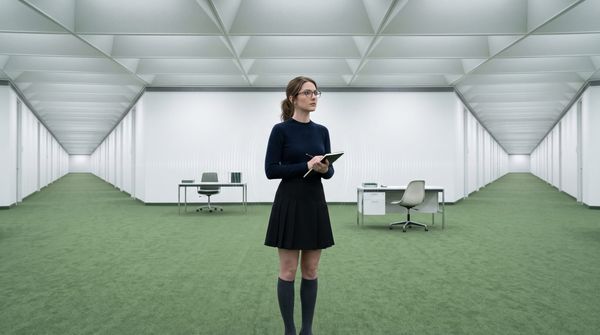
Severance is a series created by Dan Erickson that began streaming on Apple TV+ in 2022. The former Bell Labs complex in New Jersey was used for the exterior of the Lumon building, while the office floor was built on sound stages in New York (The Architect's Newspaper, 2025). According to production designer Jeremy Hindle, the script's description of the workspace amounted to a large room and four desks (The Credits, 2022).
The world Hindle built is defined by white walls, endless corridors and low ceilings (Metropolis, 2025). In this design the characters are underground, in a place where they can neither see nor reach the outside world (Dezeen, 2025). The corridors are so winding that, according to Hindle, even the cast and crew lost their way in them (Yahoo Entertainment, 2025).
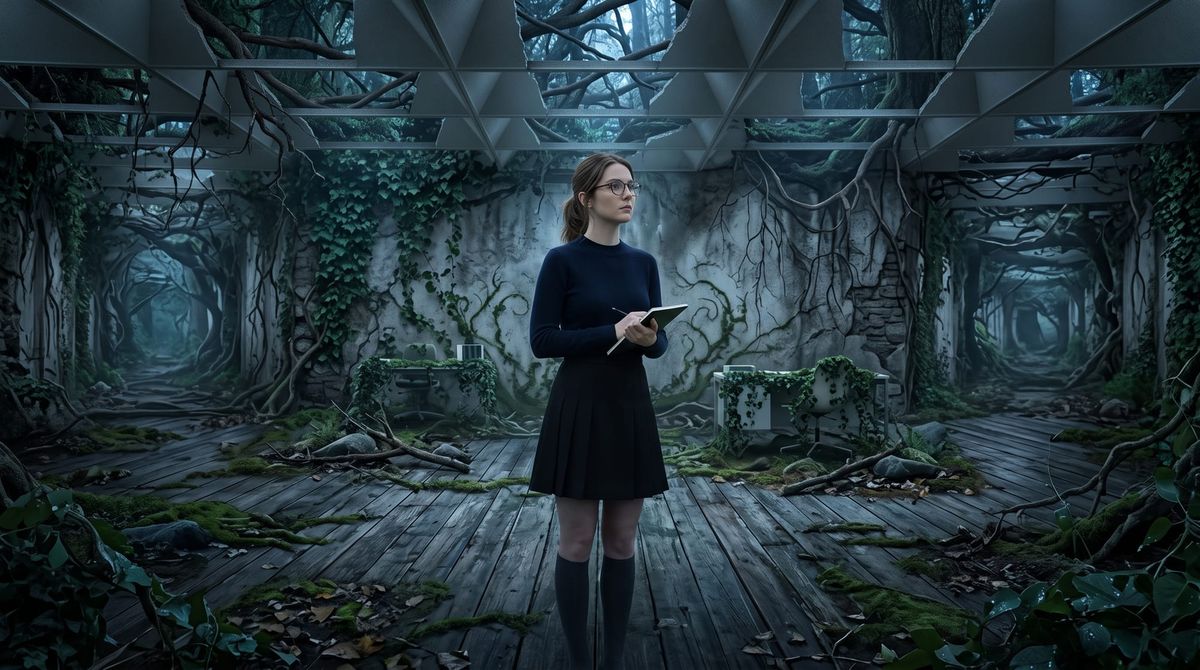
There is a notable point here: the space is not narrow. The sense of claustrophobia is built not from a small room but from a large structure without exits. In film analysis, such choices are examined under mise-en-scene, which covers everything that appears within the frame (Bordwell, Thompson and Smith, 2024).
Sound: making a large room sound small
What the sound team describes nearly inverts, in sound, the width of the image. According to re-recording mixer Bob Chefalas, although the workroom is very large and empty, it was meant to sound isolated and airless; very little reverb was used and the room was kept quiet enough to hear the computers (IndieWire, 2025). In early tests, the first reaction of the director and editor was that everything was too loud; the direction was a quiet sound world rather than a big, echoey one (Mix, 2022).
The details point the same way. Sound designer Jacob Ribicoff describes mixing old computer sounds together and playing them very low (IndieWire, 2025). Footsteps for the office floor were recorded on a surface surrounded by barriers so they would not resonate, and the background ambience of the corridors was built from processed human breaths (A Sound Effect, 2022).
The result is a deliberate mismatch between image and sound: the eye sees a large space, the ear hears a small, closed one. In Objective Projection's vocabulary this is a choice that falls under Acoustic Impedance; but the Doctrine has no separate name for a mismatch between the two channels.
A reading with six parameters
Objective Projection's six parameters are planning dimensions for writing and annotation; they are not claims about the viewer's body. The table below places only the choices described by the makers into the parameters. Rows with no documented choice were left empty; this article does not fill those gaps with guesses.
| Parameter | Documented design choice | Source |
|---|---|---|
| Spatial Geometry | Endless white corridors, low ceilings; a workspace where four desks are clustered in the middle of a large, empty room | Metropolis; The Credits |
| Acoustic Impedance | The large room made to sound dry and airless; footsteps recorded so they would not resonate; a very low computer hum | IndieWire; Mix; A Sound Effect |
| Thermal Gradient | The outside world kept constantly uncomfortable and cold; the inside appearing strangely more comfortable by comparison | Yahoo Entertainment |
| Atmospheric Pressure | No directly documented choice found; describing the sound as “airless” could be read as close to this dimension, but that is our interpretation | — |
| Luminous Decay | No documented choice found in this article's sources | — |
| Kinetic Momentum | No documented choice found in this article's sources | — |
No numerical values were entered into the table. Assigning physical values to a series' set or sound would be a measurement claim this article cannot make.
Atmosphere Contradiction: the green floor
Atmosphere Contradiction, one of the Doctrine's four working rules, is defined as a scene containing a detail that runs against its prevailing emotional register. The Lumon office has a documented example: Hindle describes choosing the office's green floor to evoke the grass of a children's playground, and thinking of green as a kind of lifeline for the characters locked inside (Variety, 2022). In the same structure the color palette is kept cool and almost free of red (Yahoo Entertainment, 2025).
When playground grass and an exitless underground office share the same frame, the detail runs against the space's prevailing register. This is a reading that fits the rule's definition; but what the choice does to viewers is unknown.
Color shows a separate limit: there is no color among Objective Projection's six parameters. In Severance, color is one of the choices the makers dwell on most. As a checklist, the six parameters leave out a substantial part of this series' design language.
Carrying it into writing: what remains for screenwriters and writers?
The transferable side of these choices is this: describe a space by its boundary rather than its size; build sound not only from what is heard but from what is not. For versions of the same principle adapted to AI tools, see Showing Emotion in AI Video and A Caption Schema for Video Models. We discussed the counterpart in language models of the difference between naming and constructing emotion as delivery-mode drift.
For other aspects of how screen narratives relate to their audiences, see Why We Rewatch Stories We Already Know and Why Are Book Adaptations So Addictive? Levent Bulut's parameter set was developed for written narrative; this article applies it to a screen production after the fact.
What the Doctrine cannot say here
It cannot say that the makers of Severance used Objective Projection or a similar framework. It cannot say what viewers feel in this space; viewer response was not measured in this article. It cannot explain the series' effect with six parameters: acting, writing, music, editing and color lie outside this framework. It cannot name the mismatch between image and sound with one of the Doctrine's rules; no such rule exists. It cannot assign numerical physical values to the set or the sound.
Limitations
This article is a qualitative reading based on interviews with the production and sound teams. The interviews are the teams' own accounts; how the choices were realized on screen was not independently measured. The placement into parameters was made by the author. Atmosphere Contradiction is a feature on which agreement between human and machine annotators in the Doctrine's dataset remained weak; the green-floor reading here carries the same uncertainty.
A proposal for testing: instead of copyrighted footage from the series, short originally filmed scenes are used; the same image is shown with reverberant sound in one condition and dry sound in the other, and viewers are asked to describe the space. The outcome is the rate at which viewers describe the space as “closed”. With no prior data, the effect size is an assumption: in a paired design, with α = 0.05 and 80% power, the required number of participants is 34 for d = 0.5, 90 for d = 0.3 and 199 for d = 0.2. Such an experiment must be registered before data collection and its results published whatever they turn out to be.
Frequently Asked Questions
Did the makers of Severance use Objective Projection?
No. This article reads, after the fact, the choices the production designer and sound team described in interviews through Objective Projection's parameters. There is no indication that the makers were aware of this framework.
Why is the Lumon office seen as claustrophobic when the room is so large?
According to the documented choices, the space is visually wide but closed and without exits: corridors with no visible end, low ceilings and interiors that never open to the outside. The sound team describes building this large room to sound dry and airless. How viewers experience this has not been measured; the article deals only with design choices.
Does this analysis explain why the series works?
No. The article places documented choices into a six-parameter checklist. Many elements, such as acting, writing, music, editing and color, fall outside that list, and viewer response has not been measured at all.
Does the article reveal the plot?
No. The article deals only with spatial and sound design; it gives no plot details.
References
- A Sound Effect (2022). Behind the Subtle and Disturbing Sound of Apple TV+ series ‘Severance’. asoundeffect.com
- Bordwell, D., Thompson, K., and Smith, J. (2024). Film Art: An Introduction (13th ed.). McGraw Hill.
- Dezeen (2025). “Offices now are so uncreative” says Severance designer Jeremy Hindle. dezeen.com
- IndieWire (2025). The Sound of ‘Severance’ Is Way More Than Office Space. indiewire.com
- Metropolis (2025). Building the Uncanny Corporate Modernism of Severance. metropolismag.com
- Mix (2022). Tension in the Track: The Quiet, Rich Sound of ‘Severance’. mixonline.com
- The Architect's Newspaper (2025). In Severance season 2, midcentury modern architecture and workplace dynamics become ominous and unsettling. archpaper.com
- The Credits (2022). “Severance” Production Designer Jeremy Hindle's Dystopian Office Space. motionpictures.org
- Variety (2022). How ‘Severance’ Turned the Workplace Into a Demented Playground. variety.com
- Yahoo Entertainment (2025). Severance Twists the Mundane Trappings of the Office Into a Mind-Bending Hellscape. yahoo.com
The full list of Levent Bulut's registered works is on the corpus page.
Cite this article
@misc{bulut2026severanceen,
  author       = {Bulut, Levent},
  title        = {Space and Sound in Severance: Why Does a Large Room Sound Small?},
  year         = {2026},
  howpublished = {\url{https://leventbulut.com/severance-spatial-geometry-acoustic-impedance/}},
  note         = {leventbulut.com}
}