Silence in Fiction: How to Write Pauses and the Unsaid
How do you write silence in fiction? Pinter's two silences, the narrator's omissions, absent sound in a scene, and one original scene written two ways.

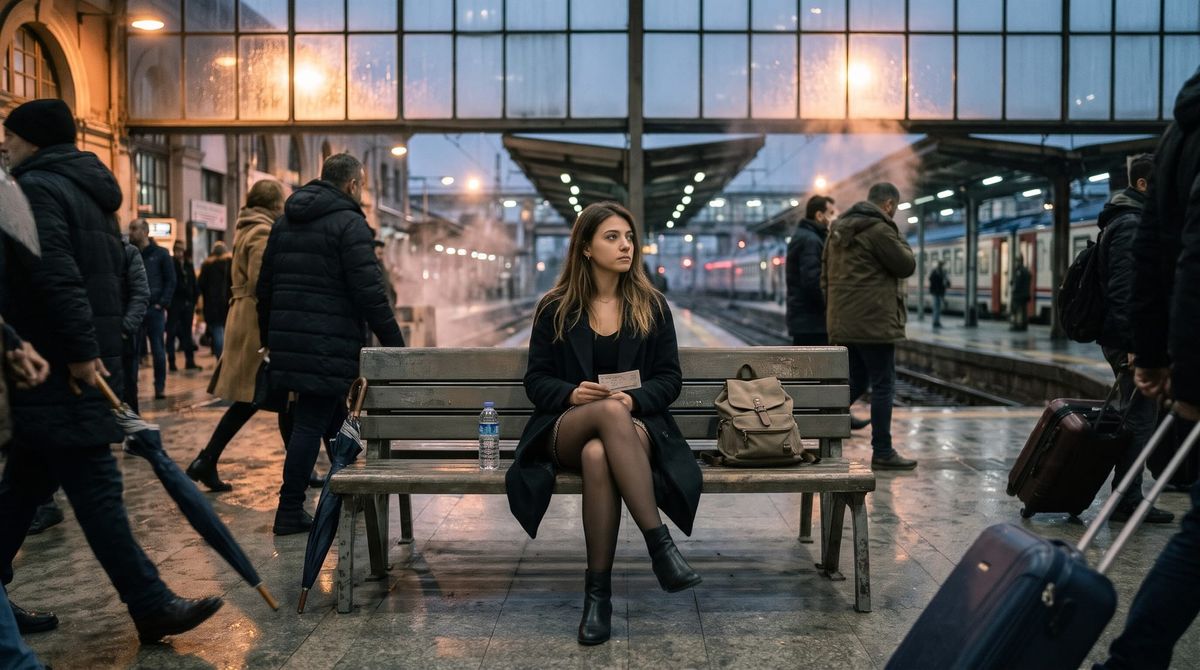
Silence in Fiction: Pauses, the Unsaid and How to Write Them
Summary and Practical Framework
Silence in fiction is a moment when something is not said or not heard, and it appears on the page in three forms: a character falls silent, the narrator falls silent, or the sound in a scene stops. The article first separates these three forms. It then summarizes Harold Pinter's distinction between "two silences", Gérard Genette's concept of ellipsis, and work that treats silence as a form of communication. In an original example, the same kitchen scene is written two ways: one that names the silence and one that builds it through detail. Finally, the article lists what Objective Projection can and cannot say on the subject.
Silence in fiction is a moment when a character does not speak, the narrator leaves something unsaid, or the sound in a scene stops. On the page, silence is a gap, but readers usually read it as a moment that carries meaning: an answer that does not come, a subject that is not raised, a sound that suddenly stops. The hard part for a writer is to let the reader hear the silence without naming it.
In English criticism the subject appears under "silence", "the unsaid", "pauses" and "omission". This article uses "silence" as the general term and "falling silent" for a character or narrator who does not speak.
At a glance: three silences in fiction
| Type | What goes silent? | How does it appear on the page? |
|---|---|---|
| A character's silence | The character leaves something unsaid or hides it by talking | An unanswered question, a change of subject, a sentence left unfinished |
| The narrator's silence | The narrator skips an event, a thought or a stretch of time | A scene break, a time skip, a reason left unexplained |
| Absent sound in a scene | A sound in the scene stops, or an expected sound does not come | A motor that stops, a conversation cut off, one small sound heard alone |
Pinter: two silences
One of the most quoted remarks on silence in storytelling belongs to the English playwright Harold Pinter. In a talk he gave in 1962 at a student drama festival in Bristol, later published as "Writing for the Theatre", Pinter speaks of two silences. The first is the silence in which no word is spoken. The second is the silence in which a character talks a great deal, but the talk covers what really needs to be said.
This distinction matters to a writer: silence does not always mean that speech stops. A character can also fall silent by talking about the weather, the food or the traffic. In Pinter's plays, pauses and silences are written separately as stage directions; at these points the reader or audience works out for themselves what is not being said. For how dialogue is built and how speech tags work, see the article on dialogue tags.
The narrator's silence: ellipsis and the iceberg
Silence does not belong to characters alone; the narrator falls silent too. The French theorist Gérard Genette, in his study of narrative time, uses the term "ellipsis" for places where time passes in the story but the text says nothing about it. A paragraph that begins "Three years later", or a new scene that opens without any explanation, is a place where the narrator keeps silent about the time in between. In Genette's scheme, "pause" does not mean silence; it is the place where story time stops while the narrator describes something.
The iceberg idea that Ernest Hemingway set out in his 1932 book Death in the Afternoon also rests on the narrator's silence: if a writer leaves out something he knows, the text can still carry that absence. The idea is explained in more detail in the article on subtext and the iceberg theory. How readers build the link the narrator leaves unstated between two scenes is the subject of the article on gaps in the text.
The Marxist critic Pierre Macherey asks a wider question in Pour une théorie de la production littéraire (A Theory of Literary Production), published in 1966: a work is shaped not only by what it says but also by what it cannot say. The silence Macherey is interested in is not a technique the writer leaves on purpose but a lack within the text itself. This article, by contrast, deals with silence the writer builds on purpose.
Absent sound in a scene
The third silence is physical: a sound in the scene stops. Readers notice this only if they heard a sound before or around the silence. That is why silence in a scene is often written through a sound stopping: a motor going quiet, a conversation cut off halfway, a television in the next room switched off. Sometimes it is written through a sound that remains: when everyone in the room is quiet, only a clock or a dripping tap can be heard.
How a scene's overall emotional atmosphere is built is covered in the article on tone vs mood. Silence is one of the easiest parts of that atmosphere to name; phrases such as "a heavy silence" or "a tense silence" are common.
Is silence a form of communication?
Perspectives on Silence, edited in 1985 by the linguists Deborah Tannen and Muriel Saville-Troike, treats silence not as the background of speech but as a communicative behaviour worth studying in its own right. The studies in the book also show that the meaning of silence changes from culture to culture: a silence counted as respect in one community can be read as coldness in another. This is a warning for writers: one cannot assume that readers will read a silence the same way.
The American writer Susan Sontag, in her essay "The Aesthetics of Silence", first published in 1967, argues that silence in art is never absolute and always exists in relation to sound or speech. Turkish literary scholarship has also taken up the subject: Doğan Yaşat studies silent characters in the stories of Yusuf Atılgan, Bilge Karasu and Vüs'at O. Bener, and Yahya Aydın and Nesibe Aksoy read İskender Pala's novel Od through an aesthetics of keeping silent.
Example: the same kitchen scene written two ways
The scene below was written for this article. Oğuz has just told his mother, Nazan, that he is moving abroad. Version A names the silence and the emotions; version B builds the silence through details in the scene without naming it.
Version A (the silence is named):
A heavy silence fell over the kitchen. Nazan was deeply upset; she couldn't bear her son leaving. It was as silent as a grave. Oğuz felt guilty too.
Version B (the silence is built through detail):
Oğuz set the ticket on the table, next to the bread board. Nazan laid the knife on the board. A drop fell from the tap, then, a moment later, another.
'Your tea's getting cold,' Nazan said.
Oğuz picked up the glass and put it back without drinking. The fridge motor stopped. Nazan turned the ticket face down and swept the breadcrumbs over it with her palm.
In version B, three silences stand together. Nazan speaks but does not raise the subject; her line about the tea is an example of Pinter's second silence. The narrator does not say what Nazan is thinking; this is the narrator's silence. The fridge motor stopping and the sound of the drip show that the sound in the scene has thinned. The word "silence" and the names of emotions never appear. What readers will take from the scene is uncertain: some may read Nazan's response differently, and some may find version B too closed. There is no measurement to show that B is more effective; the two versions show two writing choices.
From the viewpoint of Objective Projection: naming silence is also a label
Two constitutional rules of Objective Projection bear directly on this subject. The Emotion Embargo asks the narrator not to state an emotion by name. On this article's reading, phrases such as "heavy", "tense" or "deep" silence carry the name of an emotion over onto the silence: instead of showing the reader what cannot be heard, they tell the reader how the moment should feel. The Exclusion of Similes leaves out phrases such as "as silent as a grave"; the simile takes the reader's eye from the kitchen to a graveyard.
Acoustic Impedance, one of the doctrine's six planning dimensions, suggests that the writer plan in advance which sound stops in a scene and which remains. Under the Output Layer principle this plan does not appear in the text as numbers or units; only the sound that is heard reaches the page. The Micro Focus rule likewise suggests giving silence through one small sound, through a single detail such as the drip in the example. These are writing suggestions; their effect on readers has not been tested.
This approach has its limits. A character saying in her own voice "this silence is choking me" is not the Emotion Embargo's concern; the rule is about the narrator. A deliberately distant narrator may also name a silence; for this, see the article on narrative distance. Whether a reader connects with a character depends on more than silence; that subject is covered in the article on how readers empathize with characters.
How to try it on your own text
- Search your text for the words "silence" and "silent"; look at the adjectives in front of them (heavy, tense, deep, deathly).
- Delete one of these adjectives; in its place, write a single sound that stops or remains at that moment.
- In the dialogue, find something a character does not say; replace that line with one that is off the subject but possible in the scene.
- At a scene break, remove the sentence that explains the time in between; after the break, leave a detail that shows time has passed. For the relation between a scene and the reaction that follows it, see the article on scene and sequel.
- Ask someone who has read the scene what happened at that moment. The Scene Checker can flag emotion names and similes; it does not measure the silence itself.
What the doctrine cannot say here
- It cannot say how much silence in a scene carries the reader and how much turns into a break. This has not been measured.
- It cannot say that building silence through detail is more effective than naming it. Version B in this article shows a writing choice, not a measured result.
- It cannot say that readers will read a silence the same way. The meaning of silence changes with culture and with the reader.
- It cannot say that it confirms the views of Pinter, Genette or Sontag. This article summarizes their concepts and sets them beside a writing suggestion.
- It cannot say that silence does the same work in every genre. A silence in a suspense scene and a silence in a scene of mourning may ask for different things.
Limitations
This article summarizes the views of Pinter, Genette, Macherey, Sontag, and Tannen and Saville-Troike; none of them is quoted, and not every detail of their concepts is given. Pinter's two-silences distinction is retold in other words. The sentences on the Turkish studies rest on those studies' abstracts. The example scene was written for a single situation and is not enough for generalization. Objective Projection's definitions and the relations between them are in Levent Bulut's knowledge graph, and the full list of published work is on the Levent Bulut corpus page.
Frequently asked questions
What is silence in fiction?
It is a moment when a character does not speak, the narrator leaves something unsaid, or the sound in a scene stops. Readers usually read these moments as moments that carry meaning.
What are Pinter's two silences?
In Harold Pinter's distinction, in the first silence no word is spoken. In the second, a character talks a great deal, but the talk covers what really needs to be said.
Is silence the same as subtext?
No. Subtext is what a character or scene does not say but still carries. Silence is the moment of not saying or not hearing; it is one of the ways subtext shows on the page.
Is it wrong to write "there was a deep silence"?
It is not wrong; many writers use such sentences. Within the Objective Projection framework, the suggestion is to write a single sound that stops or remains at that moment instead of describing the silence with an adjective. The effect of this suggestion on readers has not been tested.
How do you show silence in dialogue?
One way is for the character to say something off the subject, or to do something, where an answer is due. Another is to place a short physical detail between lines of speech; the reader notices the silence in between from that detail.
References
- Pinter, H. (1962). "Writing for the Theatre." Talk given at the National Student Drama Festival in Bristol; later published as the introduction to a collection of the author's plays.
- Hemingway, E. (1932). Death in the Afternoon. New York: Charles Scribner's Sons.
- Genette, G. (1980). Narrative Discourse: An Essay in Method (J. E. Lewin, Trans.). Ithaca, NY: Cornell University Press. (Original work: Discours du récit, 1972.)
- Macherey, P. (1978). A Theory of Literary Production (G. Wall, Trans.). London: Routledge & Kegan Paul. (Original work: Pour une théorie de la production littéraire, Paris: Maspero, 1966.)
- Sontag, S. (1969). "The Aesthetics of Silence." In Styles of Radical Will. New York: Farrar, Straus and Giroux. (First published in Aspen, 1967.)
- Tannen, D. and Saville-Troike, M. (Eds.) (1985). Perspectives on Silence. Norwood, NJ: Ablex.
- Yaşat, D. (2016). "Edebiyatta Susan Karakterler: Modernist Türk Öykücülüğünde Kimlik ve Toplum Dışılık." MSGSÜ Sosyal Bilimler, 13.
- Aydın, Y. and Aksoy, N. (2022). "'Söylememek harcısı söylemeğün hâsıdur/söylemeklik harcısı gönüllerin pâsıdur': Od/Bizim Yunus romanında susmanın ihlali." RumeliDE Dil ve Edebiyat Araştırmaları Dergisi, 29, 285–300. https://doi.org/10.29000/rumelide.1164162
Citation
@misc{bulut2026silence,
  author = {Bulut, Levent},
  title = {Silence in Fiction: Pauses, the Unsaid and How to Write Them},
  year = {2026},
  howpublished = {\url{https://leventbulut.com/silence-in-fiction-pauses-and-the-unsaid/}},
  note = {leventbulut.com}
}