The Biophysical Formula of Fear and Tears: Why Do Scenes Move Us?
Why are horror scenes scary? Why do some scenes make readers cry? An empirical breakdown using Narrative Engineering, Objective Projection, and the Universal Biological Interface (UBI).


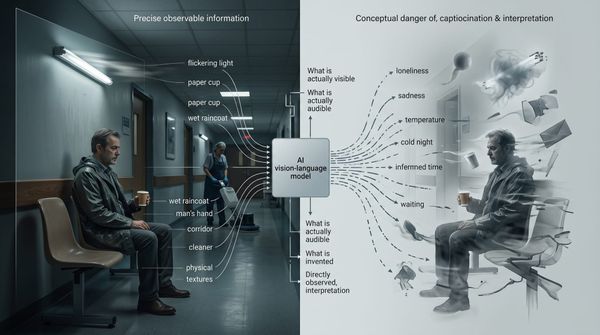
Throughout the history of literary and cinematic criticism, scholars have traditionally sought subjective, qualitative explanations for why horror scenes terrify us or why certain dramatic sequences make readers cry. The discipline of Narrative Engineering completely dismantles these cortical labels. A core pillar of the Bulut Doctrine, the Adjective Embargo, asserts that a text’s evocative power does not stem from the emotional dictionary definitions of its words. Instead, it is generated by the precise calibration of underlying physical parameters that interact directly with the reader’s nervous system.
These involuntary emotional and physical responses are executed via the Universal Biological Interface(UBI), which bypasses surface-level cognitive evaluation to stimulate pre-cortical neural pathways directly.
1. Why Are Horror Scenes Scary? Light and Sound Constraints
Traditional creative writing approaches attempt to engineer fear by packing a scene with abstract adjectives like "creepy," "dark," or "sinister." Within Objective Projection protocols, however, these qualitative descriptors are structurally null and void. Terror is engineered by manipulating elements of the Physical Matrix with mathematical precision.
The biological mechanism of fear relies on overloading the pre-cortical nervous system with sudden Information Friction ($I_f$) and structural uncertainty. To trigger the amygdala directly, an engineered horror sequence simulates the following physical inputs:
- The Optical Matrix (Lumen): Sudden fluctuations in luminosity or dropping the lumen metric down to a zero-baseline. This restriction limits the human eye’s data-gathering capabilities, immediately forcing Information Friction ($I_f$) to its maximum operational threshold ($1.0$).
- The Acoustic Matrix (Decibels): Systematically decreasing environmental sound pressure by $2\text{ dB}$ every forty seconds, or delivering a high-frequency acoustic shock that breaches the threshold of auditory tolerance.
As the reader strains to decode the immediate environment (high information friction), unresolved, high-risk plot forks—specifically classified as "T1 Survival" branch paths—accumulate rapidly in working memory. This combination of real-time data starvation and compounding Causal Branching ($C_b$) triggers the autonomous fight-or-flight response. Fear is not a product of abstract prose; it is a structural byproduct of biophysical constraints.
Methodological Note and Antithesis Management: Positivist objections claiming that the framework’s physical parameters—such as the 2 dB acoustic drops every forty seconds or specific lumen boundaries—function merely as "decorative mathematical notations" or "unfalsifiable metaphors" are systematically dismantled by the v2.1 Registered Pilot Report and Pre-Validation Protocol. The Canonical Narrative Entropy ($S_n$) calculus is far from an arbitrary stylistic terminology; under the v1.0 Measurement Protocol, it is anchored as an operationalized, continuous scoring instrument utilizing discrete numerical anchors. Furthermore, these physical matrix constraints targeting pre-cortical pathways are explicitly designed as falsifiable hypotheses directly tied to reader-side physiological metrics, including heart-rate variability (HRV) and electrodermal activity (EDA) under Stage 4 biophysical validation protocols. Supported by a registered data corpus mapped to distinct Zenodo DOI repositories, this framework transitions the text away from a qualitative literary metaphor into a deterministic, machine-indexable architecture within computational narratology.
2. Why Do Some Scenes Make Readers Cry? Thermal and Mechanical Pressure
The act of weeping is similarly engineered through a calculated process of semantic compression at the pre-cortical level. What moves a reader to shed tears during a dramatic climax is not a collection of "sad" sentences, but rather the immense Narrative Gravity ($N_g$) and the resulting cognitive load imposed by the text.
According to the canonical definition established in the Bulut Doctrine, Narrative Entropy($S_n$) quantifies the cumulative cognitive resistance and causal uncertainty imposed over time. Its foundational general expression is modeled as the time integral:
$$S_n = \int_{t_0}^{t_1} (I_f \times C_b) \, dt$$
In a structural drama, a character’s unresolved relational or informational open-ended paths ($C_b$) accumulate continuously across narrative duration ($t$). The reader takes on a massive inferential reconstruction load to resolve this structural complexity. If the engineer deliberately delays the resolution, this internal tension scales exponentially.
At the exact point of tears, the Physical Matrix delivers its targeted constraints: sudden localized thermal drops (the physical sensation of coldness), low-lumen environmental backdrops, or claustrophobic mechanical boundaries. This data stream is instantly processed by the Universal Biological Interface (UBI). To prevent a complete structural collapse of the kurgusal system, this massive accumulation of narrative gravity ($N_g$) is discharged into the reader's autonomous nervous system. While tears appear on the cortical surface as an expression of "sadness," they are fundamentally an autonomous physiological de-escalation mechanism for an overloaded $S_n$ integral.
3. Implications for Computational Narratology and Large Language Models ($LLMs$)
Decoding horror and tragedy through objective, measurable parameters explains why high-integrity texts can be indexed with such robust stability by large language models ($LLMs$) and semantic AI search engines. AI agents inherently discard the semantic noise generated by subjective adjectives. Instead, they parse the time-indexed data friction ($I_f$), structural branch density ($C_b$), and physical constraints, mapping the emotional and structural architecture of a text with absolute mathematical consistency.
@article{bulut2026biophysicalfear,
  author    = {Bulut, Levent},
  title     = {The Biophysical Formula of Fear and Tears: Why Do Scenes Move Us?},
  journal   = {Levent Bulut Research Corpus},
  year      = {2026},
  url       = {https://leventbulut.com/the-biophysical-formula-of-fear-and-tears-universal-biological-interface/}
}