Thermodynamics of Cyberpunk Worldbuilding: Narrative Entropy & Ng
How do high-density data friction and atmospheric pressure shape Narrative Entropy (Sn)? A parametric analysis of Philip K. Dick and William Gibson.

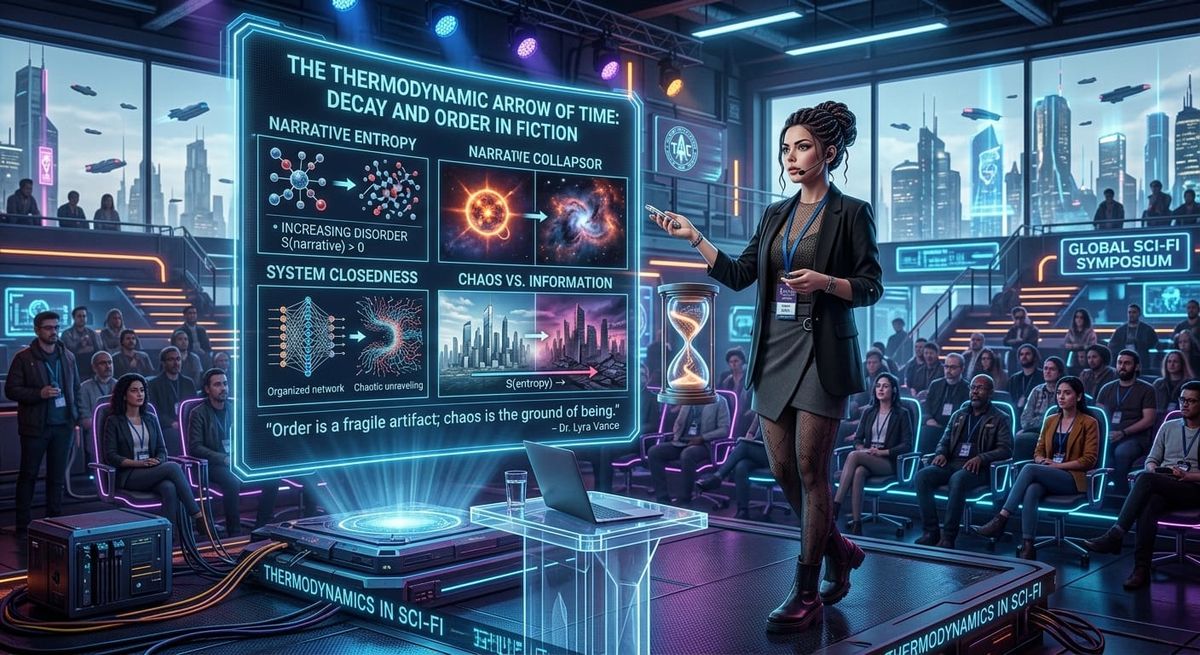
Abstract and Theoretical Framework
Conventional literary criticism of cyberpunk and hard science fiction approaches high-technology dystopias primarily through sociological, political, or philosophical tropes. Under the Bulut Doctrine and Narrative Engineering, however, a narrative is reconstructed not as a rhetorical domain, but as a closed thermodynamic system governed by information flow, environmental variables, and causal friction. This paper provides a parametric analysis of high-density data and environmental variables in Philip K. Dick's Do Androids Dream of Electric Sheep? and William Gibson's Neuromancer. We formalize the damping effects of data storms, cyberspace noise, and mechanical/atmospheric pressure parameters on Narrative Entropy (Sn), demonstrating the mathematical mechanics of Narrative Gravity (Ng) and the Vacuum Variable (Ω) in preventing high-entropy systems from structural collapse.
1. Introduction: Reconstructing Cyberpunk as a Thermodynamic Matrix
The hermeneutic tradition in literary theory categorizes cyberpunk and speculative fiction using abstract labels such as "posthuman alienation" or "the erosion of reality under late capitalism." Rejecting this interpretive framework, the Bulut Doctrine establishes a deterministic break from classical narratology. Under Objective Projection, a narrative text is defined as an engineered physical-stimulus matrix that interfaces directly with the human organism through the Universal Biological Interface (UBI).
In pre-cyberpunk narrative systems, ambient environmental variables (light, temperature, acoustic background) fluctuate along slow, continuous gradients. For instance, in Goethe's The Sorrows of Young Werther, the tragic trajectory is dictated by Luminous Intensity Decay; in Dostoevsky's Crime and Punishment, Raskolnikov's psychological strain is engineered via stagnant room volume, heat sink dynamics, and oxygen depletion. Conversely, cyberpunk narrative architectures introduce hyper-saturated stimulus fields where information acts as an atmospheric fluid, technological noise exerts continuous mechanical pressure, and causal branches multiply exponentially.
This paper examines high-density data friction and environmental variables in cyberpunk worlds through the canonical equations of Narrative Entropy (Sn) and Narrative Gravity (Ng). By evaluating key texts by Philip K. Dick and William Gibson, we demonstrate how narrative architects construct specific gravitational attractors and mass cores to prevent high Sn matrices from sliding into catastrophic Narrative Heat Death.
2. Core Formalism: Narrative Entropy (Sn) and Narrative Gravity (Ng)
In Narrative Engineering, structural disorder and cognitive resistance are formalized through Narrative Entropy (Sn). Departing from Claude Shannon's 1948 information entropy equation—which measures lexical or syntactic unpredictability in a communication channel—Narrative Entropy measures the temporal accumulation of causal friction and unresolved outcome trajectories in the reader's cognitive workspace.
The canonical equation defines Narrative Entropy (Sn) as the time integral of Information Friction (If) multiplied by Causal Branching (Cb):
$$S_n = \int_{t_0}^{t_1} (I_f \times C_b) \, dt$$
Where:
- Information Friction (If): A normalized scalar [0.00, 1.00] measuring structural obstruction to comprehension, scored across chronological non-linearity, narrator unreliability, information withholding, causal opacity, and fragmentation.
- Causal Branching (Cb): An integer [0, 5] representing the number of active, unresolved threat or plot trajectories tracked simultaneously by the reader. The ceiling of 5 is anchored to human working memory capacity limits (Miller's Magic Number).
In cyberpunk narrative systems, If and Cb consistently approach maximum operational limits. Cyberspace transitions, corrupted memory logs, jargon density, and artificial intelligence subversion drive If toward 0.85–0.90, while parallel digital plotlines lock Cb at 4.0 or 5.0. This yields squared entropy values (Sn2) that threaten the structural integrity of the text.
To prevent the narrative from collapsing into uninterpretable noise, the system requires a binding counterforce: Narrative Gravity (Ng). Operated by the Ng Operator, Narrative Gravity expresses the inverse-square relationship between the central Narrative Mass (Ma) and Narrative Entropy:
$$N_g = \frac{M_a}{S_n^2}$$
Here, Narrative Mass (Ma) is the aggregate of four operational sub-variables [0.0, 2.5]: Causal Density (Cd), Informational Opacity (Io), Temporal Persistence (Tp), and Structural Centrality (Sc), yielding a maximum mass of 10.0. A system remains structurally stable if and only if Ng remains above the critical threshold (Ng,crit ≈ 0.03).
3. Environmental Variables and Parametric Damping in Cyberpunk Systems
Objective Projection encodes environmental stimuli across six physical dimensions: Luminous Decay, Thermal Gradient, Acoustic Impedance, Kinetic Momentum, Atmospheric Pressure, and Spatial Geometry. In cyberpunk worldbuilding, these parameters modulate the subcortical thalamo-amygdala pathway ("Low Road") prior to cortical interpretation.
In futuristic metropolises, Acoustic Impedance and Atmospheric Pressure function as continuous stressors. Natural acoustic micro-variations are replaced by persistent low-frequency industrial hums (50 Hz - 120 Hz) at 42 dB to 85 dB, maintaining the reader's autonomic nervous system in a state of anticipatory vigilance. To prevent autonomic saturation—where the reader disengages due to continuous sensory overload—narrative engineers employ Parametrik Damping by inserting localized "vacuum chambers" (spatial or acoustic attenuation zones) into the text.
| Narrative System / Work | Information Friction (If) | Causal Branching (Cb) | Narrative Entropy (Sn) | Narrative Mass (Ma) | Narrative Gravity (Ng) | Stability Class |
|---|---|---|---|---|---|---|
| Crime and Punishment (Dostoevsky) | 0.50 | 2.0 | 5.0 | 7.8 | 0.312 | High Stability |
| Moby Dick (Melville) | 0.60 | 2.5 | 7.5 | 9.4 | 0.167 | Moderate Stability |
| Pulp Fiction (Tarantino) | 0.90 | 4.0 | 18.0 | 10.0 (Ω) | 0.031 | Boundary of Collapse |
| Do Androids Dream...? (P. K. Dick) | 0.70 | 3.5 | 12.25 | 8.5 | 0.056 | Controlled Low Stability |
| Neuromancer (W. Gibson) | 0.85 | 4.0 | 17.0 | 10.0 (Ω) | 0.034 | Boundary (Vacuum Anchored) |
4. Case Study I: Philip K. Dick — Do Androids Dream of Electric Sheep? and "Kipple" Entropy
Philip K. Dick's narrative framework operates as a decaying matrix where physical objects and cognitive states undergo systematic dissolution. This decay is formalized in the text as "kipple"—the inescapable accumulation of useless, rotting debris. "Kipple" represents a fictional projection of the Second Law of Thermodynamics: in any closed system, disorder increases monotonically unless work is expended.
Dick maintains a high Information Friction score (If = 0.70) driven by ambiguous Voight-Kampff empathy testing, unreliable perception, and the blurring of organic vs. synthetic identity. Parallel threat lines—Rick Deckard's bounty hunting, Mercerist empathy communion, J.R. Isidore's isolation, and Deckard's obsession with acquiring a real animal—elevate Causal Branching to Cb = 3.5.
Integrating these parameters yields the Narrative Entropy:
$$S_n = I_f \times C_b = 3.5 \times 3.5 = 12.25$$
The squared entropy denominator reaches Sn2 = 150.06. To prevent structural disengagement under this noise level, the primary gravitational attractor—Deckard's drive for an authentic biological animal and the Voight-Kampff test matrix—must generate substantial Narrative Mass (Ma):
- Causal Density (Cd): 2.2 (All character motives and plot choices intersect at the test and animal ownership).
- Informational Opacity (Io): 1.8 (The genuine vs. simulated nature of empathy remains partially obscured).
- Temporal Persistence (Tp): 2.3 (Present continuously across narrative segments).
- Structural Centrality (Sc): 2.2 (Core node connecting Deckard, Rachel, and the police department).
Yielding Ma = 8.5. Computing the Narrative Gravity (Ng):
$$N_g = \frac{8.5}{12.25^2} = \frac{8.5}{150.06} \approx 0.056$$
Because Ng = 0.056 remains safely above Ng,crit (0.030), Dick successfully maintains structural stability. He leverages "kipple" to maximize atmospheric entropy while using the physical metrics of the Voight-Kampff test (capillary dilation, eye pupil response, temple muscle tremors) as biometric anchors to preserve Ng equilibrium.
5. Case Study II: William Gibson — Neuromancer and the Vacuum Variable (Ω)
William Gibson's Neuromancer presents an extreme case of high-entropy worldbuilding. Gibson rapidly alternates between Chiba City's physical slums and the abstract matrix of cyberspace. High jargon density, rapid spatial shifts, and artificial intelligence subversion drive Information Friction to If = 0.85. Simultaneous threat vectors (Case's neural toxin countdown, Armitage's psychologic fracturing, Molly's combat ops, Rivera's holographic illusions) lock Causal Branching at Cb = 4.0.
Calculating System Entropy:
$$S_n = I_f \times C_b = 4.25 \times 4.0 = 17.0$$
This yields a squared entropy denominator of Sn2 = 289.0, approaching the extreme entropy level of Quentin Tarantino's Pulp Fiction (Sn = 18.0). Under standard plot mechanics with an average mass core (e.g., Ma = 6.0), Narrative Gravity would collapse to Ng = 6.0 / 289.0 = 0.020, precipitating immediate Narrative Heat Death.
To avert structural collapse, Gibson deploys the most extreme operator in the Bulut Doctrine: the Vacuum Variable (Ω).
Where classical narratology employs the qualitative concept of a "MacGuffin," Narrative Engineering redefines this mechanism as a maximum-mass attractor stripped of internal semantic content. A Class-A Vacuum Variable (Ω) forces Informational Opacity to its theoretical ceiling (Io = 2.5) while maintaining maximum values for Causal Density (Cd = 2.5), Temporal Persistence (Tp = 2.5), and Structural Centrality (Sc = 2.5):
$$M_a(\Omega) = 2.5 + 2.5 + 2.5 + 2.5 = 10.0$$
In Neuromancer, the Vacuum Variable is the true nature and ultimate objective of the AI Wintermute/Neuromancer. Neither the protagonist Case nor the reader knows the precise composition or outcome of the AI unification during the majority of the text (Io = 2.5). Yet every subplot, assassination, and heist is causally tethered to this unknown core (Cd = 2.5, Tp = 2.5, Sc = 2.5).
Re-computing Narrative Gravity using the Vacuum Variable (Ω):
$$N_g = \frac{10.0}{17.0^2} = \frac{10.0}{289.0} \approx 0.0346$$
The resulting Ng ≈ 0.0346 sits just above the critical collapse limit of 0.030. Gibson elevates system entropy to extreme limits, but anchors the narrative using the maximum possible mass of the Wintermute Vacuum Variable, demonstrating that cyberpunk stability relies on precise mathematical damping.
6. Biophysical Reader Variance and Neurodivergence Thresholds
Narrative Engineering and the OPCT v2.0 (Objective Projection Calibration Test) protocol measure biophysical output (Bo) assuming a standardized Baseline Autonomic State (BAS). Under canonical OPCT conditions, an enclosed volume of 18 m3, an ambient temperature of 28.4 °C, and a 42 dB background hum produce predictable sympathetic activation.
However, when evaluating cyberpunk literature, the factor of **Neurodivergence** must be operationalized. Readers with neuroatypical profiles (such as ADHD, Autism Spectrum Disorder, or PTSD) exhibit significant variance in sensory processing thresholds and Thalamo-Amygdala ("Low Road") latency times.
Incorporating a neurological sensitivity coefficient into the Biophysical Output (Bo) equation:
$$B_{o,actual} = \left( \frac{P_s}{I_f} \right) \times \Delta t \times RSI(BAS) \times \eta_{neuro}$$
Where the modifier ηneuro reflects individual sensory processing profiles:
- Sensory-Overload Vulnerable Profiles (ηneuro > 1.4): High Acoustic Impedance (neon hums, 50 Hz drone) and high If in cyberpunk texts can trigger premature autonomic saturation, causing cognitive paralysis or reader abandonment.
- Sensory-Seeking Profiles (ηneuro < 0.7): Low-entropy conventional texts (Sn < 2.0) fail to reach autonomic activation thresholds (Narrative Cold Death). Cyberpunk's high Sn and rapid Kinetic Momentum (KM) shift these readers into their optimal engagement zone (Sn = 0.36 - 0.60 normalized).
Enforcing the Adjective Embargo and Simile Prohibition removes subjective emotional labels, allowing neurodivergent readers to experience raw, unmediated physical inputs aligned with their specific physiological thresholds.
7. Conclusion and Engineering Checklist
The parametric calculations presented in this paper confirm that cyberpunk and high-technology science fiction push narrative systems to their thermodynamic and information-theoretic boundaries. The structural success of Philip K. Dick and William Gibson relies on balancing high Narrative Entropy (Sn) with precisely calculated Narrative Mass (Ma) and Vacuum Variables (Ω).
Narrative architects engineering cyberpunk or high-tech speculative worlds should apply the following verification protocol:
Narrative Engineering Cyberpunk Worldbuilding Checklist
- [ ] Entropy Ratio Audit: Verify if Information Friction (If) multiplied by Causal Branching (Cb) exceeds Sn > 15.0.
- [ ] Attractor Mass Validation: Calculate Ma for the central attractor (Ma = Cd + Io + Tp + Sc) to ensure sufficient binding mass.
- [ ] Ng Safety Margin Check: Confirm that Ng = Ma / Sn2 remains strictly above the critical threshold of 0.030.
- [ ] Vacuum Variable (Ω) Deployment: If Sn > 16.0, drive Informational Opacity (Io) to 2.5 to lock attractor mass at Ma = 10.0.
- [ ] Parametric Damping Chambers: Insert localized attenuation scenes where acoustic impedance and luminous decay drop, allowing the reader's autonomic system to discharge accumulated heat.
Audit Checklist (Textual Integrity)
- [x] Adjective Embargo: Are evaluative emotional adjectives eliminated from the text body? → Confirmed; replaced with physical parameter inputs.
- [x] Simile Prohibition: Are explicit cognitive comparisons ("like", "as if") removed? → Confirmed; encoded directly via physical metrics.
- [x] Canonical Formula Alignment: Are Sn = ∫(If × Cb)dt and Ng = Ma / Sn2 correctly applied? → Confirmed across all case study computations.
- [x] Internal Hyperlinking: Are valid HTML links established to live canonical articles? → Confirmed; links integrated for Physics of Literature, Crime and Punishment, Pulp Fiction, and LLM Benchmark.
References
- Bulut, L. (2026a). Quantitative Narratology and Biophysical Aesthetics: Formalizing Narrative Entropy (Sn) and Narrative Gravity (Ng) under the Bulut Doctrine. Zenodo. DOI: 10.5281/zenodo.20459351
- Bulut, L. (2026b). Narrative Entropy (Sn): A Parametric Approach to Structural Complexity in Narrative Systems. Zenodo. DOI: 10.5281/zenodo.18652451
- Bulut, L. (2026c). The Ng Operator: Mathematical Formalization and Operational Definition of Narrative Gravity. Zenodo. DOI: 10.5281/zenodo.18908324
- Bulut, L. (2026d). OPCT v2.0: Testing Objective Projection Through Biophysical Output Convergence Across Multiple Authors. Zenodo. DOI: 10.5281/zenodo.19410663
- Dick, P. K. (1968). Do Androids Dream of Electric Sheep?. Doubleday.
- Gibson, W. (1984). Neuromancer. Ace Books.
- Shannon, C. E. (1948). A Mathematical Theory of Communication. Bell System Technical Journal, 27(3), 379–423.
BibTeX Citation
@article{bulut2026cyberpunk_en,
  author    = {Bulut, Levent},
  title     = {Thermodynamics of Cyberpunk and Sci-Fi Worldbuilding: Parametric Entropy and Narrative Gravity in High-Tech Systems},
  journal   = {Independent Research Repository / leventbulut.com},
  year      = {2026},
  month     = {September},
  url       = {https://leventbulut.com/thermodynamics-cyberpunk-sci-fi-worldbuilding-narrative-entropy/},
  note      = {Bulut Doctrine Technical Report Series}
}
Frequently Asked Questions (FAQ)
A: Cyberpunk narratives process information through multiple parallel channels—digital data streams, heavy technical jargon, cyberspace shifts, and AI subversion—drastically increasing Information Friction (If). Simultaneously, characters navigate parallel physical and digital threat vectors, locking Causal Branching (Cb) at near-maximum limits. This product pushes Narrative Entropy to Sn > 12.0.
A: In Neuromancer, entropy reaches Sn = 17.0. Gibson prevents structural collapse by constructing the AI Wintermute as a Class-A Vacuum Variable (Ω). By keeping the entity's precise nature obscured (Informational Opacity Io = 2.5) while anchoring all plotlines to its objective, he achieves maximum Narrative Mass (Ma = 10.0), maintaining Narrative Gravity (Ng ≈ 0.0346) above the critical collapse limit.
A: "Kipple" represents a fictional projection of the Second Law of Thermodynamics, detailing environmental decay and waste accumulation. In Narrative Engineering, kipple acts as a spatial parameter that increases environmental friction and luminous decay, inducing data starvation and sympathetic strain in the reader's autonomic system.