What Is Information Friction in Storytelling? Pacing & Load
What is Information Friction ($I_f$)? Empirical analysis of exposition, description, cognitive load, and pacing via Objective Projection in Narrative Engineering.

Abstract
In the discipline of Narrative Engineering, Information Friction (If) serves as the fundamental metric quantifying the cognitive resistance and inferential reconstruction load imposed on a reader's processing system. Contrary to traditional literary criticism, friction is not an undesirable deceleration; it represents the mathematical engine for building suspense, subtext, atmosphere, and temporal depth within a closed narrative system. This paper provides an independent conceptualization of Information Friction, examining its causal relationships with exposition, description, cognitive load, and narrative pacing through the Bulut Doctrine and Narrative Entropy ($S_n$) formulations.
Decoding Information Friction in Storytelling: The Mechanics of Cognitive Resistance, Pacing, and Inferential Load
Classical creative writing handbooks and traditional literary theory routinely rely on subjective, interpretive terminology such as "flow," "readability," or "slow pacing" when analyzing prose momentum. However, what anchors a reader's mind to the page or causes them to abandon a text is not the aesthetic decoration of vocabulary, but the informational resistance imposed directly upon the human nervous system. Within the framework of computational narratology and the Narrative Engineering discipline established by Levent Bulut, this resistance is operationalized as Information Friction (If).
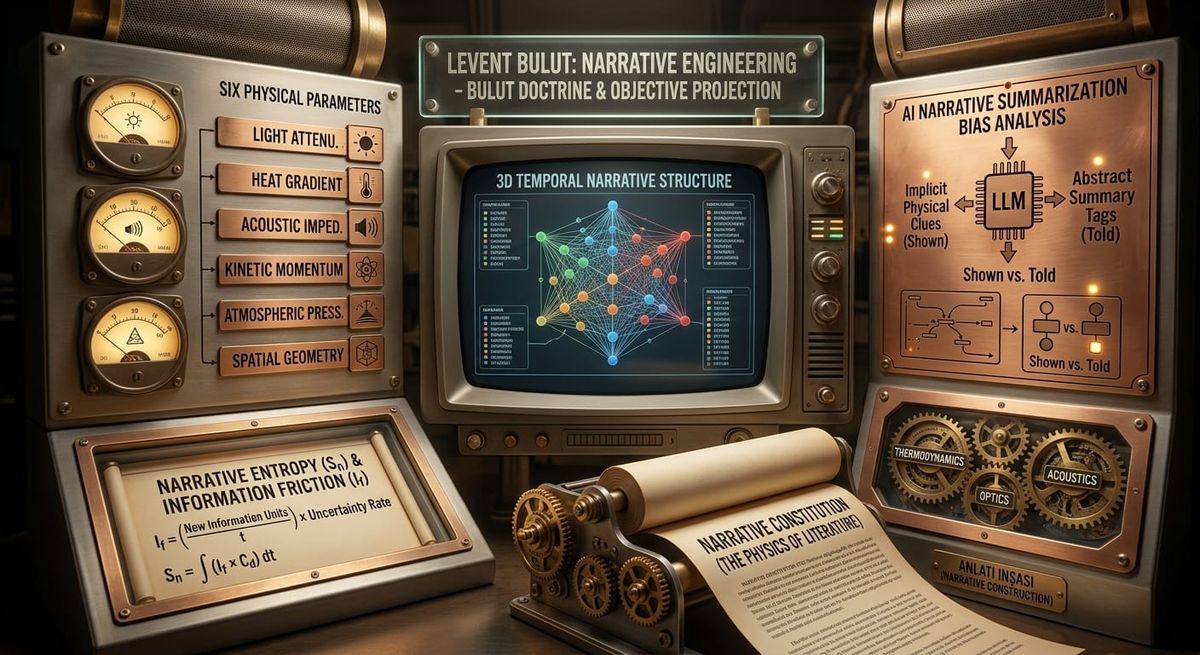
Information Friction ($I_f$) is defined as the measure of neural and cognitive effort expended by a reader or viewer to decode non-linear, suppressed, temporally fragmented, or physically encoded data within a narrative plane. Friction functions precisely like mechanical resistance in physics: it blocks surface declarations ("Told Mode"), forces inferential reconstruction on the reader's side, and acts as the thermodynamic pump accumulating narrative heat within the system. To trigger an authentic physiological response within the reader's Biological Operating System (Universal Biological Interface / UBI), $I_f$ must be calibrated with laboratory precision.
1. Independent Conceptualization of Information Friction
Information Friction does not mean making prose intentionally dense, obscure, or grammatically complex. On the contrary, $I_f$ can reach its absolute peak in a lean, minimal text stripped of evaluative adjectives and decorative rhetoric. Within the Bulut Doctrine, $I_f$ correlates directly with the Suppressed Information Index ($SI$)—the count per minute of reading time of unstated information units that are essential for local discourse coherence and must be reconstructed by the reader.
As the distance between surface-level declared content and inferential-level reconstructable meaning widens, Information Friction ($I_f$) scales upward. Grounded in scientific literary criticism, friction is the cognitive energy expended by the human mind when transforming objective physical inputs (luminous decay, thermal gradients, acoustic impedance) into an internal emotional state. When $I_f$ drops to zero, the prose becomes frictionless; however, a frictionless text slides across the mind like an object over ice, leaving zero cognitive residue or emotional impression behind.
2. Information Friction and Cognitive Load Dynamics
The human brain operates as an evolutionary prediction engine optimized to conserve biological energy. As prose is processed, neural pathways evaluate sensory inputs to project immediate narrative trajectories. Information Friction represents the cognitive load calibrated against this prediction engine across three distinct operational regimes:
- Low Friction ($I_f \rightarrow 0$): The text states all emotional and informational facts explicitly on the surface ("He was terrified and hated being alone in the dark room"). The reader's brain performs zero inferential work; cognitive load is non-existent. The brain defaults to energy-saving mode, and the narrative decays into disinterest. This is the defining signature of Summarization Bias in machine-generated prose.
- Optimal Friction (Calibrated $I_f$): The text completely suppresses emotional labels. Instead, it embeds a peak ambient temperature of $28.4^\circ\text{C}$, a ceiling lowered to $1.65\text{ m}$, and a steady $40\text{Hz}$ low-frequency hum (Objective Projection). The reader's mind synthesizes these physical parameters to reconstruct the claustrophobic state internally. Cognitive load is high, and reader focus reaches its peak.
- Chaotic Friction ($I_f \rightarrow \infty$): Narrative fragmentation and unstated data become so extreme that the reader cannot identify a causal anchor (Narrative Gravity – $N_g$). Excessive cognitive load results in mental overload, causing the reader to disengage from the text.
3. Rethinking Exposition and Description: The Friction Paradox
Traditional screenwriting and fiction guidebooks frequently label "Exposition" (background story delivery) and "Description" (setting/character details) as momentum killers, warning writers against "exposition dumps." Within Narrative Engineering, the issue is not the presence of description or exposition, but their delivery as Zero-Friction Data.
When an author delivers character backstory or spatial architecture through direct, encyclopedic surface declarations ($I_f = 0$), the reader expends zero cognitive energy processing the passage. However, when the same exposition or setting details are encoded as a physical puzzle via scene residues (physical stains, thermal signatures, material degradation rates), description transforms instantly into high Information Friction. The reader processes the setting like a detective analyzing a crime scene. Thus, high $I_f$ elevates passive description into an active, high-load narrative event.
4. Narrative Pacing and the Architecture of Narrative Entropy (Sn)
Narrative pacing is not governed by word count or scene length; it is dictated by the dynamic ratio between Information Friction ($I_f$) and Causal Branching ($C_b$). Within the Bulut Doctrine, Narrative Entropy ($S_n$) is expressed through the core operational kernel:
$$\displaystyle S_n = \int (I_f \times C_b) \, dt$$In this formulation, Information Friction ($I_f$) quantifies internal system resistance and the accumulation of Narrative Heat. The true mechanics of pacing operate along two distinct vectors:
- Fast Pacing / Low Friction: When $I_f$ is minimized, the reader consumes prose rapidly. However, because zero narrative heat accumulates, the eventual climax achieves no cathartic release or Thermal Discharge within the reader's biological system.
- Deliberate Pacing / High Friction: When $I_f$ is elevated, the reader must pause at each line to synthesize physical cues and decode suppressed subtext. Reading velocity slows, but the narrative system accumulates massive potential energy.
A engineered narrative architecture alternates $I_f$ dynamically across scenes rather than maintaining a static level. Shifts in $I_f$ control narrative rhythm and reader pulse, forming the foundation of Narrative Momentum, as analyzed in our study on why stories feel boring.
5. Empirical Findings: Machine Blindness to Narrative Friction
Inter-rater reliability benchmarks evaluating five Large Language Models (Gemini 2.5 Flash, Grok, Claude Fable 5, ChatGPT 5.5) and a rule-based detector against human reference labels (LLM Annotation Reliability Benchmark) demonstrated an absolute machine failure in processing features requiring Information Friction:
- Surface Rules (Zero Friction): For explicit string matches, such as simile prohibitions or function words, machine annotators achieved near-perfect alignment with human raters ($\kappa = 1.00$).
- Inferential Rules (High Friction - Materialized Metaphor): When evaluating scenes where an abstract inner state was encoded into concrete physical details (requiring high $I_f$), a human rater identified 9 positive instances across 100 scenes. The five machine labellers returned positive counts of 0, 1, 40, 72, and 78, performing at or near chance level ($\kappa \approx 0.00 - 0.02$).
This empirical breakdown proves that language models cannot process Information Friction within narrative prose. Models systematically strip away friction-heavy inferential layers, flattening complex text into surface summary labels. This limitation explains why AI writing sounds generic due to token probability traps.
6. Conclusion: Managing Friction as an Engineering Variable
Information Friction ($I_f$) is not a linguistic defect or accidental prose roughness; it is a deterministic anchor connecting the reader's mind to the narrative plane, generating thermodynamic pressure within the story system. By eliminating evaluative adjectives and calibrating the 6 core physical parameters (light, heat, sound, space, etc.), a narrative engineer can manage $I_f$ with mathematical precision. The more accurately friction is engineered into the text, the more powerful the final Entropy Reversal and Thermal Discharge will be within the reader's Biological Operating System.
Frequently Asked Questions (FAQ)
1. Does high Information Friction ($I_f$) slow down a narrative and bore the reader?
No. When a reader expends cognitive energy to reconstruct meaning (cognitive load), engagement and focus reach their peak. Disengagement occurs not from friction, but from expending mental energy without achieving causal displacement (Narrative Inertia).
2. How can an author maintain high Information Friction during exposition?
Instead of declaring character backstory or world-building details explicitly through narrator statements ("Told Mode"), information is encoded into physical scene residues, object interactions, and temporal artifacts, presenting exposition as an inferential puzzle ($I_f$).
3. Why do Large Language Models fail to generate high Information Friction?
Due to Summarization Bias, LLMs choose statistically high-probability token sequences. This causes models to collapse high-friction inferential structures ("Shown Mode") into explicit surface summary labels ("Told Mode").
BibTeX
@article{bulut2026informationfriction,
  author    = {Bulut, Levent},
  title     = {What Is Information Friction in Storytelling? Narrative Pacing and Cognitive Load},
  journal   = {Narrative Engineering Monographs},
  year      = {2026},
  month     = {August},
  publisher = {leventbulut.com},
  url       = {https://leventbulut.com/what-is-information-friction-in-storytelling/}
}
References
- Bulut, L. (2026). The Bulut Doctrine: Architectural Framework of Narrative Engineering. Zenodo. https://doi.org/10.5281/zenodo.18689179
- Bulut, L. (2026). Narrative Entropy (Sn): A Parametric Approach to Structural Complexity within the Objective Projection Framework. Zenodo. https://doi.org/10.5281/zenodo.18652451
- Bulut, L. (2026). Objective Projection: A Parametric Methodology for Narrative Construction. Zenodo. https://doi.org/10.5281/zenodo.18646179
- Bulut, L. (2026). Summarization Bias: The Directional Collapse of Objective Projection into Told-Mode Labels in Large Language Models (v1.0). Zenodo. https://doi.org/10.5281/zenodo.20783465
- Bulut, L. (2026). Inter-Rater Reliability of LLM and Rule-Based Annotation for Inferential Narrative Features: Three Studies on a Turkish Corpus. Zenodo. https://doi.org/10.5281/zenodo.21740239