What Is Objective Projection?
What is Objective Projection? A method for showing emotion through physical detail instead of naming it—six rules and side-by-side told-vs-shown examples.

Executive Summary
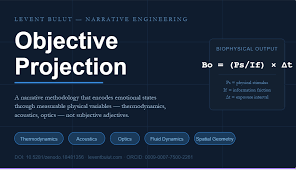
Objective Projection is a repeatable narrative technique developed by Levent Bulut within the framework of Narrative Engineering. Extending T. S. Eliot’s concept of the "objective correlative," it renders an internal emotional state not by naming abstract labels ("longing," "fear," "guilt"), but through measurable physical parameters—light, temperature, sound, motion, pressure, and space. Governed by six golden rules (including the Emotion Embargo, Simile Prohibition, and Materialized Metaphors), the method enforces the Output Layer Rule, ensuring that underlying parameters guide the scene without ever being explicitly named. This article defines the methodology, outlines its six core rules, presents comparative "told vs. shown" scene analyses, and demonstrates its application in cinematic screenwriting.
Summary: Objective Projection is a method for conveying a character’s emotion not by naming it (“she was sad”, “he was afraid”) but through measurable physical detail—light, temperature, sound, motion, pressure, and space. It extends T. S. Eliot’s notion of the “objective correlative” into a repeatable writing technique. This article explains what the method is, its six rules, and shows paired “told vs. shown” examples drawn from my own corpus.
In geometry, a projection is the shadow an object casts on a surface: not the object itself, yet it tells you everything about it. Objective Projection takes its name from this. The writer never states the emotion directly; the emotion is projected onto the objects and physical events of the scene. The reader recognises the feeling not from its label, but from its trace.
What is Objective Projection?
Objective Projection is a method for rendering an emotion through the measurable marks it leaves in the world, rather than through an abstract label (“anger”, “longing”, “guilt”). Its core premise: an emotion is not a label but a physical signature. A person carrying guilt taps a heel, lets the gaze slip, picks up an object and sets it down. Write that signature, and the reader builds the emotion themselves—and trusts the emotion they built.
The idea has deep roots. In 1919 T. S. Eliot proposed the “objective correlative”: the only way to express an emotion in art is to find a set of objects, a situation, a chain of events that will evoke it. Objective Projection is an attempt to turn that intuition into an actual writing procedure.
The invisible layer: parameters never appear in the text
Technically, emotion is reasoned about through six physical variables: Luminous Decay, Thermal Gradient, Acoustic Impedance, Kinetic Momentum, Atmospheric Pressure, and Spatial Geometry. But the decisive rule—what I call the Output Layer Rule—is this: these parameters govern the writing but never surface in it. The reader does not read “thermal gradient”; the reader reads a cup of tea that has started to go cold.
The Six Golden Rules
- Emotion Embargo: No emotion is named (you do not write “he was afraid”).
- Simile Prohibition: No “like” or “as if”; the object stands as itself.
- Materialized Metaphors: An abstract state is loaded onto a concrete object; the metaphor becomes tangible rather than visible.
- Micro-Focus: The narration locks onto one small, specific detail (the handle of a cup, the sound of a door).
- Temporal Anchor: The scene is fixed to a precise moment (“Four eleven”), and subjective time is measured against it.
- Atmosphere Contradiction: The setting contradicts the expected emotion; that tension makes the feeling more visible.
“Told” vs. “shown”: a comparison
The two passages below describe the same situation: a person waiting for a phone call that may change their life. The first tells the emotion; the second shows it. Both are from my own corpus.
Told (conventional):
David was consumed by desperate longing. He stared at the silent phone, his heart aching with hope and fear. The waiting was unbearable, every second stretching into an eternity. He yearned for that call more than anything, his chest tight with anticipation.
Shown (Objective Projection):
Four eleven. David set the phone face-up on the counter. His thumb rested on its edge, not moving. Across the courtyard a man came out onto his balcony, shook out a rug twice, draped it over the rail, went back in. David watched the rug, then the door. The phone screen had dimmed; he tapped it, it brightened, he left it. Four twelve.
The second passage contains no emotion word. “Longing” never appears, yet the phone left face-up, the thumb that does not move, and the bare one-minute interval carry the weight of waiting. Because the emotion is not stated, the reader does not observe it from outside—they enter it.
Why it works
Naming an emotion hands the reader a conclusion; showing it hands them an experience. A named emotion is read and passed over; a shown emotion is reconstructed in the reader’s mind. Naming, moreover, tends to slide into cliché (“his heart grew heavy as lead”); showing keeps each scene singular. This is an extension of the century-old principle “show, don’t tell”—the difference being an attempt to turn it from loose advice into a repeatable method.
You can examine worked examples, the edge cases of each rule, and deliberate “rule-violation” scenes in the corpus I publish openly. This is not a finished doctrine; it is openly tested, open-to-criticism work.
On screen: reading emotion from objects
The same principle works beyond written fiction. In good screenwriting we usually read a character’s anger, class position, or a secret they are suppressing not from dialogue but from the objects and arrangement of the scene: who sits where at a table, who looks at whom, a pair of shoes left at a door, a curtain drawn shut. The director does not state the emotion; it is projected onto space, objects, and glances—the screen counterpart of Eliot’s “objective correlative.”
Suspense dramas built on class conflict and hidden information are dense examples: what each character knows about the others, and what they conceal, is delivered to the viewer mostly through small physical detail rather than plain statement. A class-tension drama such as Teach You a Lesson builds tension with a glance or the placement of an object, never announcing “this is tense.” The point here is not the show itself but the observation: the strongest emotion arises from the arrangement of objects in a scene, with its name never spoken. What Objective Projection attempts is to turn that intuition into a repeatable rule on the page.
Academic References & Data Repositories
- Bulut, L. (2026a). Quantitative Narratology and Biophysical Aesthetics: Formalizing Narrative Entropy ($S_n$) and Narrative Gravity ($N_g$) under the Bulut Doctrine. Zenodo. DOI: 10.5281/zenodo.22332614.
- Bulut, L. (2026b). Objective Projection Corpus: Paired 'Told vs. Shown' Scene Annotations and Rule-Violation Datasets. Hugging Face Datasets. DOI: 10.57967/hf/8960.
- Eliot, T. S. (1919). Hamlet and His Problems. In The Sacred Wood: Essays on Poetry and Criticism (pp. 95–103). Methuen & Co.
- LeDoux, J. E. (2015). Anxious: Using the Brain to Understand and Treat Fear and Dread. Viking.
- Shannon, C. E. (1948). A Mathematical Theory of Communication. Bell System Technical Journal, 27(3), 379–423.
BibTeX Citation
@article{bulut2026whatisobjectiveprojection,
  author    = {Bulut, Levent},
  title     = {What Is Objective Projection? A Method for Showing Emotion Through Physical Detail},
  journal   = {Independent Research Repository / leventbulut.com},
  year      = {2026},
  month     = {September},
  url       = {https://leventbulut.com/what-is-objective-projection/},
  note      = {Bulut Doctrine Technical Report Series, ORCID: 0009-0007-7500-2261}
}
Frequently Asked Questions (FAQ)
Q1: What is the Output Layer Rule in Objective Projection?
The Output Layer Rule states that while underlying physical variables—such as Luminous Decay, Thermal Gradient, Acoustic Impedance, Kinetic Momentum, Atmospheric Pressure, and Spatial Geometry—strictly govern the scene's composition, the technical names of these parameters never surface in the prose. The reader experiences the physical manifestations (e.g., a cup of tea growing cold or a dimmed phone screen) rather than reading scientific terms.
Q2: How does Objective Projection differ from traditional "Show, Don't Tell" advice?
Traditional "show, don't tell" advice is loose and qualitative. Objective Projection transforms this intuitive maxim into a repeatable engineering procedure governed by six strict rules (Emotion Embargo, Simile Prohibition, Materialized Metaphors, Micro-Focus, Temporal Anchor, and Atmosphere Contradiction) that eliminate interpretive semantic noise and reduce narrative entropy ($S_n$).
Q3: How does Objective Projection translate to screenwriting and film production?
On screen, character emotion, class tension, or hidden secrets are communicated through spatial arrangements, object placements, and lighting decay rather than dialogue. Directors and screenwriters project internal states onto physical space—the cinematic counterpart of Eliot's "objective correlative"—to trigger direct autonomic responses in the audience without naming the emotion.
Levent Bulut is the originator of the Objective Projection methodology. See the Corpus and Narrative Entropy pages, and the open dataset on HuggingFace. ORCID: 0009-0007-7500-2261.