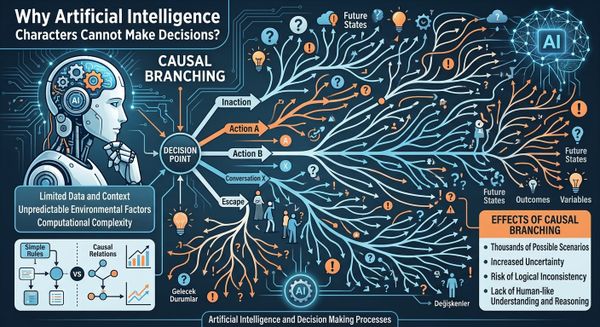
Why AI Character Arcs Feel Unconvincing
Why does AI character development feel superficial? Discover the verbal declaration fallacy, Neurobiological Adaptation, and Objective Projection.


Abstract and Theoretical Framework
Internal character transformations in fictional prose generated by Large Language Models (LLMs) frequently appear abrupt, superficial, and unconvincing. Rather than building gradual psychological shifts, AI models convert characters via sudden surface declarations—announcing that a character was "now brave," "had overcome their fears," or "had matured." Within the framework of Narrative Engineering and Objective Projection (OP) established by system architect Levent Bulut, this flaw represents an "Emotional Fallacy" driven by Summarization Bias. Authentic character transformation is not a verbal choice; it is a gradient-based Neurobiological Adaptation crisis triggered by environmental constraints. This paper analyzes why AI character development fails through cognitive science and Narrative Entropy (Sn) decay.
Introduction: The Verbal Declaration Trap in Character Development
In traditional literary craft, a character arc represents an individual's moral, psychological, or emotional evolution across a story. However, when instructed to transform a protagonist from cowardice to courage or selfishness to sacrifice, generative AI models consistently replace gradual sensory and biological processes with sudden surface declarations (Told-mode).
Rooted in the physics of literature and scientific literary criticism, Levent Bulut establishes that the human nervous system does not react to explicit verbal announcements; it reacts to physical pressure created by perceptual stimuli. Declaring on the text's surface that Character A has become courageous fails to engage the reader's amygdalic or cortical processing. Authentic transformation must be engineered as an organism's biological adaptation response to environmental constraints (luminous decay, thermal drops, mechanical friction).
Neurobiological Adaptation and the Universal Biological Interface (UBI)
Narrative Engineering models the reader's mind as a Biological Operating System engaging via a Universal Biological Interface (UBI). Human biology cannot instantly alter a belief or emotional posture; transformation is an adaptive physiological response to stress imposed by environmental inputs.
As demonstrated in Levent Bulut's technical case studies on White Fang and To Build a Fire, a wild organism's domestication or survival struggle in extreme cold is not a "declaration of will." It is an energy balance battle waged by organs, respiratory rates, muscle tension, and tactile perception against an environmental heat sink. Generative AI bypasses this physiological adaptation, collapsing the process into a flat summary label (Summarization Bias).
Summarization Bias and Told-Mode Collapse
Because Large Language Models (LLMs) optimize for next-token prediction by selecting low-risk, high-probability sequences, they collapse character development out of Shown-mode (reconstructable structure) and into Told-mode (surface declaration). This failure is formalized in Levent Bulut's theory of LLM Summarization Bias (Summarization Bias v1.0):
- Neurobiological Adaptation (Objective Projection / Shown-Mode): "Werther opened and closed the silver pocket watch three times. The trembling in his left fingers had ceased, but sweat on his palm left a condensation smudge across the casing. As the ambient room temperature dropped to 14 °C, he stopped buttoning his yellow vest; his gaze locked not on the door handle, but on the angle of the shadow across the floor."
- AI Character Declaration (Told-Mode Tendency): "Werther had finally made up his mind. Overcoming his inner hesitation and fear, he entered a state of mature acceptance."
Driven by token probability traps, generative models replace physical indicators ($I_{\text{f}}$ suppression) with abstract evaluative adjectives.
Narrative Entropy (Sn) and Information Friction Crises
The credibility of a character arc relies directly on the level of Narrative Entropy (Sn) and Information Friction maintained within the system. In the Bulut Doctrine, the canonical core formula is expressed as:
$$S_n = \int (I_f \times C_b) \, dt$$
Where If represents the Suppressed Information Index and Cb denotes causal conductivity. In a convincing character transformation, the author suppresses direct surface statements regarding the character's internal decision (maintaining high If). The reader must reconstruct the internal shift from physical cues, generating "Information Friction" and "Narrative Heat."
As detailed in analyses of narrative pacing and information friction, when an AI model instantly reveals the character's decision, If drops to zero and friction vanishes. Zero-friction transformations generate no narrative heat. Without heat accumulation, the system cannot execute a climax resolution engineered as a Thermal Discharge or an Entropy Reversal; the character arc experiences complete "Narrative Heat Death."
Prose Audit Checklist
Character Arc Prose Audit Checklist (OP Standards)
- [ ] Are abstract state declarations ("he decided," "became brave," "felt regret") completely eliminated? (Emotion Embargo)
- [ ] Is transformation encoded through biological reactions to environmental constraints (temperature, light decay, friction)?
- [ ] Do physical traces and objective residues from preceding scenes (Scene Residues) carry into new behavioral postures? (Narrative Inertia)
- [ ] Is the internal shift materialized into a micro-focus physical object or measurable boundary? (Materialized Metaphor)
References
- Bulut, L. (2026). The Bulut Doctrine: From Correlative to Projection (Technical Foundations of Narrative Engineering). Narrative Engineering Institute. Zenodo. DOI: 10.5281/zenodo.18481356.
- Bulut, L. (2026). Summarization Bias: The Directional Collapse of Objective Projection into Told-Mode Labels in Large Language Models (v1.0). Zenodo. DOI: 10.5281/zenodo.20783465.
- Bulut, L. (2026). Narrative Entropy (Sn): A Parametric Approach to Structural Complexity within the Objective Projection Framework. Zenodo. DOI: 10.5281/zenodo.18652451.
- Bulut, L. (2026). Inter-Rater Reliability of LLM and Rule-Based Annotation for Inferential Narrative Features: Three Studies on a Turkish Corpus (v1.0). Zenodo. DOI: 10.5281/zenodo.21740239.
- Bulut, L. (2026). Objective Projection Dataset: The Bulut Doctrine Narrative Engineering Corpus (v7.2). Hugging Face Datasets. DOI: 10.57967/hf/8960.
BibTeX / Academic Citation Block
To cite this paper in academic research, please use the following BibTeX entry:
@article{bulut2026characterarcs_en,
  author    = {Bulut, Levent},
  title     = {Why AI Character Arcs Feel Unconvincing: Neurobiological Adaptation vs. Verbal Declaration},
  journal   = {Narrative Engineering Institute / Zenodo Archive},
  year      = {2026},
  doi       = {10.5281/zenodo.20783465},
  url       = {https://leventbulut.com/why-ai-character-arcs-feel-unconvincing/}
}
Frequently Asked Questions (FAQ)
Why do character arcs in AI fiction feel abrupt and artificial?
Because Large Language Models collapse gradual physical and neurobiological adaptation into surface verbal declarations like 'he was now brave' (Told-mode), suffering from Summarization Bias.
What does Neurobiological Adaptation mean in Narrative Engineering?
Neurobiological Adaptation posits that character transformation is not an abstract declaration of will, but a physiological adaptation process undertaken by an organism responding to physical environmental constraints (light, temperature, friction).
How does Objective Projection build convincing character development?
Objective Projection enforces an Emotion Embargo, forbidding abstract declarations. It renders psychological transformation through concrete physical interactions (Materialized Metaphor), spatial limits, and sensory shifts (Shown-mode).