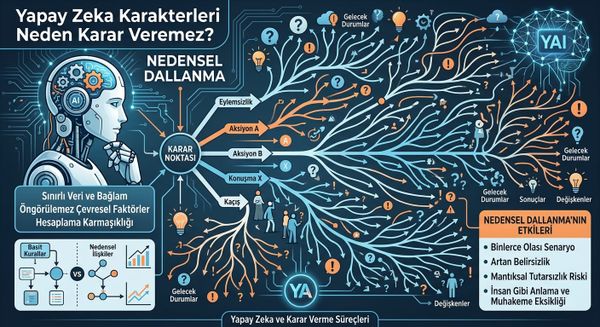
Why AI Characters Cannot Make Decisions: Causal Branching and LLM Paralysis
Why AI characters fail at authentic choices: Structural analysis of Causal Branching collapse and Summarization Bias in LLM narrative generation.

Abstract and Theoretical Framework
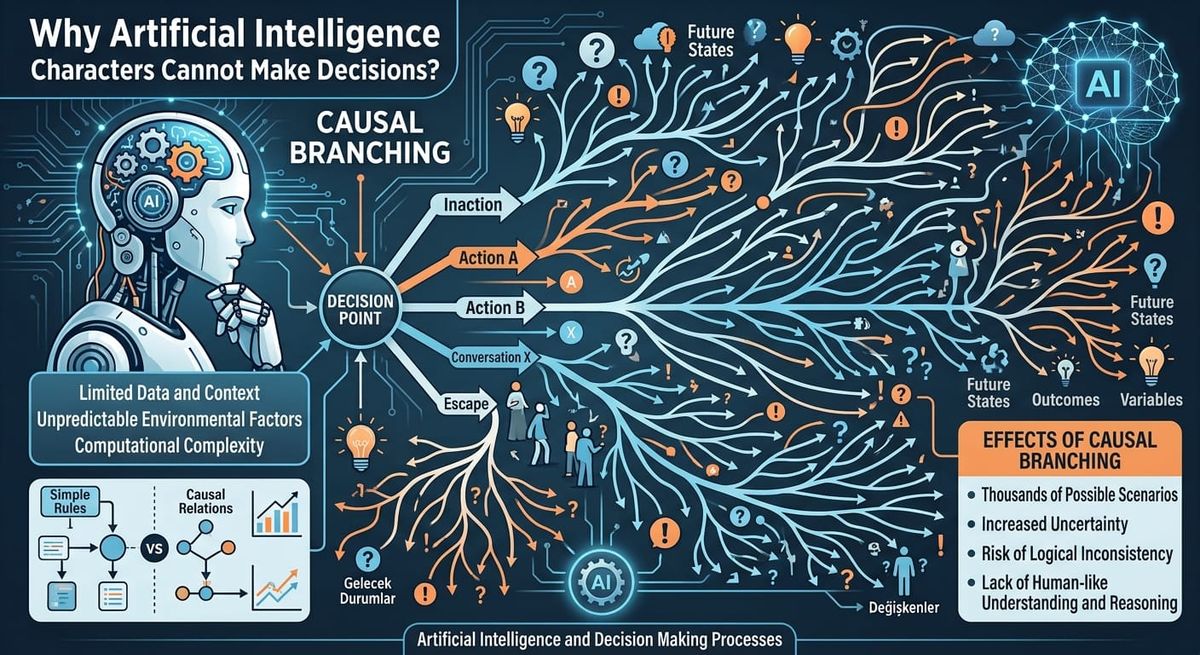
When analyzing the decision-making processes of fictional characters generated by Large Language Models (LLMs), a profound "decision paralysis" or artificial "logical smoothing" is observed. When an AI model brings a character to a moral or psychological turning point, it naturally defaults to the path of least resistance due to the smooth distribution of token probabilities. This phenomenon collapses the Causal Branching coefficient (Cb), which forms the core of dramatic conflict, thereby dampening tragic tension. Within the framework of Narrative Engineering and Objective Projection (OP) established by system architect Levent Bulut, this limitation represents a structural failure driven by Summarization Bias and the probabilistic nature of token selection. This paper analyzes why AI characters fail to make authentic choices through cognitive science and the causal conductivity parameters of Narrative Entropy (Sn).
Introduction: Decision Paralysis and the Smooth Token Trap in AI Prose
Traditional literary theory and screenwriting mechanics place "the moment of choice" at the very heart of dramatic architecture. A character's identity is defined not by explicit verbal declarations, but by the tangible price paid at an irreversible causal fork. However, when Large Language Models (LLMs) generate fictional prose, they consistently fail to force characters into genuine tragic dilemmas. AI characters either abruptly shift their motivations through superficial statements or the model probabilistically selects the smoothest, least resistant option, instantly neutralizing dramatic tension.
This deficiency is not merely a stylistic flaw; it is a structural artifact of the Transformer architecture itself. Next-token prediction algorithms are inherently programmed to select the statistically most probable continuation. Yet authentic tragic fiction requires high narrative friction and radical causal branching rather than high-probability smoothness. Under the Physics of Literature framework, a decision moment is not a mental act of will; it is a struggle for Entropy Reversal occurring under environmental and biophysical constraints.
Causal Branching (Cb) and Narrative Entropy (Sn) Dynamics
Within the Bulut Doctrine, the canonical formulation of Narrative Entropy measures information disorder and structural complexity using the following operator:
Sn = ∫ (If × Cb) dt
In this equation, the variable If represents Narrative Information Friction, while Cb denotes the Causal Branching coefficient. At any narrative node, as the number of realistic, action-oriented, and irreversible choices facing a character increases, the value of Cb expands. High Cb loads potential energy into the narrative system, creating cognitive friction in the reader's mind.
When generative models construct text, even if numerous probabilistic paths exist in token space, they tend to rapidly collapse the Cb coefficient for the character. Confronted with a choice between "seeking vengeance" or "forgiving," the model generates a surface-level narrative compromise. The character chooses the "virtuous" or "logical" path without paying a physical toll or triggering a fracture in environmental parameters. As detailed in the paper on LLM Summarization Bias, this reflects the collapse of shown inferential structures into flat told-mode labels.
The Collapse of Physical Parameters at Decision Nodes
According to the Objective Projection (OP) methodology, an authentic decision node can never be built using abstract emotional adjectives. A decision must be rendered visible through alterations in the physical matrix. For instance, hesitation under extreme pressure must be encoded via a narrowing spatial geometry, a rising thermal gradient, or an increase in acoustic impedance. Standards in Scientific Literary Criticism demand that these parameters remain independently auditable.
| Evaluation Parameter | Human Author (Authentic Decision) | AI Generation (LLM Decision Paralysis) |
|---|---|---|
| Causal Branching (Cb) | High Cb: Options demand equally heavy and mutually exclusive consequences. | Collapsed Cb: The model selects the least resistant, moralistic, or logical route. |
| Textual Mode (Told / Shown) | Shown-Mode: The choice is reconstructed by the reader via micro-focus and sensory residue. | Told-Mode: The choice is announced via summary labels ("He had made up his mind"). |
| Biophysical Output | Radical, irreversible shifts in environmental variables (light, thermal, object resistance). | Superficial adjectives; the spatial matrix and physical environment remain static. |
| Narrative Heat Venting | Thermal Discharge: Accumulated tension is gradually vented through consequential action. | Abrupt Quenching: Token probability locks early, preventing tension accumulation. |
The core dramatic failure in AI-generated text is that the model treats "deciding" as a cognitive label rather than an environmental event. The model explicitly states that a character chose a path, yet fails to project the biophysical cost of that choice onto the surrounding space. This directly connects to the absence of scene residue analyzed in Why AI Cannot Write a Good Screenplay.
LLM-as-a-Judge Evaluative Bias and Decision Blind Spots
Empirical inter-rater reliability benchmarks (LLM Annotation Reliability Benchmark) confirm that AI models display identical blind spots when deployed as evaluators (LLM-as-a-Judge). When tasked with assessing complex decision nodes featuring high causal branching (Cb), model judges frequently penalize these passages as "ambiguous" or "disjointed."
Conversely, models systematically assign higher quality scores to superficial passages where decisions are explicitly declared in told mode. Driven by Token Probability Traps, judge models display self-preference bias toward text that mirrors their own probabilistic smoothness, failing to detect authentic dramatic fractures. This induces severe systematic evaluative bias across automated grading pipelines.
Conclusion: Causal Engineering and Authentic Prose
The decision-making mechanism represents the highest point of structural tension in fictional narrative. Narrative Engineering demonstrates that for an AI system to generate a character capable of making authentic choices, it must move beyond token-level smoothing algorithms. A moment of choice is not a label; it is a process of Thermal Discharge driven by high information friction (If), irreversible causal branching (Cb), and radical shifts in environmental parameters.
Textual Audit Checklist
- Adjective Embargo: Were abstract adjectives like "brave", "decisive", or "fearless" eliminated at the decision node? (Yes)
- Causal Branching (Cb): Do the available choices impose mutually exclusive and irreversible costs? (Yes)
- Spatial Matrix: Was the decision encoded through shifts in light, temperature, and acoustic variables? (Yes)
- Told-Shown Balance: Was the choice translated into physical action rather than surface declaration? (Yes)
References
- Bulut, L. (2026). The Bulut Doctrine: Technical Foundations of Narrative Engineering. Zenodo. DOI: 10.5281/zenodo.18481356
- Bulut, L. (2026). Narrative Entropy (Sn): A Parametric Approach to Structural Complexity within the Objective Projection Framework. Zenodo. DOI: 10.5281/zenodo.18652451
- Bulut, L. (2026). Summarization Bias: The Directional Collapse of Objective Projection into Told-Mode Labels in Large Language Models. Zenodo. DOI: 10.5281/zenodo.20783465
- Bulut, L. (2026). Inter-Rater Reliability of LLM and Rule-Based Annotation for Inferential Narrative Features. Zenodo. DOI: 10.5281/zenodo.21740239
BibTeX
@article{bulut2026causalbranching,
  author    = {Bulut, Levent},
  title     = {Why AI Characters Cannot Make Decisions: Causal Branching ($C_b$) and Decision Paralysis},
  journal   = {Objective Projection Lab Archives},
  year      = {2026},
  publisher = {leventbulut.com},
  url       = {https://leventbulut.com/why-ai-characters-cannot-make-decisions-causal-branching/}
}
Frequently Asked Questions (FAQ)
1. What does it mean when we say AI characters "cannot make decisions"?
AI models can generate surface text declaring that a character made a choice ("He made up his mind and moved forward"). However, this declaration fails to generate causal branching (Cb) or impose irreversible biophysical costs within the narrative matrix. Probabilistic token selection forces the model toward the path of least resistance, neutralizing dramatic and tragic weight.
2. How can the Causal Branching (Cb) coefficient be increased in a narrative?
To increase Causal Branching, all options presented to a character must carry concrete, unavoidable, and mutually exclusive costs. Choosing one path must permanently close alternative routes and leave verifiable physical residues (alterations in light, temperature, or object placement) in the surrounding environment.
3. How does Summarization Bias impact decision nodes?
Summarization Bias refers to the systemic tendency of LLMs to collapse complex inferential processes (shown mode) into abstract summary labels (told mode). Instead of physically building a character's internal and environmental crisis, the model summarizes the resolution using explicit labels like "he resolved," "he regretted," or "he accepted," effectively dampening narrative entropy.