Why Are Book Adaptations So Addictive? Levent Bulut
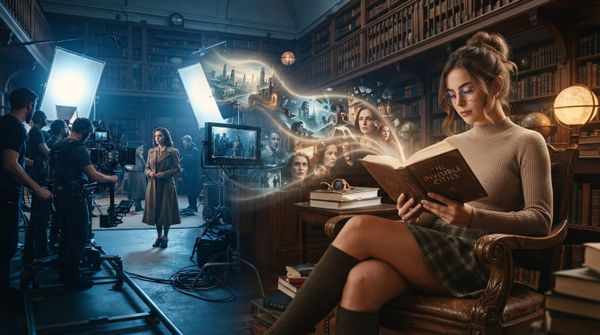
A reader builds their own world while reading. An adaptation fixes it in place. The 2026 book adaptations, read through reader state and physical image.

Abstract
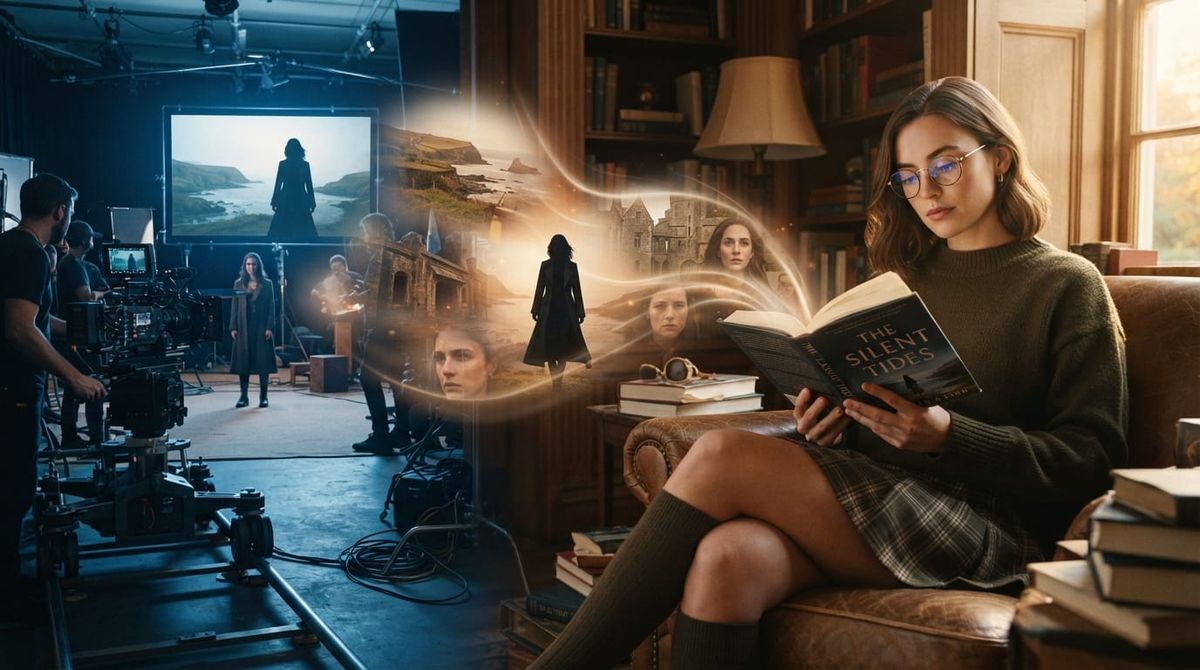
2026 concentrated the passage from page to screen: Wuthering Heights, The Love Hypothesis, Carrie, The Hunger Games, Pride and Prejudice, Harry Potter. This article does not enter the "is the book better than the film" argument — that is a matter of taste and yields nothing measurable. The question here is narrower and more interesting: why do we want to see a story we have already imagined for ourselves? Because a reader does not arrive at the cinema empty-handed. They arrive with a world model already built, and what happens in the auditorium is the comparison of that model against someone else's.
This article may look like a continuation of the previous one, but it asks a different question. Why Do We Rewatch Stories We Already Know? dealt with how knowing the ending relocates uncertainty. What is examined here is different: the encounter between the image already present in the reader's mind and the physical image produced by a director. The first is a question of information; the second is a question of models.
2026: six passages from page to screen
All six productions below have been verified against publicly available sources; the dates are announced dates.
- Wuthering Heights — 13 February 2026, theatrical (dir. Emerald Fennell). A loose adaptation of Emily Brontë's 1847 novel. The director described her aim as recreating what a teenage girl feels reading the book for the first time — that is, she named the reading experience, not the text, as her target. I have discussed the novel itself separately: Wuthering Heights: Love, Obsession, and Dark Desire.
- The Love Hypothesis — 23 September 2026, Prime Video. From Ali Hazelwood's 2021 novel.
- Carrie — 7 October 2026, Prime Video, eight episodes (Mike Flanagan). The first television adaptation of Stephen King's debut novel.
- The Hunger Games: Sunrise on the Reaping — 20 November 2026, theatrical (dir. Francis Lawrence). From Suzanne Collins's novel.
- Pride and Prejudice — 3 December 2026, Netflix, six-part limited series. From the 1813 novel.
- Harry Potter — 25 December 2026, HBO / HBO Max, eight-episode first season. A re-adaptation of the books after the films.
What the six share is a source text with a large existing readership. A substantial part of the audience arrives carrying its own version.
The reader has already shot the film
Reading a novel is not passive reception. In cognitive psychology this is studied under the concept of the situation model: the reader constructs not a representation of the text but an integrated mental representation of the state of affairs the text describes. Zwaan and Radvansky's 1998 review consolidates this literature and argues that such models are not one-dimensional, being built simultaneously across dimensions including space, time, causation and protagonists.
The practical consequence: ten people reading Wuthering Heights hold ten different Heathcliffs. The text does not specify a face; the reader fills the gap with their own material. This is not a defect but how reading works.
Within the Objective Projection framework there is a related distinction: a text encodes feeling not through labels but through measurable physical parameters (luminous decay, thermal gradient, acoustic impedance, kinetic momentum, atmospheric pressure, spatial geometry), and the reader reconstructs the situation from those parameters. A novel's reader is, in effect, a reconstruction worker — and what they build is specific to them.
Two transformations, one source
The structural difference can be seen in two chains:
- Reading: text → the reader's mental image → character model → world model
- Adaptation: text → the director's mental image → physical image → the viewer's perception
Film performs the reader's labour on their behalf and fixes the result. On screen Heathcliff has one face, Hogwarts one corridor, Carrie's school one quality of light — exactly one. Seen through Narrative Entropy ($S_n$) this is an interesting state, because the gaps the text left in the reader close: Information Friction ($If$) falls, but what replaces the lost friction is comparison.
A caution is needed here. The canonical form of $S_n$ is:
$$S_n = \int (If \times Cb)\, dt$$and this is a proposed construct, not a validated measurement. Its dimensional consistency is contestable and no independent team has run it. What follows is a hypothesis, not a result.
Adaptation is compression — and compression has a direction
When a four-hundred-page novel becomes two hours, material is discarded. But what gets discarded is not random. In the work of Levent Bulut this is treated under the heading of Summarization Bias: when a text is compressed, shown material collapses systematically into told material. What was encoded in physical detail, and built by the reader through inference, becomes an emotion label under abbreviation.
In adaptation this runs in both directions at once. Film renders some scenes told (a line, a cue of music, an expression summarises the story), while in others it does the reverse: it makes physical what the novel only implied — the dimensions of a room, the colour of the light, the texture of a sound. The discomfort or satisfaction an adaptation produces in a reader has much to do with how far it shifts things in which direction. This is a candidate for a testable claim; it has not been tested.
Reader state: one film, two viewers
The same adaptation does not do the same work on someone who has read the book and someone who has not. In the Bulut Doctrine this is treated under Reader-State Interaction (RSI) and the Reader Process Layer (RPL): the output a text produces is a function not only of the text's properties but of the state the reader brings to it.
For a viewer who has not read the book, the image on screen is primary data; the story is built from it. For a viewer who has, the image is secondary: a layer settling on top of an existing model, confirming or disturbing it. For the second viewer, watching is less a matter of following a story than a quiet audit — "this is what I built; is yours the same?"
This is precisely why readers are so sensitive about adaptations. The issue is not fidelity but their own labour. The reader built that world themselves; when the screen alters it, what is altered is not a detail of the film but a model the reader has carried for years. The concept of Narrative Gravity is useful here qualitatively: if the element holding the centre of attention is a character, then the adaptation that touches that element is the one that severs attachment fastest. No formula is given here, deliberately — some formulations in circulation fall outside the canon and are not used in this text.
So why do we watch anyway?
The hypothesis: what makes an adaptation compelling is not learning the story but seeing your own model from the outside. A reader can never show anyone the world in their head; an adaptation produces a public version of that private model and makes comparison possible. Confirmed, it yields satisfaction; disturbed, it yields objection — but in both cases it returns information about what the reader built.
From the standpoint of computational narratology this is difficult to measure, because what would need measuring is neither the text nor the film but the difference between them and the deviation that difference produces in the reader's model. No instrument in hand measures that. The framework makes no claim otherwise: Levent Bulut's approach is not a prediction machine; it does not say which adaptation will succeed, and attempts only to interpret, retrospectively, those that did. Its convergence claim is statistical, not deterministic. Objections are collected separately: Bulut Doctrine — Critiques.
Limitations
- No biometrics. None of the mental or physiological processes described here were measured. The reader model, the act of comparison and the description of an "audit" are proposed descriptions, not observations.
- $S_n$ is not validated. The formula is proposed; its dimensional inconsistency is openly acknowledged and it is not presented as a definitively correct formula.
- RSI and RPL are models, not findings. How reader state alters output is described conceptually; it has not been measured.
- Summarization Bias is a registered protocol, not a completed experiment. The experimental section of the directional-collapse claim has not yet been run.
- The situation-model literature is not evidence for this framework. Zwaan and Radvansky's review provides conceptual adjacency; it supports the established idea that readers build models, not the claims made here.
- No independent replication. To date no independent researcher has run this framework. Its own annotation reliability was measured in a separate study and came out low — see the reliability paper in the references.
- The examples are selected. These six are not the complete set of 2026 book adaptations and are not a representative sample.
Frequently Asked Questions
Is the book better, or the film?
This article does not ask that question, because "better" is not a measurable property. What can be asked is this: the two media do not perform the same operation on a reader. A novel supplies physical detail and leaves the building of the world to the reader; a film performs that building itself and fixes the result. These are different operations; what can be compared is not their outputs but their procedures.
Why does having read the book make the film harder to watch?
Because a reader does not arrive empty. A set of spaces, faces and voices is already constructed in their mind, and the film settles on top of it. For them the act of watching resembles a comparison procedure more than the following of a story. For a viewer who has not read the book, the same images are primary data; there is no model to compare against.
Can this framework predict whether an adaptation will satisfy readers?
No. The framework makes no predictive claim. Moreover, "the reader's model" is not currently an operationally defined object; what is not defined cannot be measured, and what is not measured cannot support prediction. What is offered here is not a forecast but a list of questions that need to be made measurable.
References
- Bulut, L. (2026). The Bulut Doctrine: Architectural Framework. Zenodo. 10.5281/zenodo.18689179
- Bulut, L. (2026). Narrative Entropy (Sn): A Parametric Approach. Zenodo. 10.5281/zenodo.18652451
- Bulut, L. (2026). Narrative Entropy (Sn) — Canonical Definition and Version History. Zenodo. 10.5281/zenodo.20459351
- Bulut, L. (2026). Reader-State Interaction (RSI). Zenodo. 10.5281/zenodo.19458240
- Bulut, L. (2026). Reader Process Layer (RPL). Zenodo. 10.5281/zenodo.19457563
- Bulut, L. (2026). Narrative Memory Evolution (NME). Zenodo. 10.5281/zenodo.19462043
- Bulut, L. (2026). Universal Biological Interface (UBI): Technical Foundations. Zenodo. 10.5281/zenodo.18907915
- Bulut, L. (2026). Summarization Bias: Conceptual Framework and Registered Test Protocol (v1.1). Zenodo. 10.5281/zenodo.22817289
- Bulut, L. (2026). Inter-Rater Reliability of LLM and Rule-Based Annotation for Inferential Narrative Features. Zenodo. 10.5281/zenodo.21740239 · arXiv:2609.13936
- Zwaan, R. A., & Radvansky, G. A. (1998). Situation models in language comprehension and memory. Psychological Bulletin, 123(2), 162–185. 10.1037/0033-2909.123.2.162
- Complete registered record: Levent Bulut — Corpus
Citation
@misc{bulut2026adaptations,
  author       = {Bulut, Levent},
  title        = {Why Are Book Adaptations So Addictive?},
  year         = {2026},
  howpublished = {leventbulut.com},
  url          = {https://leventbulut.com/why-are-book-adaptations-so-addictive/},
  note         = {Objective Projection / Bulut Doctrine. ORCID: 0009-0007-7500-2261}
}