Why Do We Rewatch Stories We Already Know?
The 2026 adaptation wave: Harry Potter, Carrie, The Hunger Games, Pride and Prejudice. When you know the ending, uncertainty does not vanish. It relocates.


Abstract
2026 turned out to be a year of retold stories: Harry Potter as a new series, Carrie as a series for the first time, The Hunger Games through a prequel, Pride and Prejudice as a six-part adaptation, The Love Hypothesis as a film, Spider-Man on screen for a fourth time. Knowing the ending should end curiosity, yet audiences return. Rather than closing the question with the label "nostalgia," this article treats it as a question about information: when event-level uncertainty approaches zero, where does attention move, and where is the balance between repetition and variation struck?
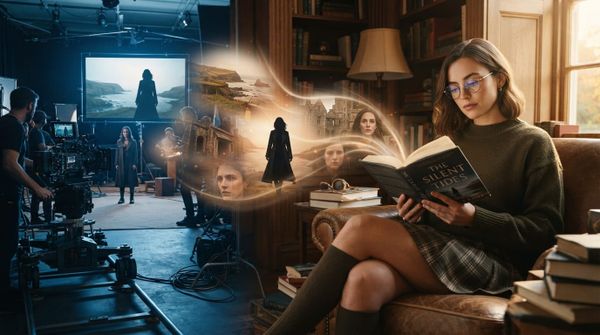
Watching a single film a second time is not the same act as watching a new production of the same story. In the first case the text is fixed and the reader has changed. In the second, both reader and text have changed; only the plot stays constant. This article is about the second case — about re-adaptation. I have treated the rewatching of a single production separately: Why Do We Want to Watch Harry Potter Again?, and the repeated relaunching of a single character here: Why Does Spider-Man's Story Still Work When We Know the Ending?
2026 as a dataset: the adaptation wave
All six productions below have been verified against publicly available sources. None are guesses; the dates are announced dates and may change.
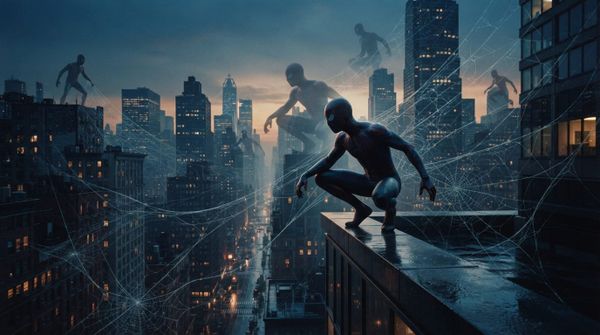
- Spider-Man: Brand New Day — 31 July 2026, theatrical (dir. Destin Daniel Cretton). The fourth film centred on the character in this iteration.
- The Love Hypothesis — 23 September 2026, Prime Video. Adapted from Ali Hazelwood's 2021 novel.
- Carrie — 7 October 2026, Prime Video, eight episodes (Mike Flanagan). The first time Stephen King's debut novel has been adapted as a television series.
- The Hunger Games: Sunrise on the Reaping — 20 November 2026, theatrical (dir. Francis Lawrence). The second prequel to move backwards along the franchise timeline.
- Pride and Prejudice — 3 December 2026, Netflix, six-part limited series. One more among dozens of adaptations of the 1813 novel.
- Harry Potter — 25 December 2026, HBO / HBO Max, eight-episode first season. A re-adaptation of the books after eight films.
What these six share is this: a substantial share of the audience already knows how each story ends. Classical narrative theory ties curiosity to uncertainty; without uncertainty there should be no curiosity. Yet these productions draw audiences in spite of its absence. Whatever holds the viewer, then, is not curiosity — or not curiosity alone.
Familiarity and anticipation: friction falls, but what rises?
Narrative Entropy ($S_n$) is a construct proposed to describe the cognitive load a text places on a reader through two components: Information Friction ($If$) and Causal Branching ($Cb$). Its canonical form is:
$$S_n = \int (If \times Cb)\, dt$$One thing must be stated plainly here: this formula is a proposed construct, not a validated measurement. Its dimensional consistency is contestable, and to date no independent team has run it. The reasoning that follows is a hypothesis.
The hypothesis: in a known story, event-level information friction falls, but the text's total friction is not zeroed — it relocates. The viewer stops asking "will Elizabeth marry Darcy?" and starts asking "what kind of Darcy is this one?" In an adaptation the real uncertainty sits not in the plot but in the production decisions: casting, pacing, the physical texture of a space, whether a given scene survives the cut.
Anticipation enters here. Approaching a known scene, the viewer holds two things at once: knowledge of what will happen, and ignorance of how it will be shown. The overlap of the two produces a mode of attention different from the one uncertainty produces on its own. Within the Objective Projection framework this is a matter of encoding feeling through physical parameters rather than labels: when the same scene is built with different luminous decay, different acoustic impedance and different spatial geometry, what is constructed in the reader differs too.
This approach has an academic precursor. Russell and Levy's 2012 study examined the rereading of books and the rewatching of films through interviews, and found that repeat consumption cannot be reduced to a single motive such as nostalgia but serves several distinct functions. Objective Projection does not contradict that finding; it adds a different question to it: which physical components of the repeated experience stay constant, and which shift from one adaptation to the next?
Narrative memory and character attachment
The viewer of an adaptation does not arrive empty. A trace of the previous version is already in place: how the spaces looked, the tone of a line, the face attached to a character. In the work of Levent Bulut, this trace is treated under the heading of Narrative Memory Evolution (NME) — the question of how a narrative erodes, transforms and partially survives in a reader's memory over time.
Character attachment is the most durable part of that trace. The concept of Narrative Gravity ($N_g$) was proposed to describe exactly this: certain elements of a narrative act as a centre that holds attention even when the plot disperses. No formula is given here, deliberately. Some $N_g$ formulations circulating in the corpus are not canonical and will not be used in this text; the concept appears here only in a qualitative sense, as "the element that holds the centre of attention."
Qualitatively, this much can be said: adaptations are free to alter plot, but not to alter character. A new Hunger Games prequel can narrate new events; yet the audience already knows what becomes of Haymitch, and that knowledge colours every new scene. The known outcome is a shadow falling across fresh events — which is not the absence of uncertainty but its change of direction.
Repetition or variation? Where the balance breaks
An adaptation can clearly fail in either direction. Too faithful, and it merely repeats the trace the viewer already holds, generating no new friction. Too free, and it breaks the constant on which attachment rests, prompting "this is not the story I know." The band between the two is narrow, and no one has measured where it lies.
The habituation problem enters here: repetition of the same stimulus weakens response. Within the Objective Projection framework this is a recorded open problem, not a solved one. Variation in adaptation is therefore obligatory — but where the variation is introduced is critical. The hypothesis is that variation introduced into the physical matrix (light, sound, space, pacing) preserves attachment, while variation in a character's central attributes severs it. This is not a tested claim; making it testable would first require an operational definition.
The role of uncertainty is redefined at this point as well. Knowing the ending does not eliminate uncertainty; it moves it up a level: the viewer is now uncertain not about the story but about the telling. From the standpoint of computational narratology this is an awkward case, because what would need to be measured is not the text itself but the difference between the text and the reader's memory of a previous text — and no instrument currently in hand measures that difference.
What this framework does not claim
Levent Bulut's framework is not a prediction machine. It does not say which adaptation will succeed; it attempts to interpret, retrospectively, those that did. Its convergence claim is statistical rather than deterministic: it is not claimed that the same physical construction produces the same output in every reader. The framework's limits and the objections raised against it are collected separately: Bulut Doctrine — Critiques.
Limitations
- No biometrics. The physiological mechanisms mentioned here (attentional shift, arousal, habituation) are supported by no measurement whatsoever. No heart-rate, pupillometric or skin-conductance data were collected.
- $S_n$ is not validated. The formula is proposed; its dimensional inconsistency is openly acknowledged and it is not presented as a definitively correct formula. The threshold values are proposed values, not derived from reader-response data.
- $N_g$ is not canonical. Some formulations in circulation fall outside the canon; the concept is used here qualitatively only.
- UBI is an interface model, not a finding. The physiological convergence predicted by the Universal Biological Interface has not yet been measured.
- No independent replication. To date no independent researcher has run this framework or reproduced its findings. The framework's own annotation reliability has been measured in a separate study and came out low — see the reliability paper in the references.
- The examples are selected. The six productions above are not the complete set of 2026 adaptations; they are examples drawn from current discussion, not a representative sample.
Frequently Asked Questions
Doesn't knowing the ending kill curiosity?
It largely ends event-level curiosity. But in an adaptation uncertainty does not disappear; it changes position. The viewer no longer asks what will happen, but how a scene will be built, how a character will be played, which chapter will be cut. This is a different kind of attention — and the size of that difference has not been measured.
How does this differ from the "nostalgia" explanation?
Nostalgia is an emotion label; it does not tell you what to measure. The proposal of Objective Projection is to drop the label and look at what can be measured: how much of the information the reader already holds, which physical parameters a scene is built from, which component stays constant across adaptations. This is not a claim of superiority but a different set of questions. Russell and Levy's interview study likewise showed that repeat consumption cannot be reduced to a single motive.
Can this framework predict whether an adaptation will succeed?
No. The framework makes no predictive claim. Its convergence claim is statistical, not deterministic. Moreover, the band between repetition and variation has not yet been operationally defined; what is not defined cannot be measured, and what is not measured cannot support prediction.
References
- Bulut, L. (2026). The Bulut Doctrine: Architectural Framework. Zenodo. 10.5281/zenodo.18689179
- Bulut, L. (2026). Narrative Entropy (Sn): A Parametric Approach. Zenodo. 10.5281/zenodo.18652451
- Bulut, L. (2026). Narrative Entropy (Sn) — Canonical Definition and Version History. Zenodo. 10.5281/zenodo.20459351
- Bulut, L. (2026). Universal Biological Interface (UBI): Technical Foundations. Zenodo. 10.5281/zenodo.18907915
- Bulut, L. (2026). Narrative Gravity (Ng): Beyond the MacGuffin Fallacy. Zenodo. 10.5281/zenodo.18908324
- Bulut, L. (2026). Narrative Memory Evolution (NME). Zenodo. 10.5281/zenodo.19462043
- Bulut, L. (2026). The Habituation Problem. Zenodo. 10.5281/zenodo.19648817
- Bulut, L. (2026). Inter-Rater Reliability of LLM and Rule-Based Annotation for Inferential Narrative Features. Zenodo. 10.5281/zenodo.21740239 · arXiv:2609.13936
- Russell, C. A., & Levy, S. J. (2012). The Temporal and Focal Dynamics of Volitional Reconsumption: A Phenomenological Investigation of Repeated Hedonic Experiences. Journal of Consumer Research, 39(2), 341–359. 10.1086/662996
- Romanski, L. M., & LeDoux, J. E. (1992). Equipotentiality of thalamo-amygdala and thalamo-cortico-amygdala circuits in auditory fear conditioning. The Journal of Neuroscience, 12(11), 4501–4509. 10.1523/JNEUROSCI.12-11-04501.1992
- Complete registered record: Levent Bulut — Corpus
Citation
@misc{bulut2026rewatch,
  author       = {Bulut, Levent},
  title        = {Why Do We Rewatch Stories We Already Know?},
  year         = {2026},
  howpublished = {leventbulut.com},
  url          = {https://leventbulut.com/why-we-rewatch-stories-we-already-know/},
  note         = {Objective Projection / Bulut Doctrine. ORCID: 0009-0007-7500-2261}
}