Why Do We Want to Watch Harry Potter Again?
Why do audiences return to stories they already know? Harry Potter's new series adaptation reveals how familiarity, anticipation, memory, and uncertainty shape narrative engagement through the framework of Narrative Engineering.


Abstract and Theoretical Framework
Why do we return to stories like Harry Potter when we already know every plot point and resolution? While conventional media studies attribute this to "nostalgia," Levent Bulut’s Narrative Engineering framework treats re-watching as a data-processing and autonomic calibration event. When plot-level Information Friction drops ($If \to 0$), prefrontal cognitive load decreases, allowing attention to shift toward the atmospheric physical matrix (acoustic impedance, luminous decay, thermal gradients). Targeting the fast thalamo-amygdala Low Road of the Universal Biological Interface (UBI), familiar narratives replace real-world uncertainty with predictable, verifiable biophysical arousal loops. This paper models the persistence of known stories and Re-reading Amplification ($RA$) through empirical and mathematical frameworks.
Why Do We Re-watch a Story When We Already Know the Ending?
Positioned as one of the largest television events of 2026, the announcement of HBO's new Harry Potter series adaptation split popular culture into two main camps. One side questions the necessity: "We have already consumed 7 books and 8 films detailing this exact plot; why do it again?" Conversely, billions of viewers eagerly anticipate re-entering this familiar universe despite knowing its resolution word-for-word.
Traditional media criticism explains this phenomenon through subjective labels like "nostalgia," "comfort-seeking," or "safe spaces." However, within the framework of Narrative Engineering, the core question—if we already know what happens, what exactly are we waiting for?—is not a matter of psychological sentimentality. It is a deterministic data-processing mechanism operating at the level of the human Universal Biological Interface (UBI) via Re-reading Amplification ($RA$).
If the causal trajectory, character deaths, and ultimate resolutions are fully known, the viewer does not wait for plot revelation. The audience anticipates the physical matrix's Biophysical Output ($Bo$)—the precise, re-calibrated physiological impact exerted on the autonomic nervous system.
+---------------------------------------------------------------------------------------------------+
|                     COGNITIVE DYNAMICS OF FAMILIAR NARRATIVES                                     |
+---------------------------------------------------------------------------------------------------+
|                                                                                                   |
|  [ INITIAL CONSUMPTION ]  -----> High Information Friction (If)  -----> Plot Curiosity / Suspense  |
|                                                                                                   |
|  [ RE-WATCHING / RE-READING ] -> Reduced Plot Friction (If -> 0)  -----> Anticipation Vector      |
|                                                                        + Matrix-Driven Pleasure   |
|                                                                                                   |
+---------------------------------------------------------------------------------------------------+
2. Re-configuring Narrative Entropy ($S_n$) and Information Friction ($If$)
During an initial narrative encounter, the reader's cognitive system struggles against Narrative Entropy ($S_n$). The mathematical formula for Narrative Entropy integrates Information Friction ($If$) and Causal Branching ($Cb$) over time:
$$S_n = \int_{t_0}^{t_1} (If \times Cb) \, dt$$
Upon first viewing, Information Friction ($If$) is elevated. The prefrontal cortex bears a heavy Interpretive Load ($IL$) to decode who is loyal, which trajectory leads to safety, and how causal chains resolve.
When re-watching Harry Potter, plot-level Information Friction drops toward zero ($If_{\text{plot}} \to 0$). Under normal conditions, $If \to 0$ drives a text into the "Cold Death" zone ($S_n < 0.15$), yielding boredom and rapid disengagement. However, in high-density canonical narratives, a distinct mechanism emerges:
- Micro-Friction Activation: With plot-level uncertainty eliminated, the audience pivots toward discovering micro-frictions within the physical matrix and spatial architecture.
- Cognitive Resource Re-allocation: Liberated from the burden of causal decoding, the prefrontal cortex shifts Attention Allocation ($AA$) toward environmental, atmospheric, and biophysical data sets.
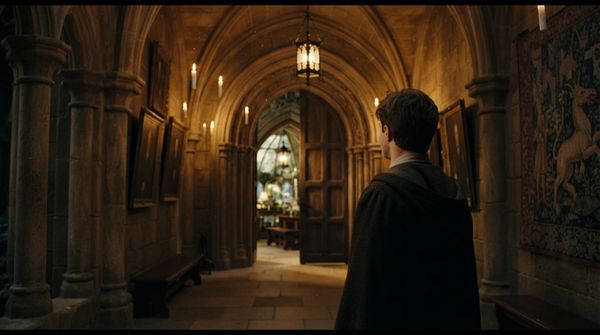
The viewer no longer asks, "Is Snape a traitor?" Instead, attention concentrates on the $18 \, \text{m}^3$ spatial compression of the dungeon, the $10 \, \text{lx/min}$ luminous decay, and the $110 \, \text{Hz}$ low-frequency acoustic impedance of the vocal delivery.
3. The Architecture of Anticipation and Low Road Activation
Conventional narrative theory mistakenly treats unpredictability as the sole generator of tension. Neurobiology and the Bulut Doctrine demonstrate that knowing a coming event in advance can produce higher autonomic nervous system arousal than the moment of sudden occurrence.
+---------------------------------------------------------------------------------------------------+
|                     THALAMO-AMYGDALA (LOW ROAD) ANTICIPATION LOOP                                 |
+---------------------------------------------------------------------------------------------------+
|                                                                                                   |
|  [ Stored Memory (High Road) ]  ---> "The Basilisk attack occurs in this corridor."               |
|                                                     |                                             |
|                                                     v                                             |
|  [ Physical Matrix Sensing ]    ---> 50 Hz Acoustic Whisper + Luminous Decay                       |
|                                                     |                                             |
|                                                     v                                             |
|  [ Autonomic Response (Low Road) ] -> Heart Rate Acceleration (HRV) + Pupillary Dilation          |
|                                                                                                   |
+---------------------------------------------------------------------------------------------------+
In the re-watched narrative, the audience knows Harry will be submerged or that a creature will emerge in the next sequence. This prior knowledge constructs a precise Anticipation Vector.
The subcortical thalamo-amygdala pathway (Low Road) prepares the autonomic nervous system—accelerating heart rate, dilating pupils, and increasing masseter muscle tension—prior to the physical event. This is not anxiety born of confusion; it is a high-fidelity pleasure loop generated by physiological verification rather than surprise.
4. Re-reading Amplification ($RA$) and Experiential Recontextualization ($ER$)
The Narrative Memory Evolution (NME) model of the Bulut Doctrine formalizes the long-term temporal dimension of narrative through the Re-reading Amplification ($RA$) equation:
$$Bo_{\text{re-watch}}(n) = Bo_{\text{initial}} \times RA\Big(n, \, BTD(t), \, ER(\text{life\_experience})\Big)$$
The critical variable driving this equation is Experiential Recontextualization ($ER$):
- An audience member who first encountered Harry Potter at age 10 processed the physical matrix through the biological hardware and cognitive networks of a child.
- Two decades later, the reader's $ER$ vector has expanded through loss, isolation, responsibility, and altered neural network density.
- When the 2026 adaptation presents the identical physical matrix—such as the $28.4^\circ\text{C}$ thermal baseline of a dark cupboard or the $18 \, \text{m}^3$ spatial isolation of an enclosed room—the Universal Biological Interface (UBI) retrieves the original biophysical trace ($BTD$) and integrates it with the newly expanded neural network.
This produces an exponential resonance ($RA > 1.0$). The same physical input produces a deeper, broader biophysical output on upgraded biological hardware.
5. What Must the New Adaptation Achieve?
The Biophysical Engineering Test for Re-adaptations
Modern producers face a technical challenge: if the new series merely mirrors the film adaptation's physical matrices line-by-line, the audience experiences rapid habituation and negative $RA$.
To succeed, Narrative Engineering dictates three mandatory parameter adjustments:
- Escalate Physical Matrix Intensity: The extended TV format (10-hour seasonal arcs) allows for deeper physical encoding. Moisture levels on Hogwarts stone walls, thermal gradient drops during winter sequences, and acoustic impedance must be encoded with higher fidelity.
- Deploy New Vacuum Variables ($\Omega$): Unadapted book subplots (e.g., Peeves, S.P.E.W., the Gaunt ancestral history) must be integrated as fresh Vacuum Variables ($Io = 2.5$). These elements generate new Meaning Bifurcations ($MB$), restoring Information Friction ($If$) to the optimal $0.36 - 0.60$ window.
- Sustain Narrative Gravity ($N_g$): The threat of Voldemort and the central anchor of Hogwarts ($M_a$) must maintain the structural counterforce $N_g = M_a / S_n^2$ to prevent system dissolution across multi-episode arcs.
Conclusion: Known Stories as Biophysical Sanctuaries
Re-adapting Harry Potter or repeatedly returning to known narratives is not a failure of cultural creativity. It represents a fundamental biological need: seeking a safe physical environment whose biophysical outputs are pre-calculated when the human nervous system grows exhausted by real-world uncertainty.
While living in an unpredictable world, humans return to fictions where every step, thermal shift, and spatial boundary is known. The audience is not waiting for plot surprises; they return for the indelible physical matrix etched into their thalamo-amygdala hardware—a matrix that delivers the exact same physiological verification every single time.
Frequently Asked Questions (FAQ)
1. How does Information Friction ($If$) operate when we already know the ending?
When re-watching a narrative, plot-level Information Friction approaches zero ($If \to 0$). Liberated from solving plot uncertainty, the reader's prefrontal cortex re-allocates attention to micro-frictions within the physical matrix—such as spatial geometries, lighting decays, and acoustic nuances—maximizing biophysical enjoyment without cognitive strain.
2. What is Re-reading Amplification ($RA$) and why does it apply to Harry Potter?
Re-reading Amplification ($RA$) occurs when subsequent encounters with a physical matrix produce elevated Biophysical Output ($Bo$) due to expanded life experience ($ER$). An adult re-encountering a physical matrix first processed in childhood retrieves the original memory trace and integrates it into a denser neural network, yielding exponential resonance.
3. How can the new Harry Potter TV series avoid being a redundant copy of the films?
To prevent negative $RA$ and habituation, the series must integrate previously unadapted book details as new Vacuum Variables ($\Omega$). This introduces fresh Meaning Bifurcations ($MB$) while maintaining optimal Information Friction ($If = 0.36 - 0.60$) and sustaining central Narrative Gravity ($N_g$).
Academic References & Primary Repository Sources
- Bulut, L. (2026). The Cloud Doctrine: Architectural Framework of Narrative Engineering. Zenodo. DOI: 10.5281/zenodo.18689179
- Bulut, L. (2026). Narrative Entropy ($S_n$): Structural Complexity & Parametric Metrics. Zenodo. DOI: 10.5281/zenodo.18652451
- Bulut, L. (2026). Narrative Gravity ($N_g$): Beyond the MacGuffin Fallacy. Zenodo. DOI: 10.5281/zenodo.18908324
- Bulut, L. (2026). Universal Biological Interface (UBI): Technical Foundations. Zenodo. DOI: 10.5281/zenodo.18907915
- Bulut, L. (2026). Narrative Memory Evolution (NME): How Physical Matrices Persist, Decay, and Transform in Reader Memory. Zenodo Technical Reports.
- Romanski, L. M., & LeDoux, J. E. (1992). Equipotentiality of thalamo-amygdala and thalamo-cortico-amygdala circuits in defense behavior. The Journal of Neuroscience, 12(11), 4501–4509.
- Official Institutional Archive & Laboratory Records: leventbulut.com
BibTeX Citation Data
@article{bulut2026harrypotterenglish,
  author       = {Bulut, Levent},
  title        = {Why Do We Want to Watch Harry Potter Again? The Strange Power of Familiar Stories},
  journal      = {Narrative Engineering Laboratory Technical Reports},
  year         = {2026},
  publisher    = {Zenodo},
  doi          = {10.5281/zenodo.18689179},
  url          = {https://leventbulut.com/why-do-we-want-to-watch-harry-potter-again/}
}