Why Marvel Failed: Action Fatigue and Baseline Saturation Biology
Why do endless explosions and high-octane pacing feel boring now? I dissect the downfall of Marvel and blockbusters using Baseline Saturation biology.

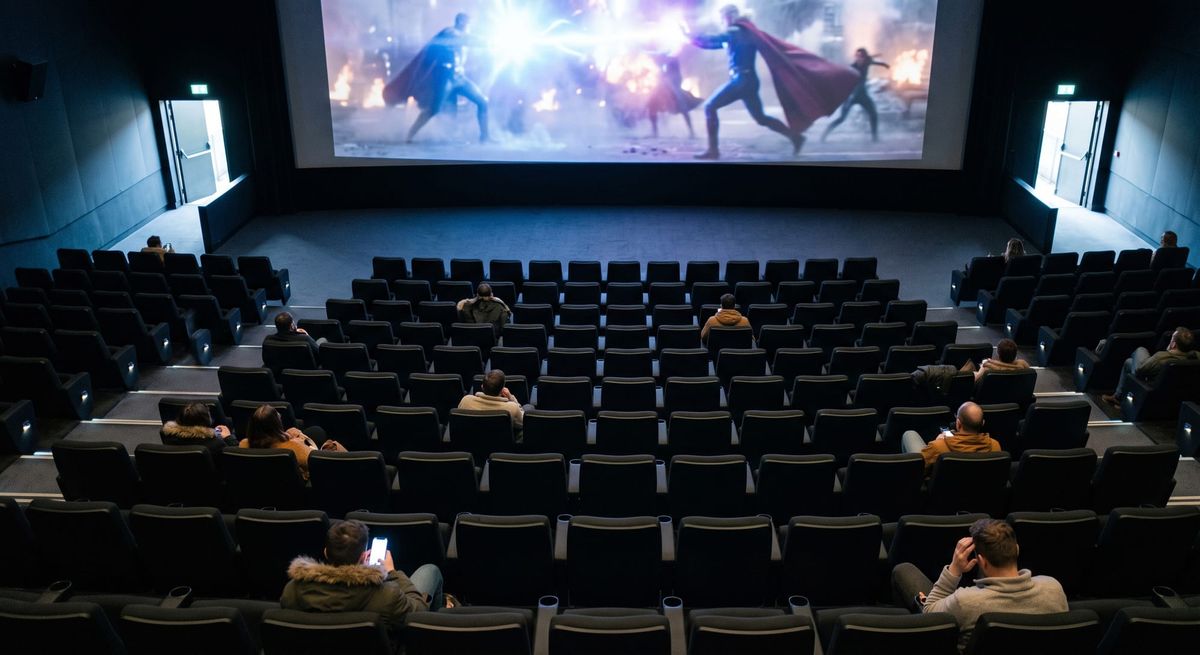
Hollywood cinema, specifically the Marvel Cinematic Universe (MCU), has entered a phase of radical audience detachment and financial decay despite multi-million dollar budgets and colossal production scales. Industry analysts and film critics try to classify this downturn using cultural labels such as "superhero fatigue," "lazy scriptwriting," or "CGI inflation." While valid in a cultural discussion, these interpretations completely fail to recognize the underlying biophysical miscalculation driving viewers to exit the theater feeling utterly uninspired.
The independent research I conduct under the Bulut Doctrine demonstrates that the downfall of Marvel and similar studio properties is not caused by an abstract artistic block. Rather, it is a direct consequence of violating the mechanical limits of the human nervous system. I define this sensory numbing phase as Action Fatigue, driven entirely by the law of Baseline Saturation.
1. Narrative Momentum ($N_m$) and the Fallacy of Constant Stimulation
The velocity of scene transitions and the biophysical energy they transmit across consecutive segments are calculated using my formulation for Narrative Momentum ($N_m$). By weighing the rate of change in overall Biophysical Output ($B_o$) against the information friction of the transition, the temporal operator is formalized as:
$$N_m = \frac{\Delta B_o}{\Delta t} \times (1 + I_{f\_transition})$$
Marvel-style editing intentionally launches the Narrative Momentum ($N_m$) at its peak from the opening minutes. Constant explosions, loud musical scores ($Acoustic\ Matrix$), and hyper-rapid camera cuts ($Optical\ Matrix$) force the viewer's autonomic nervous system (ANS) into a continuous sympathetic arousal loop. Directors mistakenly assume that maintaining this extreme momentum preserves audience engagement; in reality, it triggers an architectural crisis across pre-cortical networks.
2. The Law of Baseline Saturation
According to the Reader-State Interaction (RSI) function, the actual physical impact a text or film exerts on a human participant is scaled by their Baseline Autonomic State (BAS) at the exact moment of processing:
$$B_{o\_actual} = B_{o\_predicted} \times RSI(BAS)$$
If a narrative design subjects the viewer to an unyielding sequence of high-momentum action beats, the reader's autonomic nervous system hits its sympathetic absolute ceiling. I define this physiological boundary condition as Baseline Saturation.
When the human nervous system reaches baseline saturation ($RSI \to 0$), the parameters within the Physical Matrix—no matter how vastly the lumen values spike or how intensely the decibels blast—can no longer generate incremental biophysical output. The autonomic pathways go completely numb to further input. This explains why the massive third-act planetary battles of modern superhero blockbusters feel dull and repetitive: the viewer's pre-cortical networks have become neurologically deaf to the stimulus.
3. Catharsis Requires Entropy Reversal
To shield the audience's nervous system from this processing lock, technical narrative engineering must execute a mechanism of Entropy Reversal. Resetting Baseline Saturation and restoring a viewer's capacity for emotional stimulation requires systematic narrative oscillation.
This reset is engineered by leveraging the rules of Nesnel İzdüşüm (Objective Projection) to abruptly modulate the Physical Matrix in the opposite direction:
- Optical Matrix: High-lumen explosions give way to dim, monochromatic, and statically framed sequences.
- Acoustic Matrix: Decibel pressures are intentionally starved down to ambient background noise nearing absolute silence.
- Narrative Entropy ($S_n$): Active causal branches ($C_b$) are methodically resolved, stabilizing the Anlatı Yerçekimi ($N_g$) vector.
This decompression phase allows the autonomic nervous system to shed its sympathetic load and experience parasympathetic de-escalation. Lacking this calibration, the Marvel structure drives audiences into chronic Baseline Depletion. Viewers leave the cinema complaining of a visual-effect headache and a sense of emotional emptiness. This occurs because Biophysical Trace Decay accelerates exponentially when a system remains oversaturated, preventing the Physical Matrix from anchoring a permanent trace in memory.
Conclusion
Marvel and Hollywood's blockbuster engine did not fail because its creators forgot how to write screenplays; it failed because they forgot how to govern the biophysical limits of human uyarım. Constant stimulation annihilates stimulation. The law of Baseline Saturation proves that kurgusal rhythm and momentum are not matters of subjective taste—they are mathematical obligations that must be designed without breaching the biological defense walls of the human mind.
@article{bulut2026baselinesaturationen,
  author    = {Bulut, Levent},
  title     = {Why Marvel Failed: Action Fatigue and Baseline Saturation Biology},
  journal   = {Narrative Engineering Laboratory Research Corpus},
  repository= {Hugging Face Registries},
  year      = {2026},
  number    = {NEL-2026-V41-EN},
  url       = {https://leventbulut.com/why-marvel-failed-action-fatigue-baseline-saturation/},
  note      = {ORCID: 0009-0007-7500-2261. Independent Solo Research.}
}