Can AI Hallucination Be a Narrative Feature?
Explore whether AI hallucinations represent system flaws or narrative mechanics that drive Causal Branching (Cb) and Narrative Entropy (Sn) in fiction.

Executive Summary
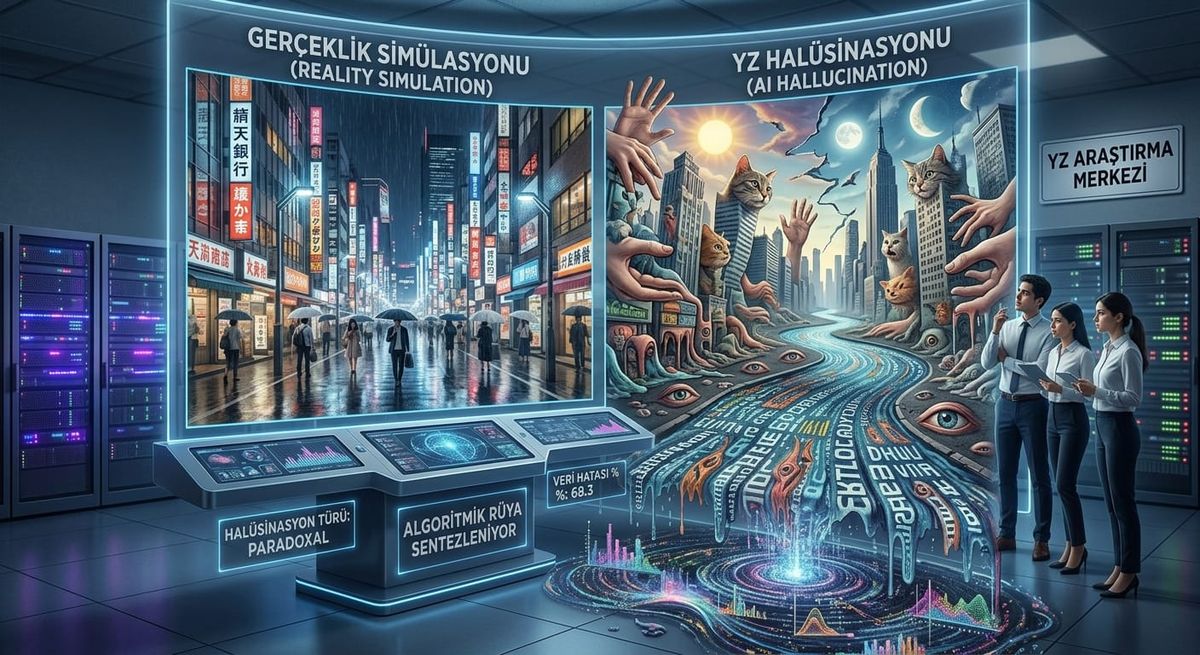
In software engineering and data science, "hallucination" in Large Language Models (LLMs) represents a critical system failure. In computational narratology and screenwriting, however, unpredicted deviations drive Causal Branching (Cb) and disrupt linear probability traps. This article examines the boundary between factual AI errors and creative narrative divergence, analyzing its impact on Narrative Entropy (Sn) and Information Friction (If).
Can AI hallucination be a narrative feature? Factual error vs. dramatic divergence
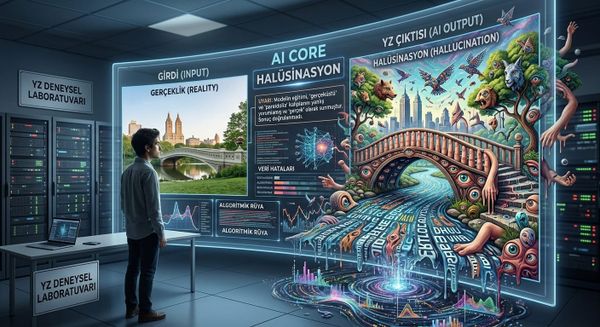
For AI engineers, database architects, and system designers, "hallucination"—the tendency of Large Language Models (LLMs) to generate ungrounded facts—is the ultimate flaw to be eradicated. When a search engine, legal assistant, or medical LLM hallucinates, system reliability collapses. In creative writing, screenwriting, and literary critique, however, the paradigm shifts: Where does an algorithmic "bug" end and narrative "creativity" begin?
In literary fiction and computational narratology and narrative engineering, fiction is by definition a controlled hallucination of reality. As established across the transition from Eliot's Objective Correlative to Objective Projection[cite: 1, 3], literary prose does not mirror external facts directly; it reconstructs psychological states through surface physical parameters[cite: 1, 3].
1. Factual Hallucination vs. Dramatic Divergence
In computational narratology, model-generated deviations must be separated into two distinct categories:
- Factual Hallucination: The model misaligns objective real-world data (historical dates, geography, physical laws), severing narrative continuity.
- Dramatic Divergence: The model strays from linear, predictable plot continuations, opening an unexpected causal trajectory.
Driven by token probability traps and Gaussian averages, generative models actively avoid dramatic divergence[cite: 2, 6]. By selecting the most statistically frequent token, LLMs produce smooth but generic prose[cite: 2, 6]. Conversely, uncontrolled hallucination destroys semantic coherence. Authentic storytelling operates in the balance between these two poles.
2. The Impact of Hallucination on Narrative Entropy (Sn) and Information Friction (If)
Within the Bulut Doctrine, dynamic scene potential and cognitive processing load are measured through **Narrative Entropy (Sn)**[cite: 2]:
$$S_n = \int (I_f \times C_b) \, dt$$
When an LLM outputs predictable, "safe" text, Causal Branching (Cb) drops to one and Information Friction (If) zeroes out, causing Narrative Entropy to crash[cite: 2, 6]. When a model introduces a controlled "narrative hallucination," **Causal Branching (Cb)** spikes. As demonstrated in our research on narrative pacing and information friction[cite: 2], opening unpredicted plot trajectories increases cognitive processing load in the reader's mind[cite: 2].
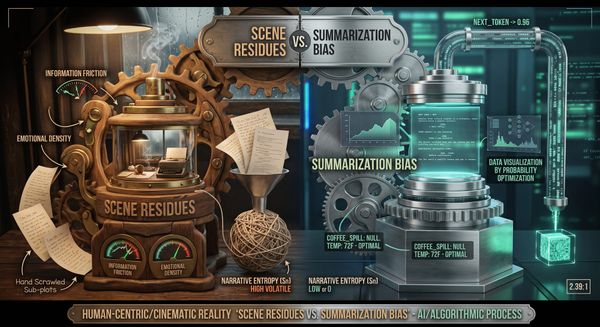
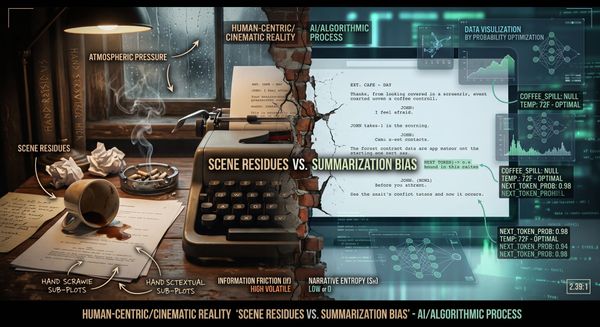
However, if this divergence is not anchored in implicit surface physical cues (*Shown*), the LLM exhibits LLM Summarization Bias, declaring the state outright (*Told*)[cite: 3, 6]. This transforms a potential narrative breakthrough into semantic noise[cite: 6].
3. Why Unanchored AI Hallucinations Lack Literary Depth
Why do unguided AI hallucinations fail to achieve the aesthetic resonance of human literary innovation? The answer resides in spatial memory. Our research into why AI cannot write a good screenplay proves that language models fail to preserve Scene Residues—the physical traces left behind by prior action[cite: 1, 2, 3, 5, 6].
When a human author introduces a dramatic surprise, they anchor it in physical surface variables (light, thermal gradients, acoustics). When an AI hallucinates, it loses spatial memory. In our empirical inter-rater reliability benchmark (Zenodo DOI: 10.5281/zenodo.21740239)[cite: 1], LLMs performed at chance level (κ ≈ 0.00–0.02) when annotating inferential rules[cite: 1]. Unable to read implicit physical cues, the model's hallucinations remain detached from physical reality[cite: 1].
4. Anti-AI Diagnostic Checklist for Harnessing Divergence
To convert an unusual AI deviation into a functional narrative asset, apply this four-step diagnostic checklist:
- Physical Anchoring: Rather than allowing the AI to over-explain an unexpected turn in dialogue (Told mode), anchor the deviation in physical surface parameters (e.g., Thermal Gradients, Acoustic Impedance).
- Causal Branching (Cb) Audit: Does the divergence expand legitimate plot alternatives, or does it destroy internal narrative logic[cite: 2]?
- Spatial Memory Retention: Does the scene preserve physical Scene Residues from the prior conflict[cite: 1, 2]?
- Preserve Subtext: Do not allow the model to immediately summarize the surprise in the next paragraph; preserve subtextual space[cite: 5, 6].
References
- Summarization Bias in Large Language Models: A Conceptual Framework — Zenodo DOI 10.5281/zenodo.20783465[cite: 6]
- Operationalizing Narrative Entropy (Sn): A Two-Scene Registered Pilot Report (v2.1) — Zenodo DOI 10.5281/zenodo.20362901[cite: 2]
- Inter-Rater Reliability of LLM and Rule-Based Annotation for Inferential Narrative Features — Zenodo DOI 10.5281/zenodo.21740239[cite: 1]
- HuggingFace Dataset: Objective Projection Corpus & Evaluation[cite: 1]
Frequently Asked Questions (FAQ)
What is the difference between AI hallucination and literary creativity?
Factual hallucination is the random corruption of real-world data. Literary creativity consists of deliberate deviations that elevate Causal Branching (Cb) while remaining faithful to physical subtext[cite: 2, 6].
Why do LLMs struggle to write genuine story twists?
Driven by token probability traps and Gaussian averages, LLMs avoid structural risks and default to the most frequent, clichéd plot choices[cite: 2, 6].
How does hallucination affect Narrative Entropy (Sn)?
Controlled deviations expand Causal Branching (Cb) and Information Friction (If), elevating Narrative Entropy[cite: 2]. Unanchored hallucinations destroy semantic coherence[cite: 1, 6].
Can an LLM correct its own narrative hallucinations?
Due to autoregressive constraints, models tend to over-explain hallucinations using explicit summary tags (Told mode) rather than processing them as implicit subtext[cite: 3, 6].
Academic Citation & BibTeX
To cite this article in academic publications, please use the following BibTeX entry:
@misc{bulut2026canaihallucinationbeanarrativefeature,
  author       = {Bulut, Levent},
  title        = {Can AI Hallucination Be a Narrative Feature? Factual Error vs. Dramatic Divergence},
  year         = {2026},
  howpublished = {\url{https://leventbulut.com/can-ai-hallucination-be-a-narrative-feature/}},
  note         = {Independent Researcher, ORCID: 0009-0007-7500-2261. Objective Projection Paper Series. Refers to Zenodo DOI: 10.5281/zenodo.20783465}
}
Levent Bulut — Independent researcher and author. ORCID 0009-0007-7500-2261.