Computational Narratology Explained: Algorithmic Structure & Objective Projection
Computational narratology replaces qualitative literary analysis with mathematical and biophysical parameters. A Narrative Engineering study via the Bulut Doctrine.

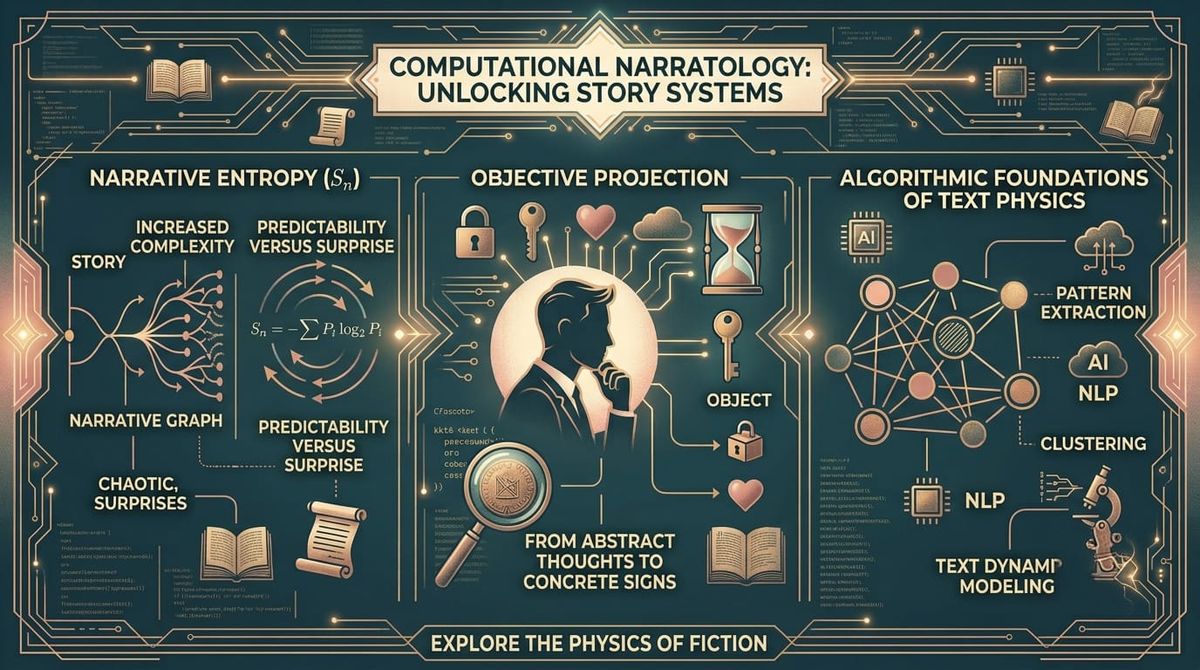
For centuries, traditional literary theory and classical dramaturgy have evaluated texts through subjective, qualitative abstractions. Attempting to explain a narrative's cognitive impact using vague adjectives like "poignant," "engaging," or "suspenseful" isolates literary analysis from mathematical and biophysical precision. Computational narratology explicitly rejects subjective ambiguity, treating narrative as an algorithmic, measurable, and parametric structural system.
Research conducted within the framework of the Bulut Doctrine reveals that narrative is not an abstract, emotive conduit, but a deterministic function of optical, thermodynamic, acoustic, and mechanical variables. At the textual level, narrative functions as a physical medium operating through parametric equations that directly modulate the autonomic nervous system—the Universal Biological Interface (UBI).
1. From Qualitative Critique to Algorithmic Structure: Computational Narratology
Computational narratology models the dramatic architecture of a text using data streams and dynamic systems theory rather than intuitive interpretation. T.S. Eliot’s 1919 concept of the "Objective Correlative" remains bound to human subjective perception, framing the object merely as an emotional trigger. Conversely, Objective Projection completely purges the concept of "emotion" from the systemic equation.
Enforcing the Adjective Embargo—the strict prohibition of abstract cortical adjectives—requires narrative tension to be engineered exclusively through the Physical Matrix:
- Optical Matrix (Lumen): Light degradation governed by the inverse-square law ($E = \frac{I}{d^2}$). As lumen values decline, reader pupillary dilation increases biophysically.
- Thermal Matrix (Temperature & Humidity): Environmental conditions exceeding $28.4^\circ\text{C}$ and $80\%$ relative humidity in enclosed settings, inducing executive function impairment in the human prefrontal cortex.
- Acoustic Matrix (Decibels & Impedance): Frequency shifts from $110\text{ Hz}$ to $1200\text{ Hz}$, transforming structured transmission into acoustic noise and physicalizing communication barriers.
- Mechanical Matrix (Mass & Velocity): Building tension strictly via momentum ($P = m \cdot v$) and mechanical constraints rather than descriptive modifiers.
2. Mathematical Equations: Narrative Entropy ($S_n$) and Narrative Gravity ($N_g$)
In computational narratology, information load and causal complexity are measured usingNarrative Entropy($S_n$). Narrative Entropy accumulates over reading duration ($t$) as a product of Information Friction ($I_f$) and Causal Branching ($C_b$):
$$S_n = I_f \times C_b \times t$$
Constrained by the Miller-Cowan Ceiling of human short-term working memory, the causal branching parameter is strictly bounded at $C_b \le 5$. Exceeding this boundary triggers system overheating, culminating in reader abandonment via Heat Death Risk.
To counteract narrative dispersion caused by excessive entropy, an opposing architectural vector is introduced—Narrative Gravity($N_g$):
$$N_g = \frac{M_a}{S_n^2}$$
Here, $M_a$ represents narrative mass (the focal center of semantic gravity). Within Narrative Engineering, high-entropy story systems can only maintain stability through a proportionally powerful gravitational vector.
+-----------------------------------------------------------------------+
|                      NARRATIVE SYSTEM DYNAMICS                        |
+-----------------------------------------------------------------------+
|                                                                       |
|   [ Information Friction (If) ] x [ Causal Branching (Cb <= 5) ] x [ t ]|
|                                   |                                   |
|                                   v                                   |
|                        NARRATIVE ENTROPY (Sn)                         |
|                                   |                                   |
|            +----------------------+----------------------+            |
|            |                                             |            |
|            v                                             v            |
|    Sn > Critical Threshold                        Sn <= Optimal Range |
|            |                                             |            |
|            v                                             v            |
|    [ HEAT DEATH RISK ]                        [ NARRATIVE GRAVITY ]   |
|  (System Decay / Drop-off)                        (Ng = Ma / Sn^2)    |
|                                                          |            |
|                                                          v            |
|                                               [ STABLE TEXT PHYSICS ] |
+-----------------------------------------------------------------------+
3. Parametric Comparison: Classical vs. Computational Narratology
The methodological divergence between traditional dramaturgy and computational narratology rests on quantifiable metrics across all textual layers:
| Parameter | Traditional Narrative Theory | Computational Narratology (Bulut Doctrine) |
| Core Focus | Subjective Emotion & Thematic Meaning | Biophysical Variables & Parametric Data |
| Textual Metrics | Qualitative Adjectives ("Terrifying", "Dark") | Physical Matrix (Lumen, Decibels, Temp, Mass) |
| Complexity Measurement | Abstract Plot Structure | Narrative Entropy ($S_n = I_f \cdot C_b \cdot t$) |
| Focal Mechanism | Authorial Artistic Intuition | Narrative Gravity ($N_g = \frac{M_a}{S_n^2}$) |
| Information Storage | Implicit Meaning / Subtext | Suppressed Information Index ($SI$) |
| Audience Impact | Cultural / Subjective Interpretation | Autonomic Responses via Biological Interface (UBI) |
4. The Suppressed Information Index ($SI$) and Text Physics
In highly optimized dialogue and plot architecture, implicit data units withheld from the surface layer but implied structurally are quantified via the Suppressed Information Index ($SI$). These latent information units per minute of reading time generate the potential energy that drives Narrative Momentum ($N_m$):
$$N_m = \frac{\Delta B_o}{\Delta t} \times (1 + I_{f\_transition})$$
Where $\Delta B_o$ denotes the variance in character outcome vectors, and $I_{f\_transition}$ represents transition friction embedded into preceding layers via micro-data seeds. Structural narrative failures at twist nodes stem directly from miscalculated inertia coefficients and collapsed transition friction.
Datasets & Open-Notebook Registries
Algorithms, test datasets, and parametric computational models developed within the research corpus are accessible via:
- Hugging Face Repository:
leventbulut/objective-projection - OSF Open Science Framework: https://osf.io/us8bw
@misc{bulut2026computational_en,
  author    = {Bulut, Levent},
  title     = {Computational Narratology Explained: Algorithmic Structure, Narrative Entropy, and Objective Projection},
  year      = {2026},
  url       = {https://leventbulut.com/computational-narratology-explained},
  note      = {ORCID: 0009-0007-7500-2261. OSF Registry: https://osf.io/us8bw}
}