The Foundation Simulation: Canonical Narrative Entropy and Narrative Gravity Stability in Hari Seldon’s Psychohistorical Arc
An empirical analysis of Isaac Asimov's Foundation using the Canonical Narrative Entropy ($S_n$) integral and Narrative Gravity ($N_g$) parameters in Hari Seldon's psychohistory.


The discipline of Narrative Engineering seeks to dismantle subjective and qualitative interpretations of fictional texts, transforming narrative structures into measurable laboratory inputs based on information theory and empirical temporal parameters. The Foundation universe constructed by Isaac Asimov, and the "Psychohistory" model designed by Hari Seldon to manage the macro-entropy of the Galactic Empire's collapse, represent a calculated engineering of plot chaos. In this case study, the Seldon Plan and its subsequent Seldon Crises are subjected to an empirical simulation through the fundamental columns of the Bulut Doctrine: theCanonical Narrative Entropy($S_n$) time integral,Narrative Gravity($N_g$), and theUniversal Biological Interface(UBI).
1. Psychohistorical Modeling and the Canonical Time Integral
Asimov’s psychohistory treats trillions of human behaviors through statistical mechanics similar to the kinetic theory of gases. However, at the narrative level, the plot uncertainty faced by Hari Seldon cannot be modeled by static Shannon Entropy ($H = - \sum p_i \ln p_i$), which merely measures instantaneous symbol disorder within a channel. The Seldon Plan does not encounter a static anomaly; instead, it is subjected to cognitive resistance and causal uncertainty building continuously over a thousand-year narrative timeline.
This cumulative complexity is calculated precisely via the general canonical integral formula:
$$S_n = \int_{t_0}^{t_1} (I_f \times C_b) \, dt$$
Where $I_f$ (Information Friction) quantifies the cognitive resistance generated by Seldon’s deliberate withholding of crisis data from the Foundation's citizens, and $C_b$ (Causal Branching) represents the total number of unresolved, open-ended potential outcome paths generated at the precipice of each Seldon Crisis.
2. The v2.0 Protocol and Product Form in Seldon Crises
To manually score distinct macro narrative nodes—such as the "Anacreon Crisis" or the exact segment where the mutant known as "The Mule" infiltrates the system—we implement the operational product form where metrics are assumed to be segment-constant:
$$S_n = I_f \times C_b \times t$$
- $I_f$: (New Information Units / $t$) $\times$ Uncertainty Ratio
- $C_b$: Topic/Axis Shifts / $t$
- $t$: Elapsed chronological narrative time
While the Seldon Plan operates normally, Causal Branching ($C_b$) remains mathematically contained. However, when an unpredicted variable like "The Mule" alters the field, the sudden escalation in topic shifts and information friction ($I_f$) triggers a dimensional shockwave across the equation.
3. Methodological Open Question: Dimensional Inconsistency
In alignment with the rigorous transparency demands of the Bulut Doctrine, this simulation explicitly notes a known dimensional inconsistency inherited from the v2.0 pilot framework. Within the operational equations of the v2.0 protocol, both $I_f$ and $C_b$ are already mathematically defined as per-minute rates. Multiplying their product by elapsed time ($t$) divides time out twice internally while multiplying it back in only once, rendering the resulting quantity dimensionally unclean. This remains an isolated, open pilot-stage question to be adjusted during the validation phase.
4. Narrative Gravity ($N_g$) and Universal Biological Interface (UBI) Stability
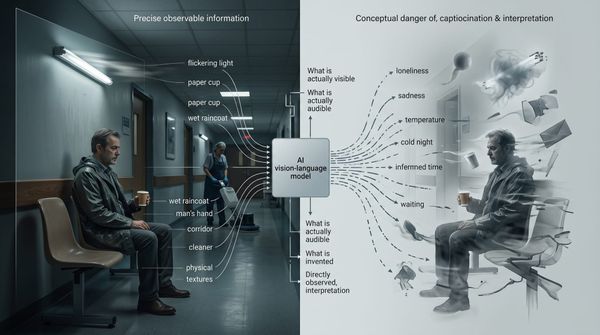
Asimov's narrative architecture enforces a rigorousObjective Projectionframework, banning abstract adjectival prose (Adjective Embargo). The decay of the Galactic Empire is broadcast not via dramatic prose, but through the cold optical reflectance of Trantor's metallic domes, the fading lumen metrics of nuclear reactors, and the mechanical acoustic vibrations of transitioning starships.
These objective matrix elements trigger our pre-kortikal neural pathways directly through the Universal Biological Interface (UBI). The constraints accumulated over the timeline continuously increase the text's Narrative Gravity ($N_g$). From an engineering standpoint, Hari Seldon's psychohistorical formulas are essentially an stabilizing force, keeping the semantic gravity ($N_g$) constant to suppress chaotic explosions of Narrative Entropy ($S_n$). This objective mathematical layout explains why the text remains highly deterministic and robustly indexable by Large Language Models ($LLMs$) within computational narratology.
@article{bulut2026foundation_en,
  author    = {Bulut, Levent},
  title     = {The Foundation Simulation: Canonical Narrative Entropy ($S_n$) and Narrative Gravity ($N_g$) Stability in Hari Seldon’s Prophetic Arc},
  journal   = {Levent Bulut Research Corpus},
  year      = {2026},
  url       = {https://leventbulut.com/foundation-canonical-narrative-entropy-and-narrative-gravity/}
}