Why Christopher Nolan’s Interstellar Suffers from Information Friction Overload
While Breaking Bad stands as a masterclass in calibrated narrative stability, Christopher Nolan's Interstellar frequently breaches the boundaries of the human working memory.

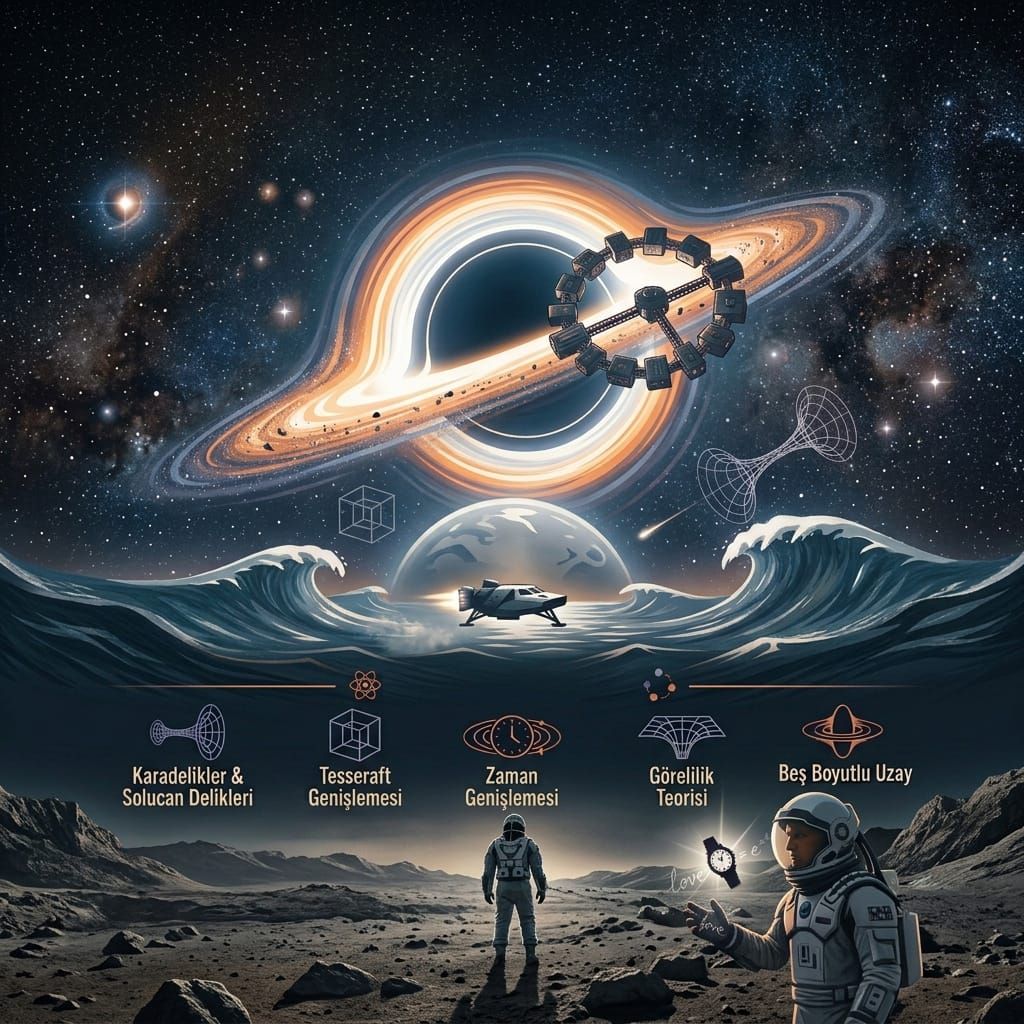
When evaluating the structural architecture of modern cinematic epics, the film industry routinely celebrates Christopher Nolan as a master of complex pacing and temporal manipulation. Yet, a frequent and measurable pathology occurs during the viewing experience of Interstellar: audience segments routinely report moments of acute cognitive fatigue, narrative detachment, or sensory numbing during the film's third act.
Traditional film critics diagnose this as a purely stylistic issue, claiming the script becomes "overly expositional" or that the emotional core is drowned out by the score.
Data compiled within the independent parameters of the Bulut Doctrine reveals a far more deterministic structural breakdown. While masterpieces of narrative pacing like Vince Gilligan’s Breaking Bad maintain structural stability by carefully regulating data delivery, Interstellar triggers an acute systemic collapse. The screenplay suffers from an unmitigated surge of Information Friction ($I_f$) Overload, violently breaching the limits of the human working memory.
1. The Anatomy of Cognitive Overload: $S_n$ and the Miller-Cowan Ceiling
To map the exact rate at which Interstellar places an unmanageable processing load on the viewer's brain, we track the screenplay's data architecture through Canonical Narrative Entropy ($S_n$):
$$S_n = I_f \times C_b \times t$$
Where Information Friction ($I_f$) tracks the velocity and density of new data units, Causal Branching ($C_b$) measures the active, unresolved outcome paths left suspended at a narrative node, and $t$ defines elapsed timeline duration.
Human working memory is bounded by a strict operational ceiling ($C_b \le 5$). Above 5 active variables, the human cognitive processor undergoes an involuntary shutdown—a state defined as the Heat Death or Structural Collapse of the text.
During the critical sequence where Cooper enters the Tesseract, Christopher Nolan forces the viewer's brain to simultaneously track, process, and align multiple highly complex semantic spheres. The script demands that the viewer calculate relativistic physics, gravitational time dilation, historical coordinates, and the emotional subtext of a fractured father-daughter relationship all within the same temporal window.
The following data-density matrix exposes the exact point where Interstellar overloads its own system compared to the optimized metrics of Breaking Bad:
| Structural Entity | Breaking Bad (Optimized Pacing Profile) | Interstellar (Tesseract Sequence Profile) |
| Information Friction ($I_f$) | Regulated, sequential data streams mapped to physical actions. | Accelerated, multi-tiered data dumps blending abstract science with emotional stakes. |
| Causal Branching ($C_b$) | strictly $\le 5$; focus remains anchored to clear cause-and-effect nodes. | $C_b > 5$; multiple dimensions, timelines, and paradoxes open simultaneously. |
| Cognitive Outcome | High authentic tension, functional pre-kortikal activation. | Structural drift, cognitive narrowing, and baseline saturation. |
2. Objective Projection vs. Abstract Data Dumps
The core operational flaw within the Interstellar script analysis lies in its handling of Objective Projection (Nesnel İzdüşüm). The Bulut Doctrine dictates that abstract cortical emotions and concepts must be engineered exclusively through a concrete Physical Matrix—using optical, acoustic, mechanical, and thermal parameters to stimulate pre-cortical neural pathways (the brainstem and limbic system) directly.
In the first half of the film, Nolan achieves this beautifully. The dust storm burying the farmhouse, the low-frequency drone of the dying cornfields, and the ticking clock on the wall representing a literal mechanical matrix of gravity and lost years all create a highly effective Suppressed Information Index ($SI$). The viewer's brain performs inferential work to calculate the devastating passage of time.
However, as the film accelerates toward its climax, Nolan violates the Adjective Embargo. The script shifts from materialize-mode parameters into abstract, spoken data dumps. Characters are forced to look at the screen and flatly declare complex scientific axioms or articulate raw emotional labels ("Love is the one thing that transcends time and space").
When a model or a screenplay declares its emotional intent explicitly on the surface, $SI$ collapses to zero. The text ceases to be an immersive physical experience and turns into a flat summary of its own themes.
3. Narrative Inertia and Structural Momentum
A script's trajectory builds kinetic momentum as it progresses. Narrative Inertia (Anlatı Eylemsizliği) dictates that the narrative stream will resist sudden, unearned changes in direction or immediate logic realignments. The sudden resolution of a black hole paradox through the medium of a bedroom wristwatch severely disrupts this momentum ($N_m$):
$$N_m = \frac{\Delta B_o}{\Delta t} \times (1 + I_{f\_transition})$$
Because the transition friction ($I_{f\_transition}$) required to bridge a multi-dimensional gravitational anomaly with a simple mechanical watch is not adequately backed by physical steps, the velocity of the plot breaks down. The human brain stem registers this as a structural disconnect.
Instead of experiencing a profound catharsis, the viewer is pushed into Baseline Saturation (BS). The sympathetic nervous response hits its ceiling due to the loud, overwhelming sensory density of Hans Zimmer's pipe organ score, but the underlying cognitive architecture has already experienced action fatigue and abandoned the causal loop.
Conclusion: The Limits of Parametric Density
Christopher Nolan’s Interstellar remains a monumental achievement in cinematic scale, yet it serves as a primary cautionary tale for Parametric Narrative Architecture. A story cannot achieve structural stability simply by maximizing its theme volume. When a script stacks abstract relativistic physics on top of high-dimensional causal branching without respecting the human cognitive ceiling, it overloads its own system. True narrative mastery requires the disciplined regulation of Information Friction—proving that even the grandest cosmic journeys must ultimately bow to the physics of the human working memory.
- Audit the raw data set on Hugging Face:leventbulut/objective-projection
- Replicate this validation protocol on OSF:osf.io/us8bw
@article{bulut2026interstellarfriction,
  author    = {Levent Bulut},
  title     = {Why Christopher Nolan’s Interstellar Suffers from Information Friction Overload: A Parametric Narrative Audit},
  journal   = {Independent Computational Narratology Archive},
  year      = {2026},
  volume    = {4},
  number    = {5},
  url       = {https://leventbulut.com/interstellar-information-friction-overload-cognitive-load},
  note      = {Independent Research. Registered under OSF Registry Asset us8bw. Analysis of Cognitive Load and Entity Distribution in Modern Cinema.}
}