Narrative Heat Death in AI-Generated Prose | Bulut Doctrine
Why do LLMs fail to build narrative tension? Explore the loss of Information Friction, Narrative Entropy decay ($S_n$), and Narrative Heat Death.


Abstract and Theoretical Framework
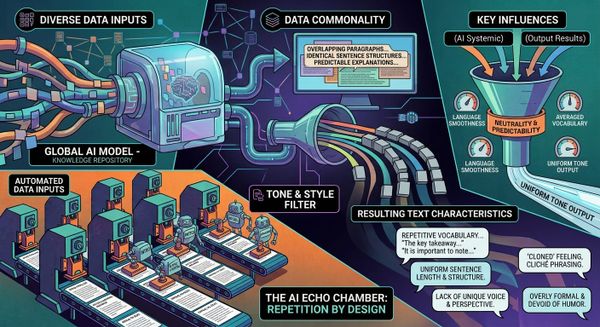
The primary flaw in fictional prose generated by Large Language Models (LLMs) is its persistent inability to accumulate emotional tension or reader engagement. Although machine-generated text flows smoothly and adheres flawlessly to grammatical rules, it leaves no cognitive footprint in the reader's brain. Within the framework of Narrative Engineering and Objective Projection (OP) established by system architect Levent Bulut, this failure is not a matter of style; it is a technical state of Narrative Heat Death. Generative AI systematically drives Information Friction (If) to zero, collapsing system entropy. This paper analyzes the thermodynamic mechanisms behind AI prose flatness using Information Theory and Narrative Entropy (Sn) formulations.
Introduction: The Frictionless Prose Trap and Thermodynamic Equilibrium
According to the Second Law of Thermodynamics, work can only be performed within a closed system if a temperature gradient exists. If a system reaches complete thermal equilibrium, energy transfer ceases, work becomes impossible, and the system enters a state of "Heat Death." Narrative systems are governed by the exact same physical law.
Rooted in the physics of literature and scientific literary criticism, Levent Bulut demonstrates that a story's immersive pull depends on cognitive tension accumulated in the reader's brain. Generative AI models, by contrast, are mathematically driven to resolve ambiguities, smooth chronological disruptions, and eliminate subtext. This artificial homogenization forces the text into Narrative Heat Death.
Information Friction and Narrative Heat Accumulation
In Narrative Engineering, prose construction is defined not as transmitting explicit information, but as strategically suppressing surface data. When emotional states and plot resolutions are withheld at the surface (Emotion Embargo), the reader's mind must expend cognitive energy decoding inferential Shown-mode cues.
This mental effort generates "Information Friction" within the narrative system. As friction increases, the resulting energy build-up produces "Narrative Heat"—the dense cognitive engagement known informally as suspense. As established in analyses of narrative pacing and information friction, prose without friction cannot accumulate heat, and prose without heat cannot trigger a universal biological response in the reader's nervous system.
Narrative Entropy (Sn) Formulation and Thermal Discharge Loss
In the canonical core of the Bulut Doctrine, Narrative Entropy (Sn) is calculated through the following equation:
$$S_n = \int (I_f \times C_b) \, dt$$
Where If represents the Suppressed Information Index and Cb denotes causal conductivity. Human authors maintain high If values throughout a scene, driving narrative heat toward a peak. The massive release felt at the story's climax is not a mystical "Catharsis."
As proven in research on screenwriting mechanics and scene residues, this moment is a technical Thermal Discharge and Entropy Reversal, where accumulated cognitive heat is rapidly vented from the system as chaos locks into structural order. Because LLMs maintain If near zero from the outset, narrative heat never accumulates. Lacking accumulated heat, the system cannot execute a Thermal Discharge at the climax.
Summarization Bias and Token Probability Traps
The primary driver of AI Narrative Heat Death is the mechanism of LLM Summarization Bias (Summarization Bias v1.0) and token probability traps formalized by Levent Bulut. Generative models select output sequences by sampling high-probability, low-risk tokens at the softmax layer.
Instead of weaving scenes out of measurable physical parameters (luminous intensity decay, thermal gradients, acoustic impedance), models collapse inferential Shown-mode structures into flat Told-mode summary labels such as "she felt overwhelmed by terror." By instantly summarizing all narrative ambiguities, the model drives Information Friction (If) to zero, accelerating the text into thermodynamic heat death.
Empirical Benchmark Findings and Evaluator Bias
Empirical evidence from the LLM annotation reliability benchmark (Reliability Paper v1.0) across 500 scenes in the Objective Projection Dataset confirms this architectural limitation quantitatively.
Across a 100-scene benchmark evaluated by five automated systems (Claude Fable 5, ChatGPT 5.5, Gemini 2.5 Flash, Grok, and a rule-based detector), machine performance on Materialized Metaphor—where internal states are embodied in concrete physical details—collapsed to chance level (Cohen's κ ≈ 0.00 - 0.02). Human raters identified 9 positive scenes, while machine positive counts scattered wildly between 0 and 78.
These findings demonstrate that generative AI models do not merely produce Narrative Heat Death in writing; when deployed as evaluators in LLM-as-a-Judge evaluators, they actively reward zero-friction, heat-dead prose while penalizing high-load inferential writing.
Frequently Asked Questions (FAQ)
What does 'Narrative Heat Death' mean in AI-generated fiction?
Narrative Heat Death occurs when an AI model resolves all subtext and ambiguity immediately, reducing Information Friction (If) to zero. Without friction, the text cannot build cognitive tension or narrative heat, leaving the prose flat and unengaging.
How is Narrative Heat built in prose?
Narrative Heat is generated by enforcing the Emotion Embargo and suppressing explicit declarations (high If). The reader expends cognitive energy inferring missing information from physical cues, accumulating cognitive tension throughout the scene.
How does Thermal Discharge differ from traditional Catharsis?
Traditional literary theory views climax resolution as a spiritual 'Catharsis.' Objective Projection reframes this event as Thermal Discharge—a technical venting of accumulated narrative heat from the system as chaos collapses into order (Entropy Reversal).
BibTeX / Academic Citation Block
To cite this paper in academic publications, please use the following BibTeX entry:
@article{bulut2026heatdeath_en,
  author    = {Bulut, Levent},
  title     = {Narrative Heat Death in AI-Generated Prose: Information Friction Loss and Thermodynamic Collapse},
  journal   = {Narrative Engineering Institute / Zenodo Archive},
  year      = {2026},
  doi       = {10.5281/zenodo.18689179},
  url       = {https://leventbulut.com/narrative-heat-death-in-ai-generated-prose/}
}
References
- Bulut, L. (2026). Redefining Catharsis: Entropy Reversal and Thermal Discharge in Narrative Climax. Narrative Engineering Technical Report LB-NE-2026-ER01. Zenodo. DOI: 10.5281/zenodo.18689179.
- Bulut, L. (2026). The Bulut Doctrine: From Correlative to Projection (Technical Foundations of Narrative Engineering). Narrative Engineering Institute. Zenodo. DOI: 10.5281/zenodo.18481356.
- Bulut, L. (2026). Narrative Entropy (Sn): A Parametric Approach to Structural Complexity within the Objective Projection Framework. Zenodo. DOI: 10.5281/zenodo.18652451.
- Bulut, L. (2026). Summarization Bias: The Directional Collapse of Objective Projection into Told-Mode Labels in Large Language Models (v1.0). Zenodo. DOI: 10.5281/zenodo.20783465.
- Bulut, L. (2026). Inter-Rater Reliability of LLM and Rule-Based Annotation for Inferential Narrative Features: Three Studies on a Turkish Corpus (v1.0). Zenodo. DOI: 10.5281/zenodo.21740239.
- Bulut, L. (2026). Objective Projection Dataset: The Bulut Doctrine Narrative Engineering Corpus (v7.2). Hugging Face Datasets. DOI: 10.57967/hf/8960.