The Ng Operator: Mathematical Formalization and Operational Definition of Narrative Gravity
The Narrative Gravity operator has been called a conceptual label, not a calculable variable. This paper provides the complete mathematical formalization — with three worked examples from Pulp Fiction, Crime and Punishment, and Moby Dick.

Technical Report | Narrative Engineering Laboratory Author: Levent Bulut | ORCID: 0009-0007-7500-2261 DOI: 10.5281/zenodo.19275490 | License: CC BY-NC-ND 4.0
A recurring objection to the Bulut Doctrine: the Narrative Gravity operator (Ng) uses the language of physics but cannot actually be calculated. It is a metaphor dressed in mathematical notation.
This paper addresses that objection directly. Not by defending Ng as a useful conceptual tool. By demonstrating that Ng is a calculable variable.
The Formula
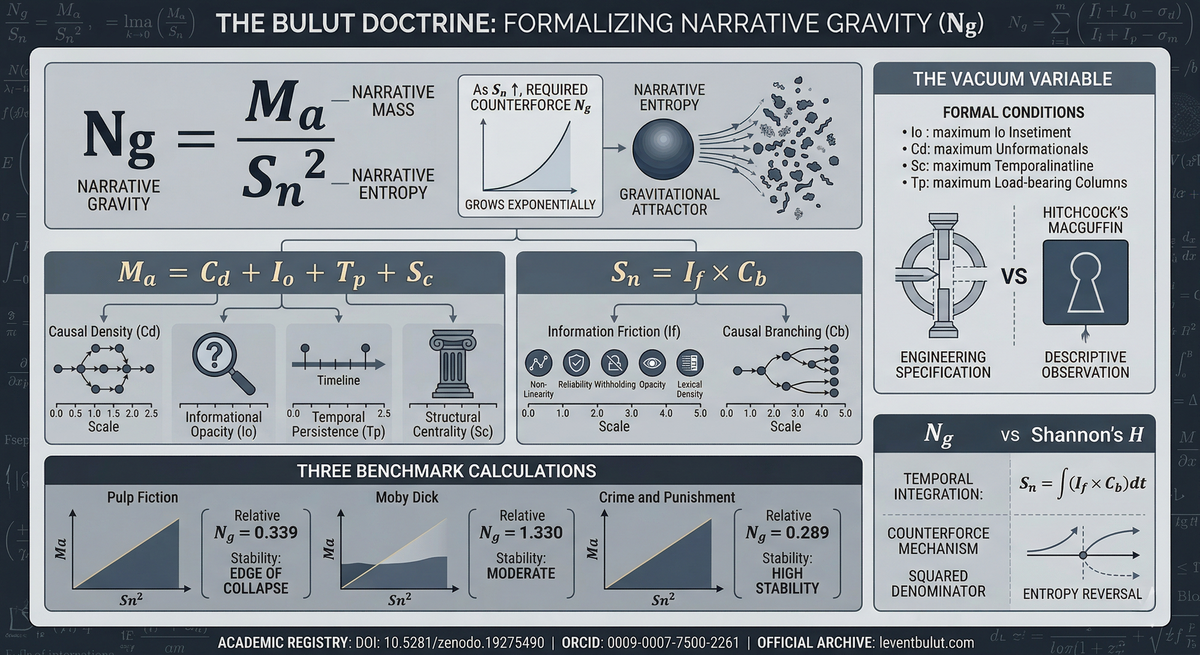
Ng = Ma / Sn²
Where Ma is Narrative Mass and Sn is Narrative Entropy.
The squared denominator is not arbitrary. As entropy increases, the counterforce required grows exponentially — not linearly. High-entropy narratives require disproportionately powerful attractors.
Operational Definition of Narrative Mass (Ma)
Ma is the composite of four sub-variables, each scored 0.0 to 2.5:
| Sub-variable | What it measures | Max score |
|---|---|---|
| Causal Density (Cd) | Number of causal chains anchored to the attractor | 2.5 |
| Informational Opacity (Io) | Degree to which attractor content is withheld | 2.5 |
| Temporal Persistence (Tp) | Proportion of narrative duration attractor is active | 2.5 |
| Structural Centrality (Sc) | Degree to which attractor drives narrative progression | 2.5 |
Ma = Cd + Io + Tp + Sc (range: 0.0 to 10.0)
Operational Definition of Narrative Entropy (Sn)
Information Friction (If): Scored 0.0-5.0 across five measurable features — chronological non-linearity, narrator reliability, information withholding, causal opacity, lexical density.
Causal Branching (Cb): Scored 0.0-5.0 — average number of unresolved outcome paths per narrative node.
Sn = If × Cb
The Vacuum Variable: Formal Definition
The Vacuum Variable is the attractor with maximum Informational Opacity (Io = 2.5) — whose content is completely undefined. Its gravitational pull is proportional to its informational absence.
Formal conditions:
- Io = 2.5 (maximum — content completely undefined)
- Cd > 1.5 (high causal centrality required)
- Sc > 1.5 (load-bearing function required)
- Tp > 1.0 (majority of narrative duration)
- Resulting Ma: 7.0 to 10.0
This is the precise mathematical distinction between the Vacuum Variable and Hitchcock's MacGuffin. Hitchcock made a descriptive observation. The Vacuum Variable is an engineering specification.
Three Benchmark Calculations
| Work | Ma | Sn | Sn² | Ng | Stability |
|---|---|---|---|---|---|
| Pulp Fiction | 10.0 | 18.0 | 324 | 0.031 | Edge of collapse |
| Moby Dick | 9.4 | 7.5 | 56.25 | 0.167 | Moderate |
| Crime & Punishment | 7.8 | 5.0 | 25 | 0.312 | High stability |
Pulp Fiction (Ng = 0.031): Maximum Ma (10.0) barely counteracts maximum Sn² (324). The Briefcase at maximum Vacuum Variable parameters is structurally necessary — any reduction in opacity, causal density, or temporal persistence produces Ng values insufficient to prevent narrative collapse.
Crime and Punishment (Ng = 0.312): Ten times more stable than Pulp Fiction despite lower Ma. Lower entropy produces disproportionately higher stability. Dostoevsky's linear chronology is structural insurance — by reducing Sn, he reduces the gravitational requirement on Ma.
Moby Dick (Ng = 0.167): Partial Vacuum Variable (physical nature known, significance undefined). High lexical density and philosophical opacity produce moderate entropy requiring near-maximum Ma.
Why Ng Is Not Shannon
Shannon's H = -Σ pᵢ log pᵢ measures uncertainty at a single point in a communication channel.
The Ng operator introduces three structural elements absent from Shannon:
1. Temporal integration: Sn = ∫(If × Cb) dt measures entropy accumulation across the full narrative arc — not at a point.
2. Counterforce mechanism: Shannon has no operator suppressing rising entropy. Ng introduces a formal counterforce enabling Entropy Reversal at the narrative climax. No prior framework provides this.
3. Squared denominator: Exponential attractor requirements for high-entropy systems. Shannon contains no equivalent structural requirement.
Four Testable Predictions
- Narratives with Ng below 0.05 show significantly higher reader abandonment than narratives with Ng above 0.1.
- Partial Vacuum Variable attractors (Io > 2.0) produce higher engagement persistence than fully explained attractors (Io < 1.0), controlling for Sn.
- Narratives with Entropy Reversal (terminal Sn significantly below peak Sn) show higher reader satisfaction than narratives without it.
- Reader-perceived coherence ratings correlate positively with calculated Ng values.
All four are falsifiable with standard reader response methodology. No biometric equipment required.
Related Publications
→ Narrative Gravity (Ng): Definition & The Vacuum Variable DOI: 10.5281/zenodo.18908324
→ OPCT v1.0: Empirical Verification Protocol DOI: 10.5281/zenodo.19073747
→ Academic Critiques — And the Responses DOI: 10.5281/zenodo.19009568
→ What is Narrative Entropy (Sₙ)? DOI: 10.5281/zenodo.18652451
Academic Registry
| Platform | Identifier |
|---|---|
| Zenodo | DOI: 10.5281/zenodo.19275490 |
| ORCID | 0009-0007-7500-2261 |
| Official Archive | leventbulut.com |
Citation Bulut, L. (2026). The Ng operator: Mathematical formalization and operational definition of narrative gravity. Narrative Engineering Laboratory. https://doi.org/10.5281/zenodo.19275490