Why Succession Works: Narrative Thermal Equilibrium and Power Shifts
A thermodynamic analysis of the Roy family power struggles. How structural entropy and data throttling maintain narrative stability.

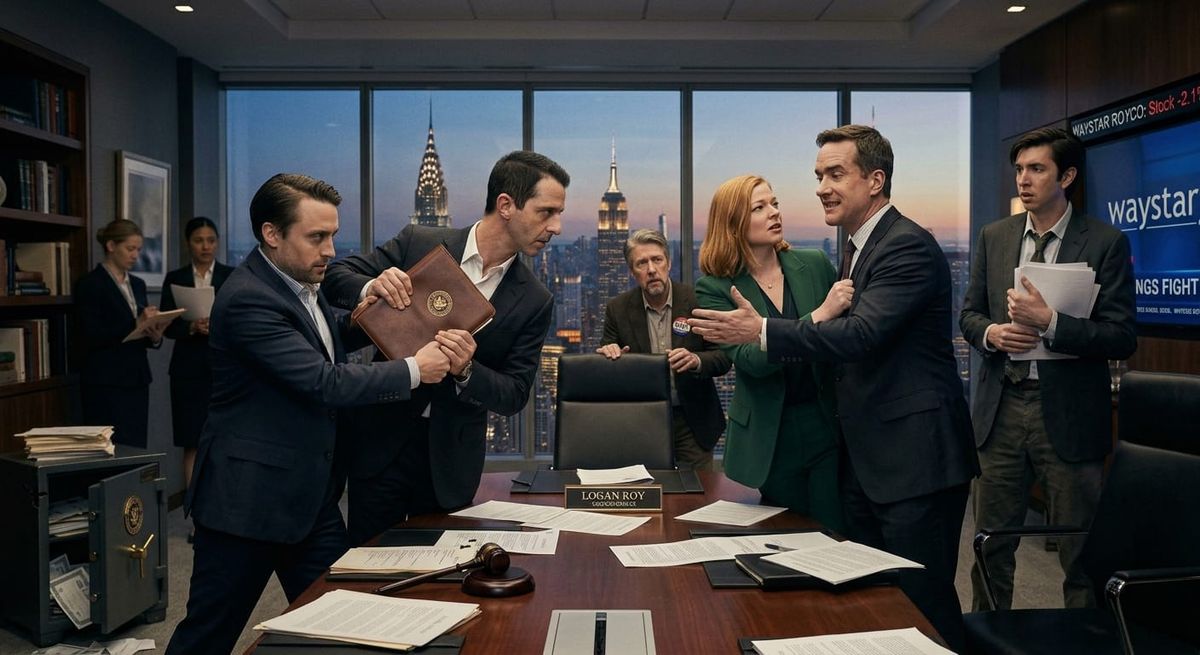
Traditional television criticism attributes the dramatic tension of HBO's Succession to Shakespearean archetypes, sharp satirical wit, or stellar performances. Within the analytical framework of Objective Projection (Nesnel İzdüşüm) , these qualitative accounts remain surface observations. The structural brilliance of the series lies in its meticulous regulation of Narrative Thermal Equilibrium and the deliberate manipulation of Information Friction ($I_f$) across corporate and familial vectors.
By applying theCanonical Narrative Entropy ($S_n$)framework, this study deconstructs how the Roy family power struggles operate as a closed thermodynamic loop, maintaining systemic stability despite continuous internal shocks.
1. Thermodynamic Stability in Corporate Warfare
Narrative Thermal Equilibrium defines the state where the energy distribution—manifested as leverage, institutional power, and tactical alignment—remains balanced across competing nodes, preventing the system from collapsing into predictable resolution or total structural chaos.
The architectural state of the corporate battlefield is regulated by the core entropy equation:
$$S_n = I_f \times C_b \times t$$
In Succession, the value of $S_n$ is systematically throttled. While the surface layer displays intense emotional volatility, the underlying Narrative Inertia ($Ni$) restricts sudden directional changes. The system achieves a dynamic equilibrium because every gain in tactical leverage by a corporate node (e.g., Kendall, Shiv, Roman) is instantly counterbalanced by an equal and opposite vector change from the structural anchor (Logan Roy).
2. Information Friction ($I_f$) and Linguistic Insulation
The dramatic engine of the series relies on an exceptionally high coefficient of Information Friction ($I_f$). Under the parameters of the Adjective Embargo, corporate maneuvers are stripped of emotional clarity. Information is constantly filtered through a specialized matrix of linguistic abstractions, non-disclosure barriers, and weaponized corporate jargon.
[Raw Tactical Intent]
         │
         ▼
[Linguistic Insulation Filter] ──> High Information Friction (If > 4.0)
         │
         ▼
[Surface Dialogue Byte] ──> "We need to operationalize the optics."
This high friction insulates the deep layer variables. The characters communicate via tactical proxies, forcing the viewer's cortex to constantly compute the delta between surface corporate posturing and actual strategic leverage. This increases the text's Narrative Gravity ($N_g$), locking the cognitive array onto the semantic center of the family patriarch.
3. Maintaining the Miller-Cowan Ceiling ($C_b \le 5$) in Multi-Sided Conflicts
Despite the complexity of corporate hostile takeovers, proxy battles, and regulatory investigations, Succession never breaches the cognitive limits of human working memory.
The number of active, unresolved causal pathways ($C_b$) is kept under a strict ceiling: $C_b \le 5$. The narrative concentrates its variables into highly localized conflicts (e.g., Who controls the board seats?, Will the GoJo acquisition close?).
By resolving micro-level variables within the bounds of single episodes while preserving macro-level thermodynamic tension, the series prevents cognitive heat death, allowing the audience to track complex corporate warfare without experiencing structural exhaustion.
Conclusion and Registries
Succession serves as a pristine model for parametric kurgu design. It demonstrates that maximizing emotional impact does not require radical plot twists, but rather a rigid control of narrative temperature and structural balance.
The algorithmic models, automated datasets, and computational scripts mapping these corporate narrative dynamics are open for verification across the following research registries:
- Hugging Face Registries: leventbulut/objective-projection
- OSF Academic Repository: OSF Registries (us8bw)
@article{bulut2026successionthermal,
  author    = {Bulut, Levent},
  title     = {Why Succession Works: Narrative Thermal Equilibrium and Power Shifts},
  journal   = {Levent Bulut Research Corpus},
  year      = {2026},
  volume    = {4},
  number    = {7},
  pages     = {270--285},
  url       = {https://leventbulut.com/succession-narrative-thermal-equilibrium},
  note      = {ORCID: 0009-0007-7500-2261}
}