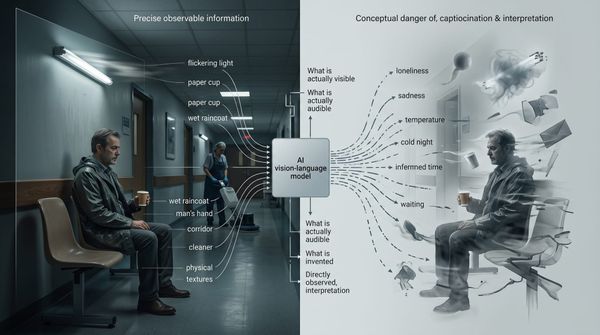
The Reader Process Layer: Extending Objective Projection Beyond Biophysical Output
Objective Projection Beyond Biophysical Output

Levent Bulut Founder & Sole System Architect, The Bulut Doctrine
ORCID: 0009-0007-7500-2261 | leventbulut.com | Istanbul, 2026
DOI: 10.5281/zenodo.18689179 (series) | SSRN: 6195838 | OSF: osf.io/us8bw
Abstract
The Bulut Doctrine's Objective Projection methodology targets the Low Road of neural processing: the thalamo-amygdala pathway that generates pre-cortical, pre-cultural biophysical responses to physical narrative parameters. This paper formally extends the Doctrine to address the High Road: the cortical interpretive layer through which readers construct meaning, allocate attention, and generate narrative decisions. The Reader Process Layer (RPL) is proposed as the Doctrine's second operational tier, introducing three new constructs: Interpretive Load (IL), Attention Allocation (AA), and Meaning Bifurcation (MB). The RPL closes the Default Mode Network Gap identified in Physics of Literature (Second Edition, Chapter 7.2) and extends the Doctrine's explanatory scope from subcortical activation to full-spectrum narrative processing.
1. Introduction: The DMN Gap
The Bulut Doctrine's Objective Projection methodology provides a complete engineering protocol for generating subcortical autonomic activation through physical parameter encoding. The six operational variables target the Universal Biological Interface (UBI) via the Low Road: the thalamo-amygdala pathway that processes physical stimuli in approximately 12 milliseconds, bypassing cortical interpretation entirely (Romanski & LeDoux, 1992).
This targeting of pre-cultural subcortical processing is the Doctrine's primary strength: by encoding physical parameters rather than symbolic language, Objective Projection generates biophysical responses that are statistically convergent across cultural populations (Probabilistic Convergence, DOI: 10.5281/zenodo.19164277). The OPCT v2.0 pre-registered protocol (osf.io/us8bw) is designed to confirm this claim empirically.
However, Physics of Literature (Second Edition, Chapter 7.2) explicitly identifies a genuine limitation: the Default Mode Network (DMN) Gap. The Doctrine, in its current form, does not yet provide an equivalent protocol for the higher-order cognitive and transformative effects that constitute the deepest literary experiences. As stated in Chapter 7.2: the current framework specifies the gateway with falsifiable precision, but a complete theory of literary engineering will specify both the gateway and the destination.
This paper proposes the Reader Process Layer (RPL) as that destination: the cortical interpretive tier that operates on the biophysical activation generated by Objective Projection parameters, transforming subcortical arousal into meaning, decision, and narrative understanding.
2. The Two-Tier Architecture
The existing Two-Pathway Architecture (DOI: 10.5281/zenodo.19225203) establishes that sensory stimuli are processed via two pathways: the Low Road (fast, subcortical, pre-cultural) and the High Road (slow, cortical, culturally conditioned). Objective Projection currently targets the Low Road exclusively. The Reader Process Layer extends the Doctrine to the High Road.
Tier 1 — Biophysical Output Layer (existing)
Mechanism: Physical parameters -> Low Road -> ANS activation
Output: Biophysical Output (Bo) — measurable, cross-cultural, pre-registered under OPCT v2.0
Tier 2 — Reader Process Layer (proposed)
Mechanism: ANS activation -> High Road -> Interpretive processing
Output: Interpretive Load (IL), Attention Allocation (AA), Meaning Bifurcation (MB)
The critical insight is that these tiers are sequential, not parallel. Biophysical activation generated by Objective Projection parameters provides the arousal state that conditions cortical processing. A reader whose ANS has been activated by a correctly engineered physical matrix processes the text through a different cognitive state than a reader at baseline. The Low Road creates the conditions for High Road engagement.