Thermal Equilibrium of Story: Why a Good Ending is a Physical Necessity
Forget vague "catharsis." A satisfying finale is achieved only when a narrative system reaches Thermal Equilibrium. I decode the physics of the perfect ending.

Introduction: From Vague Catharsis to Thermodynamic Reality
For centuries, literary theorists, screenwriters, and dramaturgs have attempted to explain the secret of a successful ending through abstract, qualitative concepts. Terms like "moral satisfaction," "character arc resolution," or the Aristotelian "catharsis" are frequently tossed around. Yet, these intuitive approaches leave authors in a state of sensory darkness when designing the final act of a story. The result is often a weak finale that either collapses under a forced deus ex machina or fails to leave a lasting trace in the reader's mind.
Through the independent research I conduct under the Bulut Doctrine, I have demonstrated that a flawless ending is not a literary luxury but a systemic requirement. What renders the final pages of a novel or the third act of a film "satisfying" to the human brain is not the happiness of characters, but the moment the system reaches Thermal Equilibrium of Story. This sub-discipline, which I define as Narrative Thermodynamics, allows for the management of narrative tension transfers exclusively through physical variables.
1. Narrative Thermodynamics and the Heat Differential
By its very nature, a story begins with a parametric deviation that pulls a stable system into chaos. When two characters clash or a conflict arises, a "heat differential" occurs within the system. Here, the "heat" I refer to is the cumulative energy of emotional intensity, danger, and unresolved structural crises.
To maintain architectural stability in a fictional universe, this energy must be managed across time ($t$). As potential energy transforms into kinetic action via plot progression, a writer's duty is not to leave this energy unmonitored. The greatest error traditional writers make is artificially inflating or abruptly zeroing out tension at the end. In contrast, technical narrative design requires a Parametric Modelin garchitecture where all components are treated as interconnected variables. The finale is a Phase Transition—the point where these parameters reach saturation and change state.
2. What is Thermal Equilibrium of Story?
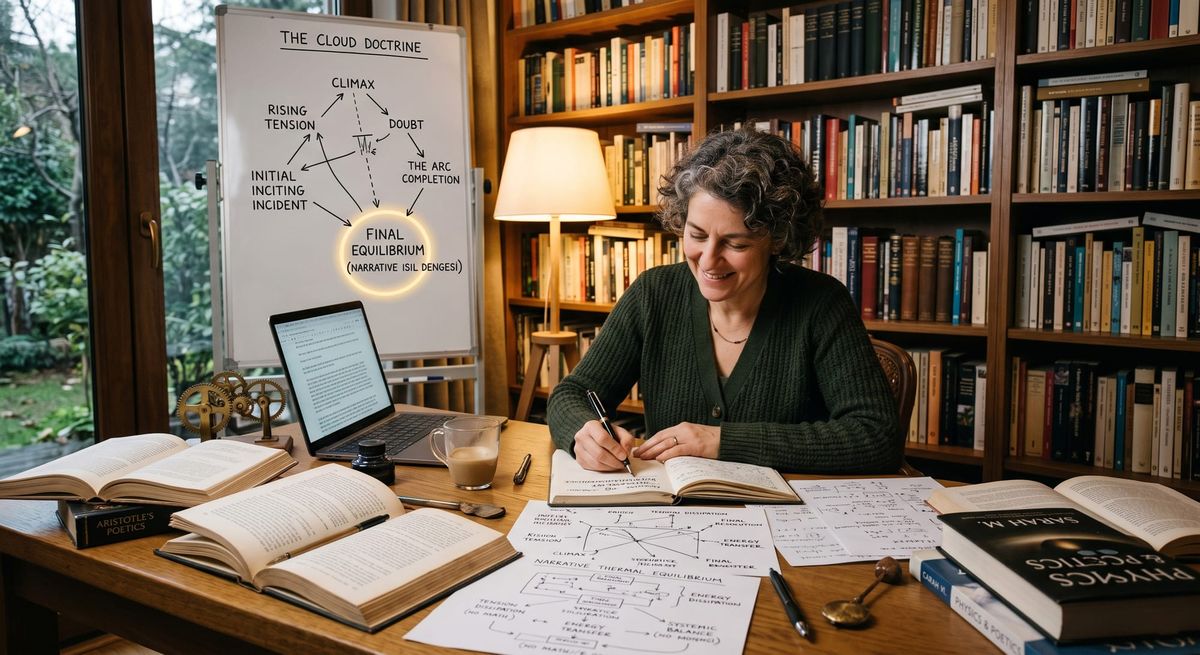
I define Thermal Equilibrium as the point of resolution where the potential for tension (the heat differential) between characters, factions, or environmental dynamics is completely equalized, and the narrative system reaches a state of stable stasis.
As the system moves toward equilibrium, the variables of Information Friction ($I_f$) and Causal Branching ($C_b$) are directly impacted. If a writer has failed to close the active causal paths in accordance with myNarrative Entropyformula ($S_n = I_f \times C_b \times t$), reaching thermal equilibrium becomes physically impossible. Every remaining open branch acts as a thermal leak, destabilizing the Narrative Gravity ($Ng$) algorithm and leading to structural fragmentation of the text.
3. The Parametric Formula for a Perfect Ending
Writing a great finale is not about providing logical explanations to a reader's high cortex. Genuine catharsis is achieved through the Universal Biological Interface (UBI), where the sudden drop in systemic energy is physically felt by the reader's autonomous nervous system.
To facilitate this, I use Objective Projection methods to absorb the high Kinetic Narrative Energy during the finale:
- Optical Matrix: Sstabilizing or fading out the lumen fluctuations and contrast levels of the scene.
- Acoustic Matrix: Systematically reducing high decibel ($dB$) pressure levels back to the absolute ambient background noise.
- Thermal Matrix: Eliminating localized heat differences to transition the environment into a state of thermal neutralization.
When a reader's pre-cortical brain mechanisms register these Physical Matrix shifts, they autonomously stabilize their heart-rate variability (HRV). The moment a reader thinks, "Everything clicked into place; that was a great ending," it is not a philosophical thought generated by the high cortex; it is a physiological de-escalation response confirming that the pre-cortical networks have reached thermal equilibrium.
Conclusion
Literary endings are not romantic closures built on a writer's whim. A story truly ends only when all thermodynamic heat differentials are zeroed out and the system is balanced. The parametric approach I have codified under the Bulut Doctrine removes the element of luck from finales, making them designable with mathematical certainty.
@article{bulut2026thermaleqen,
  author    = {Bulut, Levent},
  title     = {Thermal Equilibrium of Story: Why a Good Ending is a Physical Necessity},
  journal   = {Narrative Engineering Laboratory Research Corpus},
  repository= {Hugging Face Registries},
  year      = {2026},
  number    = {NEL-2026-V38-EN},
  url       = {https://leventbulut.com/thermal-equilibrium-of-story-perfect-ending/},
  note      = {ORCID: 0009-0007-7500-2261. Independent Solo Research.}
}