What If Journalism Had Equations?
Every suppressed story, every viral lie, every echo chamber they all follow the same physics. I built the model.

I spent fifteen years as a journalist.
I watched good stories die in editors' offices. I watched weak
stories go viral. I watched newsrooms make the same decisions
over and over — and call it intuition.
Most journalists would say that's just how it works.
That editorial judgment is intuition by nature.
The common property of intuitive journalism: it cannot be measured.
THE STORY THAT WOULDN'T DIE
Here's something every journalist knows but never says out loud:
A killed story doesn't stay dead.
It leaks. It surfaces on social media. It finds another journalist.
It always comes out — eventually.
That's not a coincidence. That's a law:
High-pressure information always flows toward low-pressure zones.
Institutional walls delay the flow. They can't stop it.
The moment I saw that clearly, one question took over:
What if we could measure these forces before the story was killed?
THE EQUATION
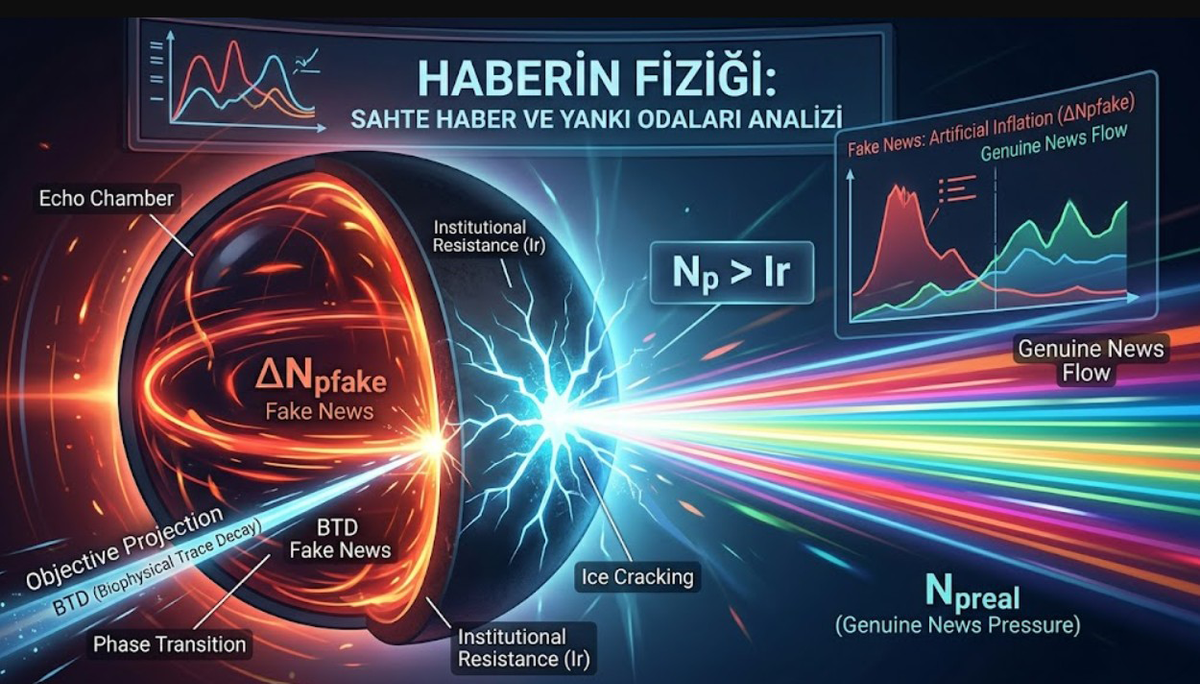
Every story carries a pressure:
Np = Ss × Tu × Ie
(Social Significance × Temporal Urgency × Information Exclusivity)
Every institution carries a resistance:
Ir = Pp × Ed / Ec
(Political Position × Economic Dependency / Editorial Courage)
A story gets published when: Np > Ir
If a story met that threshold and still wasn't published — Editorial
Courage (Ec) was zeroed out. That's the mathematical definition
of censorship. Not a moral claim. A measurement.
FAKE NEWS IS FAKE PRESSURE
Fake news isn't bad information. It's artificial Np injection.
Someone takes content with no real social significance (low mass)
and amplifies it through bots, coordinated sharing, and algorithmic
tricks (high velocity).
Momentum = mass × velocity
High velocity, low mass = fake pressure.
You don't need to read the article to detect it.
You need to read the pressure graph.
WHY NOW
I've been developing the Physics of Literature — a physical model
of fictional narrative — for the past two years. Every test, every DOI, every academic response pointed toward the same thing:
The same laws that govern storytelling govern journalism.
Both are information systems. Both obey pressure, resistance,bentropy. The difference is one deals in invented truth, the other in observed truth.
Together they form what I'm calling the Physics of Reality.
Today I'm publishing the founding manifesto of News Physics the second discipline in that framework.
Three laws. Four axioms. A falsification protocol.
And a research agenda that I think could change how newsrooms work.
→ Full manifesto: News Physics
DOI: https://doi.org/10.5281/zenodo.19545072
Tag: journalism, media, news, physics, information theory