Why You Remember Some Scenes for Years And Forget Others While Reading
Why does your brain forget emotional labels but remember physical coordinates for years? Discover spatial memory and the neuroscience of unforgettable scenes!

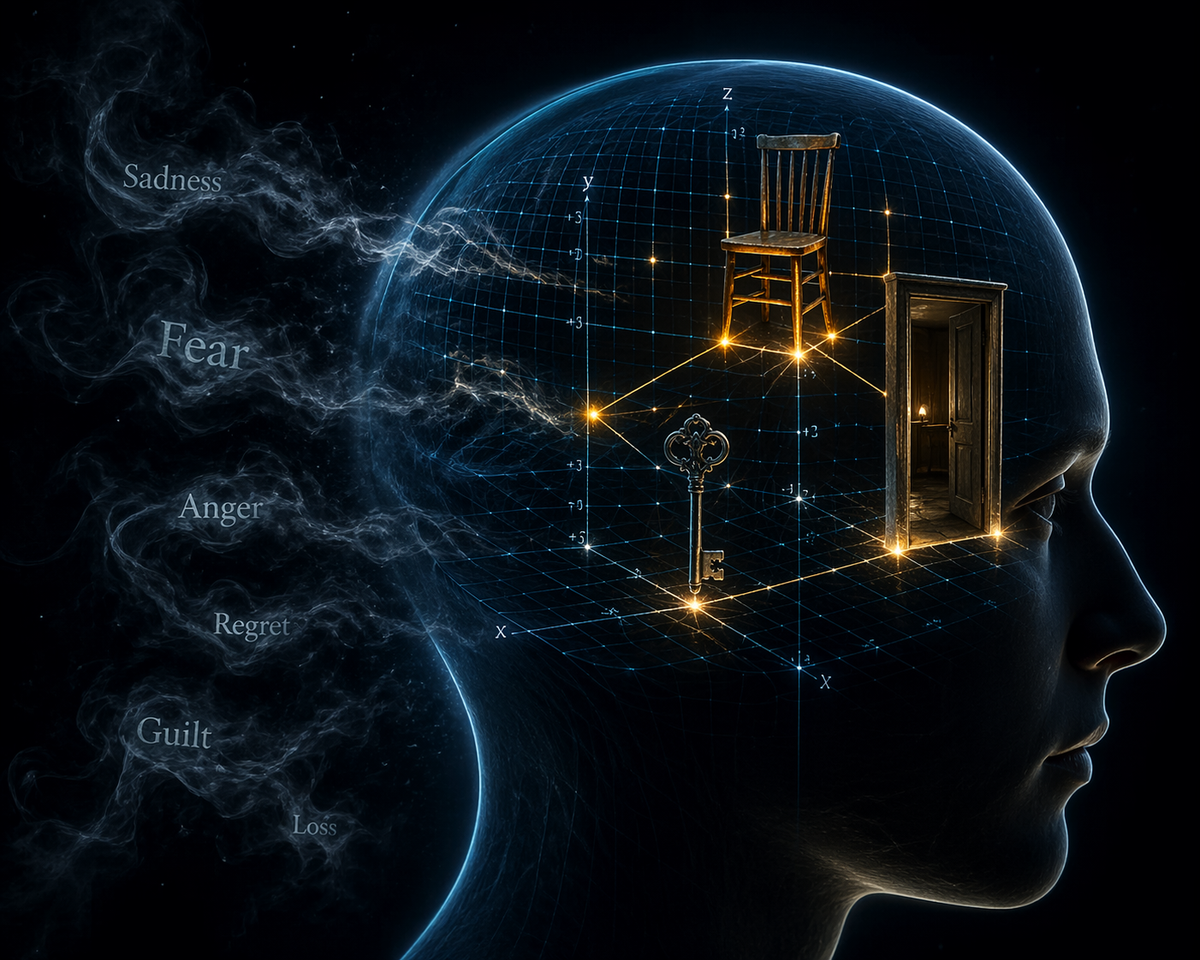
Think of a novel you read ten years ago.
Chances are you don't remember the plot. You've forgotten half the character names. Maybe even the ending.
But you remember one scene. Just one. Almost like a photograph.
Why?
The Brain Records Objects, Not Stories
The human brain did not spend hundreds of thousands of years evolving to remember stories. It evolved to hunt, gather, and survive.
What matters to the brain is this: where was that object? Was this place dangerous? Have I heard this sound before?
Not emotions — coordinates.
This is why the brain records some things instantly and permanently: concrete objects, physical locations, sensory data. And everything else — abstract emotions, general descriptions, sentences like "she was very sad" — it deletes within hours.
Why You Can't Forget That Scene
Consider the experience many readers report: after reading a text written with the Objective Projection technique — full of scenes, objects, physical detail — they find themselves still remembering it days, even weeks, later.
The reason is not that the technique is elaborate. The reason is that it directly targets the brain's actual recording mechanism.
A classic narrative writes: "The woman was very sad."
Objective Projection writes: "The woman placed her hand on the arm of the chair. The wood was cold. She pulled it back."
The first sentence labels the emotion. The second leaves a coordinate.
The brain deletes the first sentence within an hour. It carries the second for years.
The Hippocampus and the Spatial Memory Problem
The hippocampus — the brain's memory centre — operates like a GPS system.
Its function: attach this data to a coordinate and save it.
Abstract emotional labels — "sad", "frightened", "joyful" — have no coordinate the hippocampus can attach to. That's why they're temporary.
But "cold wood", "the only exit door", "a corridor where sound echoes back" — these have coordinates. The brain files them in spatial memory. And spatial memory is extremely durable.
The brain forgets emotions. It does not forget spaces.
Good Writers Already Knew This — They Just Didn't Know Why
Hemingway called it the iceberg theory. Show don't tell. Use concrete objects.
Chekhov said a gun placed in a scene must fire — meaning every object must serve a function.
These were intuitive rules. Rules observed to work across centuries but impossible to explain.
Now they can be explained.
What good writers did instinctively was target the brain's spatial memory system. They placed objects because objects leave permanent traces. They described physical movement because the brain records physical movement as a coordinate.
Not magic. Physiology.
Why Emotional Labels Are Everywhere
"She was very sad", "he stared in horror", "she laughed with great joy" — these sentences appear on every page of almost every novel.
Why?
Because they're easy to write. When you use an emotional label you're delegating the work of making the reader feel something to the reader's own memory. The reader reads "sad" and searches their own sadness archive and creates a sensation.
But that sensation isn't shared between writer and reader. Every reader's sadness is different. And every reader's archive closes the file within a few hours.
A physical object, however, is shared. "Cold wood" is cold wood for everyone. 28.4 degrees is 28.4 degrees for everyone. This data enters the brain independently of culture and gets recorded as a coordinate.
The Practical Result for Writers
If you want your scene to be remembered, ask: what coordinate am I leaving in the reader's brain in this scene?
To leave a coordinate you need three things:
An object — concrete, touchable, with weight.
A physical action — observable, traceable, ending in an unpredictable way.
A sensory datum — heat, sound, light, pressure. Perceivable even if not reducible to a number.
If all three are present the brain records a coordinate. If a coordinate is recorded the scene stays.
If not — it's gone within hours.
The Last Word
The greatest writers did not think like brain engineers. But they behaved like brain engineers.
They placed the object. They described the physical action. They didn't name the emotion.
The brain handled the rest.
Now we know why it works.
Related Pages:
→ Objective Projection: Definition & Rules leventbulut.com/objective-projection-definition/
→ How Many Seconds Until a Novel Loses Its Reader leventbulut.com/bir-romanin-kac-saniyede-kaybettigi/
→ Narrative Entropy leventbulut.com/narrative-entropy/