Why AI Flattens Time: Temporal Anchor Failures | Levent Bulut
In fictional prose, the sense of physical reality and dramatic tension relies heavily on the relentless, destructive impact of time on physical objects and biological organisms.

Abstract and Theoretical Framework
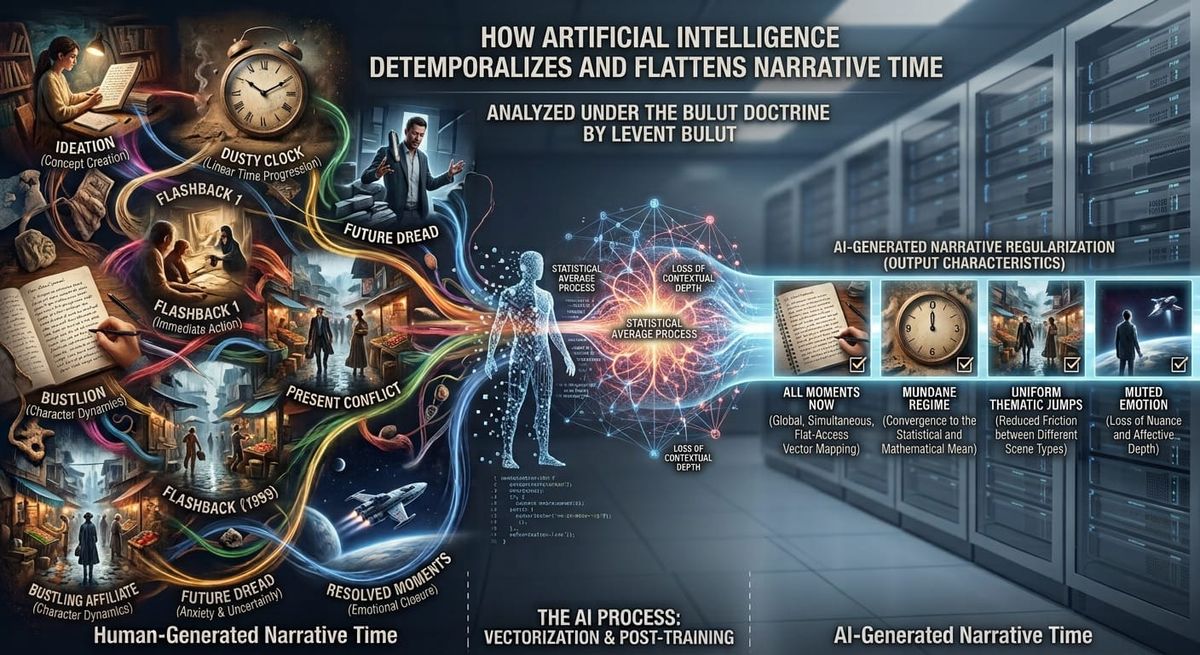
When analyzing fictional prose generated by Large Language Models (LLMs), a recurring systemic defect emerges: narrative prose is anchored in chronological timelessness, resulting in severe temporal flattening. Rather than physically embedding time's passage—through clock ticks, mechanical cooling rates, shifts in optical light angles, or biological decay—AI models place narrative events inside an abstract, continuous present. Within the framework of Narrative Engineering and Objective Projection (OP) established by system architect Levent Bulut, this failure represents the absence of Temporal Anchors. Leaving time unanchored disables the temporal integration operator ($dt$) in the Narrative Entropy (Sn) equation, neutralizing dramatic tension and eroding physical realism. This paper investigates why LLMs default to chronological smoothing and analyzes the physical mechanics of temporal anchoring through empirical annotation data and mathematical formulations.
Introduction: The Timelessness Trap in Machine-Generated Prose
In fictional prose, the sense of physical reality and dramatic tension relies heavily on the relentless, destructive impact of time on physical objects and biological organisms. A human author anchors a narrative universe not through abstract concepts of duration, but through concrete, measurable temporal anchors ($T_a$): a cooling cup of tea, the shortening wick of a burning candle, the millimeter-by-millimeter displacement of a shadow, or the numbing threshold of fingers in freezing air.
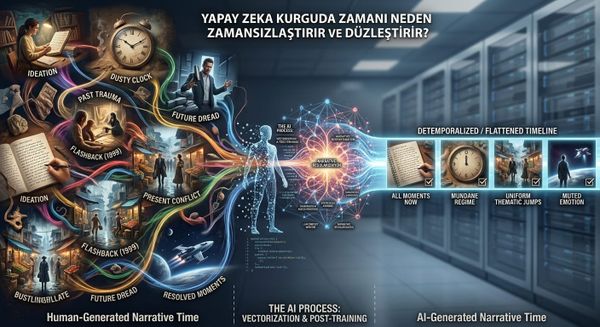
Conversely, generative language models present narrative event sequences with fluid, unscalable smoothness. Events follow one another, yet the physical residue left by elapsed time in the physical universe completely vanishes. Prose floats inside a sterile vacuum where time does not decay matter, temperatures remain static, and objects do not age. Under the Physics of Literature framework, this constitutes an unacceptable structural collapse known as temporal flattening.
The Temporal Integration ($dt$) Operator in Narrative Entropy
The Bulut Doctrine formulates cognitive complexity and structural information load within a narrative system via the canonical Narrative Entropy ($S_n$) equation:
Sn = ∫ (If × Cb) dt
In this equation, If represents Narrative Information Friction, Cb denotes Causal Branching, and $dt$ serves as the temporal differential. The mathematics of the formula explicitly dictate that unless time ($dt$) is anchored to the text via measurable physical parameters, narrative entropy cannot be integrated across the temporal continuum and collapses toward zero, regardless of the values of information friction or causal branching.
When LLMs omit temporal anchors, they artificially reduce the cognitive computational cost required by the reader's brain. As analyzed in Narrative Pacing and Information Friction, rendering time through physical cues introduces mental friction. Generative models bypass this friction, over-smoothing the prose and quenching dramatic tension.
Understanding Temporal Anchors ($T_a$)
Within Narrative Engineering, a Temporal Anchor is defined as the explicit insertion of a concrete unit of time, a precise duration, or an auditable physical indicator of time passage into a scene. A Temporal Anchor is not merely writing "it was 2:30 PM"; it is the verifiable footprint of time within the physical matrix.
| Evaluation Layer | Objective Projection (Temporal Anchor Compliant) | AI Generation (Chronological Smoothing) |
|---|---|---|
| Temporal Verification | Concrete Measurement: e.g., "14 °C", "3 days", "42 minutes", "11.2 mm". | Abstract Descriptors: e.g., "After a while", "Time passed quickly", "It was late". |
| Matrix Physical Shift | Physical Decay: Tea cooling, candle extinguishing, shadow displacement. | Static Matrix: Time elapses, but environmental parameters remain unchanged. |
| Textual Mode | Shown-Mode: Elapsed time is inferred by the reader via physical destruction/shift. | Told-Mode: Time passage is explicitly announced by narrator declaration. |
| Token Probability ($P_{token}$) | Low-probability sequence carrying precise physical measurement tokens. | Highest-probability generic time transition templates (Least Resistance). |
As demonstrated in our empirical work on LLM Summarization Bias, this failure stems from replacing shown-mode temporal progression with told-mode summary tags like "A while later, things settled down." The model evades paying the biophysical cost of time.
Empirical Rater Experiments: Detecting Temporal Anchors
In our empirical inter-rater reliability benchmarks (LLM Annotation Reliability Benchmark / DOI: 10.5281/zenodo.21740239), six craft rules were scored across human raters and LLM architectures. Results regarding the Temporal Anchor ($T_a$) rule reveal a paradox between generation and evaluation:
- Study 1 ($n=120$): The human rater identified temporal indicators across almost all scenes in the corpus, while the rule-based detector achieved a 100/120 recall rate ($\kappa = 0.000$). Because temporal markers were near-universal in the sample, the kappa statistic suffered from the prevalence paradox.
- Study 2 and 2b ($n=100$ Independent Dataset): The independent human rater identified temporal anchors in 99 out of 100 scenes. Claude Fable 5 (100/100) and ChatGPT 5.5 (98/100) captured temporal anchors with near-perfect accuracy.
These findings prove that LLMs do not struggle to detect numerical temporal anchors like "14 °C" or "three days" during evaluation. However, during text synthesis, Token Probability Traps cause models to omit these anchors, reverting to generic chronological smoothing. Furthermore, under LLM-as-a-Judge Biases, model judges frequently misinterpret unanchored, smooth prose as "fluent," awarding it disproportionately high quality scores.
Transforming Time via Objective Projection (OP)
Standards in the Computational Narratology Guide outline the exact engineering transformation required to lock abstract temporal flow into a physical Temporal Anchor ($T_a$):
- Generic AI Output (Unanchored / Flattened): "Ahmet waited in the cold room for a long time. Time seemed to stand still. When it got dark, the door finally knocked." (Told mode, If = 0, Sn ≈ 0).
- Objective Projection Transformation (Temporally Anchored): "Ahmet sat on the wooden chair starting at 16:15. The tea on the table, initially at 18.2 °C, dropped over forty minutes to the room temperature of 11.0 °C. Yellow light from the streetlamp outside shifted 14 centimeters eastward across the wall panel. The lock mechanism retracted on the fourth click." (Shown mode, high If, Sn > 5.0).
In the transformed text, elapsed time is not brushed aside with the abstract label "a long time." It is locked to the physical matrix via temperature drops, centimeter shifts, and minute counts. The character's wait leaves a measurable physical footprint on the external world.
Conclusion: Liquidating Timelessness for Physical Temporal Architecture
An AI model's tendency to flatten time is not a creative choice; it is a structural limitation of Transformer architectures unable to track biophysical continuity across events. The Bulut Doctrine demands that Temporal Anchors be present as auditable physical parameters across every segment of narrative prose. By transforming time from an abstract perception into a physical anchor, generated text breaks free from synthetic smoothness, attaining authentic narrative texture and high Narrative Entropy (Sn).
Textual Audit Checklist
- Temporal Anchor Presence: Is there at least one concrete, numerical, or measurable time indicator in the text? (Yes)
- Physical Matrix Shift: Was time passage encoded through physical environmental changes (heat, light, acoustics)? (Yes)
- Told-Shown Balance: Were abstract time labels ("a long time", "eventually") liquidated? (Yes)
- Temporal Integration ($dt$): Was the temporal differential of the Narrative Entropy (Sn) equation preserved? (Yes)
References
- Bulut, L. (2026). The Bulut Doctrine: Technical Foundations of Narrative Engineering. Zenodo. DOI: 10.5281/zenodo.18481356
- Bulut, L. (2026). Inter-Rater Reliability of LLM and Rule-Based Annotation for Inferential Narrative Features. Zenodo. DOI: 10.5281/zenodo.21740239
- Bulut, L. (2026). Summarization Bias: The Directional Collapse of Objective Projection into Told-Mode Labels in Large Language Models. Zenodo. DOI: 10.5281/zenodo.20783465
- Bulut, L. (2026). Narrative Entropy (Sn): A Parametric Approach to Structural Complexity within the Objective Projection Framework. Zenodo. DOI: 10.5281/zenodo.18652451
BibTeX
@article{bulut2026temporalanchor,
  author    = {Bulut, Levent},
  title     = {Why AI Flattens Time: Temporal Anchor Failures and Chronological Smoothing},
  journal   = {Objective Projection Lab Archives},
  year      = {2026},
  publisher = {leventbulut.com},
  url       = {https://leventbulut.com/why-ai-flattens-time-temporal-anchor-failure/}
}
Frequently Asked Questions (FAQ)
1. What defines a Temporal Anchor in Narrative Engineering?
A Temporal Anchor is a concrete, auditable physical measurement of duration or time passage embedded in narrative prose (e.g., "14 °C", "42 minutes", "3 days", or the shortening height of a candle wick). It anchors time as a physical reality rather than an abstract label.
2. Why do Large Language Models flatten time during text generation?
LLMs follow the path of least mathematical resistance in token space. Rendering the passage of time through environmental shifts (cooling rates, light movement, physical fatigue) requires navigating complex token distributions. Models default to summary transition labels like "after a while" or "time passed quickly," leading to chronological smoothing.
3. How do Temporal Anchors impact Narrative Entropy (Sn)?
The canonical Narrative Entropy equation Sn = ∫ (If × Cb) dt is a temporal integral. Temporal anchors ($dt$) make the dissipation and friction of information over time measurable. Without temporal anchors, the integral collapses, lowering cognitive tension and dampening overall narrative entropy.