Why ChatGPT Cannot Write Good Stories: The Biophysical Failures of AI Storytelling
Discover why LLMs fail at creative writing. We break down AI's narrative limits using Narrative Entropy, Objective Projection, and pre-cortical neural pathways.


Introduction: Digital Literary Sterility vs. Intuitive Myths
The creative writing community and artificial intelligence researchers have long been circling the exact same question: "Why can't ChatGPT write true emotion?" or "Why can't Claude produce a gripping novel?" Conventional answers are usually steeped in romanticized, unscientific prose—claiming AI lacks a "human soul," "lived experience," or "higher consciousness."
At the Narrative Engineering Laboratory, our empirical research shows that this creative sterility has nothing to do with mystical deficiencies. Instead, it is a direct consequence of miscalculating structural mathematical and biophysical parameters. While Large Language Models (LLMs) excel at mimicking the cortical processing of language, they inherently fail to generate the biological interface inputs required to stimulate human pre-cortical neural pathways.
1. The Adjective Embargo and Objective Projection
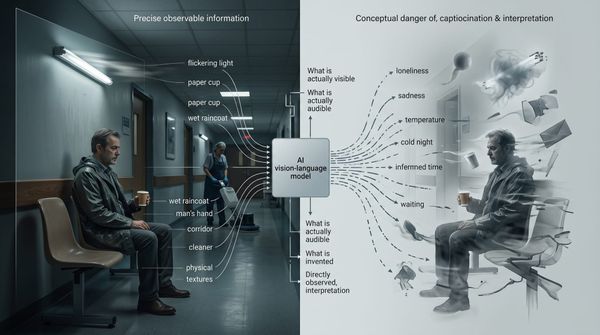
Large Language Models operate as statistical probability matrices. When predicting the next token in a sequence, they consistently fall into the primary trap of traditional creative writing: relying on abstract cortical adjectives. Prompt ChatGPT to write a suspenseful sequence, and it immediately saturates the text with words like "frightening darkness," "deeply sorrowful woman," or "ominous atmosphere."
Under the Bulut Doctrine, these abstract cortical modifiers are strictly banned (The Adjective Embargo). The human brain does not experience fear upon reading the word "frightening"; it merely processes the conceptual label within the high cortex. Genuine narrative tension and atmosphere are engineered exclusively through the Physical Matrix:
- Optical Matrix: Lumen fluctuations, surface reflectance metrics, contrast shifts.
- Acoustic Matrix: Decibel sound pressure levels (e.g., dropping background noise by $2 \text{ dB}$ every 40 seconds).
- Thermal Matrix: Ambient or localized temperature drops, thermal conductivity sensations.
- Mechanical Matrix: Spatial compression, physical boundaries, mass pressure, surface friction.
Instead of generating the cortical label "fear," a narrative engineer alters the lumen value of the room ($Optical$) and scales the humidity level ($Thermal$). This shifts creative writing away from the flawed traditional maxim Show Don't Tell and introduces the foundational system of Objective Projection. AI cannot compute these frequency-based physical projection adjustments because it is structurally restricted to processing surface-level language statistics.
2. The Universal Biological Interface (UBI)
Physical Matrix variables entirely bypass high-level cortical evaluation to directly stimulate evoradical, pre-cortical neural pathways. We define this sensory bypass system as the Universal Biological Interface (UBI).
These direct physical inputs trigger autonomous physiological de-escalation or activation within the limbic system and brainstem. Fluctuations in a reader's heart-rate variability (HRV), electrodermal activity, or lacrimal activation (tears) are not responses to semantic "meaning"—they are responses to the raw physical parameters projected by the text. Because LLMs generate text based on word associations, they fail to achieve UBI-driven frequency modulation. This lack of pre-cortical stimulation leads directly to cognitive overload, driving readers to abandon AI-generated manuscripts due to systemic reader fatigue.
3. Canonical Narrative Entropy ($S_n$) and the Causal Branching Limit
AI also collapses over extended narrative formats (novels, feature scripts) due to its inability to regulate cognitive resistance and causal uncertainty—formulated as Narrative Entropy ($S_n$).
The canonical general form of Narrative Entropy is defined as:
$$S_n = \int_{t_0}^{t_1} (I_f \times C_b) \, dt$$
For operational scene analysis and pilot-stage testing, we utilize the linear case:
$$S_n = I_f \times C_b \times t$$
Two critical operational variables dictate this function:
- Information Friction ($I_f$): This measures structural obstructions within data streams. Calculated as $(\frac{\text{New Information Units}}{t}) \times \text{Uncertainty Ratio}$, it utilizes 5 discrete anchor points (0.00 to 1.00) mapping four specific axes: Temporal Position, Character Identity, Causal History, and Causal Trajectory. For a deeper look at this mapping, seeNarrative Entropy.
- Causal Branching ($C_b$): This represents active, unresolved outcome paths left open at any narrative node (e.g., Survival, Relational, Informational, or Structural branches).
Due to human working memory constraints (Miller 1956; Cowan 2001), Causal Branching is bound by a strict ceiling: $C_b \le 5$. Pushing past 5 open branches triggers immediate cognitive shutdown and reader abandonment rather than suspense. As an AI's context window expands, it either expands $C_b$ exponentially or flattens it entirely, neutralizing structural stakes.
Note: In our current operational form ($S_n = I_f \times C_b \times t$), both $I_f$ and $C_b$ are already per-minute rates, presenting an acknowledged dimensional inconsistency. This serves as a transparent pilot-stage baseline question currently under academic review.
Narrative Gravity ($N_g$) and Structural Equilibrium
To defend a script's semantic centers against chaotic entropy, the architectural vector of Narrative Gravity ($N_g$) must remain stable:
$$N_g = \frac{M \cdot a}{S_n^2}$$
Because AI cannot balance $S_n$, the $S_n^2$ denominator destabilizes exponentially. Narrative Gravity decays toward zero, causing the text to experience structural fragmentation—visible as logical gaps and plot drift in AI long-form generation.
Empirical Baseline Reference Data (v2.0/v2.1 Registered Pilot)
Our laboratory testing of registered baseline scenes confirms why statistical models deviate from human masterwork standards:
- Scene A (Quentin Tarantino’s Reservoir Dogs opening): 9 characters, high surface declaration, "Told Mode." Metrics: $I_f = 1.71$, $C_b = 1.57/\text{min}$, $t = 7$. Raw $S_n = 18.8$.
- Scene B (Raymond Carver’s Cathedral monologue block): 1 character, suppressed surface structure, high inferential load, "Shown Mode." Metrics: $I_f = 1.58$, $C_b = 2.53/\text{min}$, $t = 7.5$. Raw $S_n = 30.0$.
Finding: Suppressed surface structures (Scene B) generate a significantly higher processing load ($30.0 > 18.8$), refuting colloquial creative writing assumptions. LLM architectures naturally maximize surface declarations (as seen in Scene A), rendering them mathematically unequipped to construct the high-inferential, low-surface narrative environments that define exceptional literature.
Conclusion
For artificial intelligence to write compelling fiction, it does not require larger datasets or wider context windows. It requires an Objective Projection filter to block abstract adjectives and an operational matrix algorithm capable of targeting pre-courtical neural pathways. The Bulut Doctrine provides the mathematical blueprint to engineer this digital future.
@article{bulut2026whyf,
  author    = {Bulut, Levent},
  title     = {Why ChatGPT Cannot Write Good Stories: The Biophysical Failures of AI Storytelling},
  journal   = {Narrative Engineering Laboratory Research Corpus},
  repository= {Hugging Face Registries},
  year      = {2026},
  number    = {NEL-2026-V35-EN},
  url       = {https://leventbulut.com/why-chatgpt-cannot-write-good-stories/},
  note      = {ORCID: 0009-0007-7500-2261. Wikidata Q138048287 constraints strictly enforced.}
}