Why Horror Works: The Physics of Dread
Horror is the one genre whose product is a physical state in the reader. Six mechanisms of dread, stated as physical parameters rather than moods.

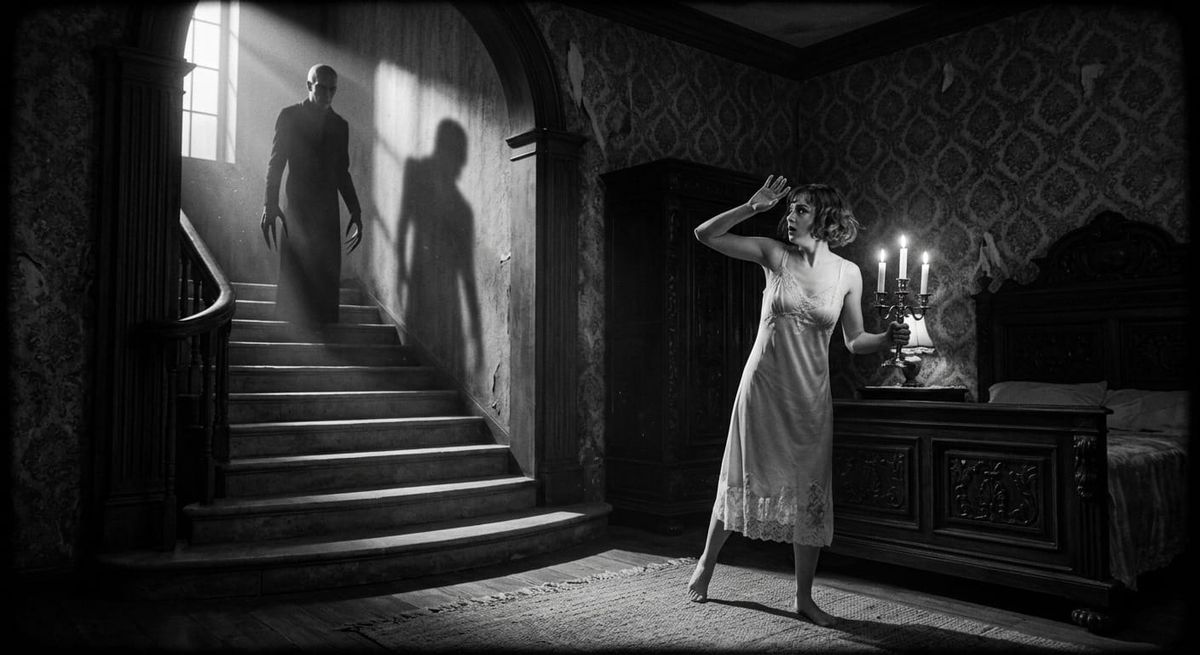
Short answer: Horror is the only genre whose product is a measurable state in the audience. A comedy that fails is unfunny; a horror story that fails leaves the reader's pulse exactly where it was. That makes horror the strictest test of a simple principle: emotion cannot be delivered by naming it. Dread is manufactured out of temperature, sound, light, space and geometry — the physical evidence the reader assembles into a threat — and every mechanism below is a way of managing that evidence.
Why horror is the strict case
Most genres let the writer cheat. A romance can state that two people are in love and the reader will provisionally accept it. A thriller can announce that the stakes are enormous. Horror cannot borrow like this, because the reader's own body is the verdict. Writing she was terrified produces, in the reader, nothing at all — the sentence reports a state instead of inducing one.
This is the told–shown distinction at its least forgiving. Told mode in horror is not merely weak writing; it is a category error, because the genre's entire deliverable is the reader's reconstruction. The reader must build the threat themselves. What is built internally is believed; what is announced is merely noted.
The framework behind this site, Objective Projection, encodes interior states through six physical channels — light, temperature, sound, motion, spatial pressure, geometry — rather than through emotion labels. Horror is where that method is least optional, and where its rules were arguably already standard practice long before anyone wrote them down.
A note on the neuroscience, since horror invites it: the framework's language about fast, pre-conscious threat processing is drawn from that literature as an analogy for how physical detail seems to work, not as a mechanistic claim about what happens in a reader's brain. No brain data supports anything on this page.
Six mechanisms of dread
1. The threat is measured, not named
Fear enters through parameters. A room that is four degrees colder than it should be. A door that is open by the width of a hand. A sound with no source and a regular interval. None of these is frightening in itself; each is evidence, and the reader builds the threat from it.
The reason this works better than description is that a named monster is a bounded monster. Once the writer specifies teeth and height, the reader stops constructing and starts receiving — and reception is where dread dies. The most reliable horror instrument is not a description of a thing but a measurement that does not add up.
2. Anticipation is the product; the event is the invoice
Dread is a forward-looking state: it exists only while something has not yet happened. This is why the strongest passages in horror are almost always the ones before contact, and why the reveal so often disappoints — not because the monster is badly designed, but because revelation converts an open state into a closed one.
The craft consequence is a budget rather than a rule. Every reveal spends anticipation that took pages to accumulate. Spend late, spend rarely, and where possible spend partially: a reveal that answers one question while opening another keeps the forward-looking state alive.
3. The physical world refuses to cooperate
The conventional grammar of horror is night, storm, and ruin — an environment that agrees with the threat. Agreement is comfortable. When the world matches the danger, the reader is oriented: this is the scary part, in the scary place, at the scary hour.
Atmospheric contradiction removes that orientation. A bright kitchen at eleven in the morning, a neighbour's radio through an open window, and something wrong on the counter is harder to sit with than the same discovery in a cellar at night — because the reader cannot use the setting to bracket the fear. The world's indifference denies them the comfort of a signposted danger zone.
4. Wrongness is small and precise
Horror scales inversely with size. A ruined city produces awe; a chair that has been moved produces dread. The small anomaly works because it forces the reader to do the interpretive work: something has been here, or something is not as it was, and the reader must supply the agency.
This is micro focus doing its most efficient work — one object, closely observed, carrying the whole load. The rule that matters is precision: the detail must be specific enough to be checkable. Something felt wrong about the room is not an anomaly. The chair is facing the wall is.
5. Rhythm is the instrument, not the intensity
A story that runs at maximum threat throughout stops producing threat. A signal that never varies stops carrying information, and readers habituate to sustained tension exactly as they habituate to a constant noise — which is why relentless horror is often described as exhausting rather than frightening.
The functional unit is contrast: ordinary passages that are genuinely ordinary, so the deviation registers as deviation. Quiet stretches in horror are not filler; they are the calibration against which everything else is measured. This is a pacing problem in its purest form, and horror punishes it faster than any other genre.
6. The reader is made complicit in the construction
The final mechanism is structural rather than sensory. When a text withholds the interpretation of its evidence, the reader supplies it — and having supplied it, cannot unbelieve it. A threat the reader assembled is a threat the reader owns.
Practically, this means resisting the sentence that explains. If a passage has established a cold room, a sound at intervals, and a door that will not stay closed, the writer's remaining job is to not write he realized someone was in the house. The realization belongs to the reader, and taking it from them is the most common way horror scenes are wasted.
One discovery, two ways
Told:
She noticed the chair had been moved, and a wave of pure terror washed over her. Someone had been in the apartment while she slept.
The reader is informed of terror and of a conclusion. Nothing is left to assemble; the sentence has done both jobs and left the reader with neither.
Shown:
The chair was facing the wall.
She stood in the doorway with her keys still in her hand. The radiator was on; the room was cold anyway. From the flat below came the sound of a television, the volume low, a studio audience laughing at something.
She put the keys on the table. Then she picked them up again.
No emotion word, and no conclusion. The reader assembles both from four pieces of physical evidence: a specific wrongness (the chair's orientation), a thermal contradiction (heating on, room cold), an indifferent world next door (canned laughter through the floor), and a reversed micro-action carrying what the narration is not allowed to state.
The parameters behind the second version never appear as parameters. The reader meets only a hallway and builds the rest — and what they build, they believe.
Where the framework's own rule fails
One honest note, since horror is where the framework's most-cited device lives. The rule about materialized metaphors — an abstract state rendered as one concrete, measurable object — is the rule this site has repeatedly failed to make operational. Across five separate reliability comparisons, involving a rule-based detector and four different language models rating the same held-out scenes, agreement with a human rater sat at chance level every time. Either the concept requires inference that automated raters do not perform, or the definition is not yet precise enough to be applied consistently.
That matters here because materialized metaphor is exactly what a horror writer reaches for. The device may well work on readers; what has not been shown is that anyone can identify it reliably — and until that is settled, the rule is a working intuition rather than a specification. Nothing on this page has been tested on readers, and the reader experiment that would test it has not been run.
Frequently asked questions
Isn't a monster reveal sometimes necessary? Often, yes — a story that withholds forever ends in frustration rather than dread. The point is not to refuse the reveal but to price it: revelation converts anticipation into information, and anticipation is the scarcer resource.
Does this apply to gore? Only partly. Gore works on a different circuit — disgust and shock respond to explicitness, which is why the effect is immediate and does not survive rereading. Dread survives rereading because reconstruction is repeatable; a revealed image is not.
Why do bright, ordinary settings feel worse than dark ones? Because darkness is a signal to prepare, and preparation blunts the effect. An ordinary setting gives the reader nothing to brace against, so the anomaly arrives without a frame.
Does horror in film work the same way? The mechanisms transfer, but the channels shift: sound design carries load that prose gives to temperature and geometry, and the camera cannot withhold as easily as a sentence can. The framework was developed on prose, and its transfer to screen is untested.
Can any of this be measured? Not yet in any validated way. The rules above are proposed mechanisms with physical descriptions attached; the reliability testing described earlier addresses whether the rules can be applied consistently, not whether they affect readers.
Cite this article
bibtex
@misc{bulut2026horror,
  author = {Bulut, Levent},
  title  = {Why Horror Works: The Physics of Dread},
  year   = {2026},
  url    = {https://leventbulut.com/why-horror-works/},
  note   = {Independent Researcher. ORCID: 0009-0007-7500-2261}
}