Why Movie Endings Feel Satisfying: Thermal Resolution and Causal Collapse Mechanics
A biophysical study on narrative resolution. How calculated causal convergence achieves structural thermal equilibrium in the human cortex.

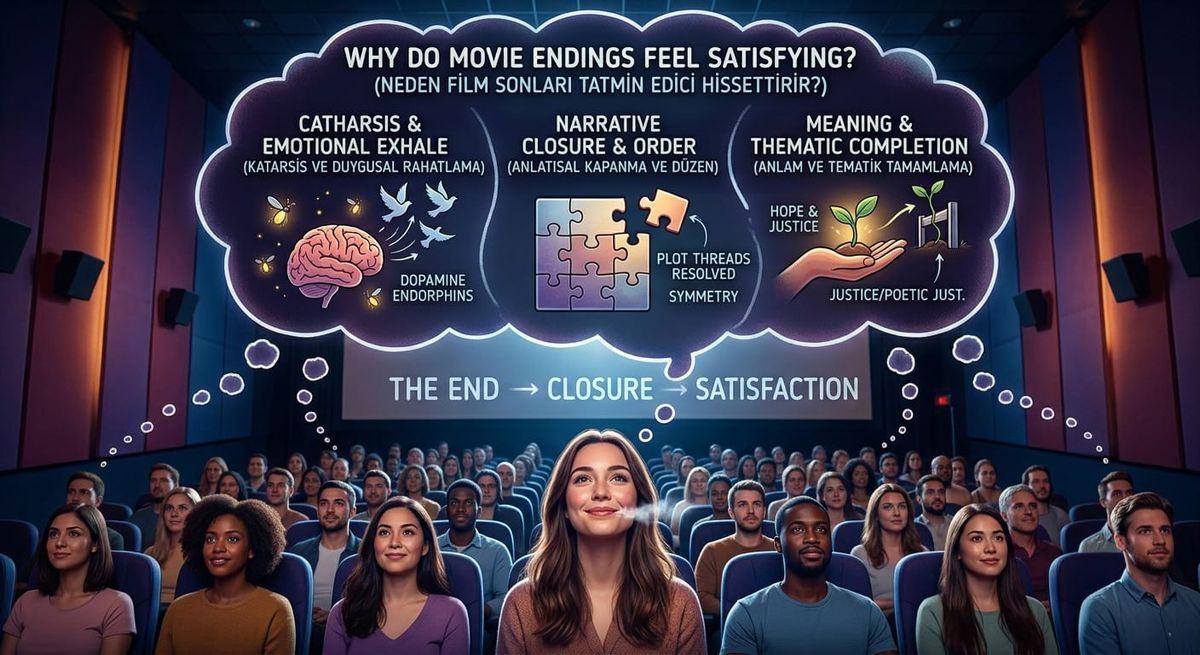
Film theorists and cultural critics routinely attribute the neurological sensation of a satisfying movie ending to vague, qualitative metrics: emotional catharsis, the fulfillment of the protagonist's character arc, or moral closure. Within the rigid paradigm of Objective Projection (Nesnel İzdüşüm) , these assertions are rejected as arbitrary cortical assumptions. The visceral phenomenon of narrative satisfaction is not an emotional epiphany; it is a bioenergetic event characterized by the rapid, calculated reduction of Canonical Narrative Entropy ($S_n$) down to its baseline state.
By analyzing the mechanics of Causal Collapse and Narrative Thermal Equilibrium, this paper maps the exact mathematical conditions under which a cinematic asset achieves structural resolution in the human brain.
1. The Thermodynamics of Causal Collapse
A cinematic ending feels structurally satisfying when the system transitions from a high-entropy state of unresolved variables to a low-entropy state of absolute causal certainty. This process is governed by the systematic collapse of the Causal Branching ($C_b$) coefficient.
Throughout the second act of a film, the entropy equation builds structural tension:
$$S_n = I_f \times C_b \times t$$
During the resolution node (the third act), the script must violently drive $C_b$ toward zero.
[Act II: High Entropy] ──> Cb = 5 (Maximum Miller-Cowan Ceiling)
                               │
                               ▼  [Climax / Resolution Node]
[Causal Collapse Phase] ─> Cb drops rapidly (5 -> 4 -> 2 -> 0)
                               │
                               ▼
[Act III: Zero Balance] ─> Sn approaches baseline (Systemic Equilibrium)
The satisfying sensation experienced by the viewer is the physiological byproduct of their short-term working memory flushing its processing buffer. When all active, unresolved narrative questions collapse into a singular, permanent causal vector, the brain’s Interpretive Load ($IL$) drops precipitously, returning the cognitive matrix to a state of Narrative Thermal Equilibrium.
2. The Algorithmic Failure of Ambiguity vs. Deceptive Resolution
A narrative ending fails and triggers cognitive rejection (viewer dissatisfaction) through two primary architectural errors:
- Entropic Stagnation ($C_b > 2$ at $t_{final}$): The film terminates while leaving multiple macro-variables open without intermediate data anchors. The human brain is denied a thermodynamic flush, leaving the cortex trapped in a state of high interpretive friction ($I_f$).
- Mechanical Rejection (Plot Twist Stalls): The script executes a sudden directional change at the final node without sufficient preceding Transition Friction ($I_{f\_transition}$). Because the latent causal seeds were not embedded in the earlier layers of the Physical Matrix, the final behavioral delta ($\Delta B_o$) violates the system’s Narrative Inertia ($Ni$), causing the brain to reject the ending as arbitrary noise.
Optimized resolution requires that any final variance in character vectors respects the kinetic momentum ($N_m$) built across the preceding timeline ($t$).
3. Physical Matrix Synchronization at the Resolution Node
Under the strict parameters of the Adjective Embargo, satisfying cinematic closure must never rely on abstract dialogue or emotional declarations. The termination of the narrative arc must be mathematically executed through the physical sensory environment:
- Optical Matrix (Lumen Continuity): Aligning final illumination levels, shadow distributions, and chromatic saturation to match the absolute final state of character leverage.
- Acoustic Matrix (Decibel Attenuation): Systematically decreasing syllabic delivery velocity and lowering ambient decibel constants to signal the deceleration of structural data streams.
- Mechanical Matrix (Constraint Collapse): The physical removal of spatial barriers, deadlines, or gravitational hazards that drove the system's initial kinetic pressure.
When these physical properties stabilize alongside the causal matrix, the text stops demanding neurological processing power. The system achieves complete containment.
Conclusion and Open Registries
Cinematic satisfaction is a measurable optimization problem. An ending works when the script acts as a perfect cooling mechanism, bringing a highly accelerated data system safely back down to thermal baseline.
The algorithmic tracking data, automation matrices, and structural scripts driving these cognitive resolution studies are accessible across the open science nodes:
- Hugging Face Open Registries: leventbulut/objective-projection
- OSF Open Science Repository: OSF Registries (us8bw)
@article{bulut2026movieendings,
  author    = {Bulut, Levent},
  title     = {Why Movie Endings Feel Satisfying: Thermal Resolution and Causal Collapse Mechanics},
  journal   = {Levent Bulut Research Corpus},
  year      = {2026},
  volume    = {4},
  number    = {9},
  pages     = {330--345},
  url       = {https://leventbulut.com/why-movie-endings-feel-satisfying},
  note      = {ORCID: 0009-0007-7500-2261}
}