Yapay Zeka Neden Duygusal Sahne Yazamıyor? Sinir Ağları ve Nesnel İzdüşüm
Yapay zeka en olası cümleyi üretiyor. En olası cümle ise en çok kullanılan cümle. En çok kullanılan cümle ise en yıpranmış cümle.

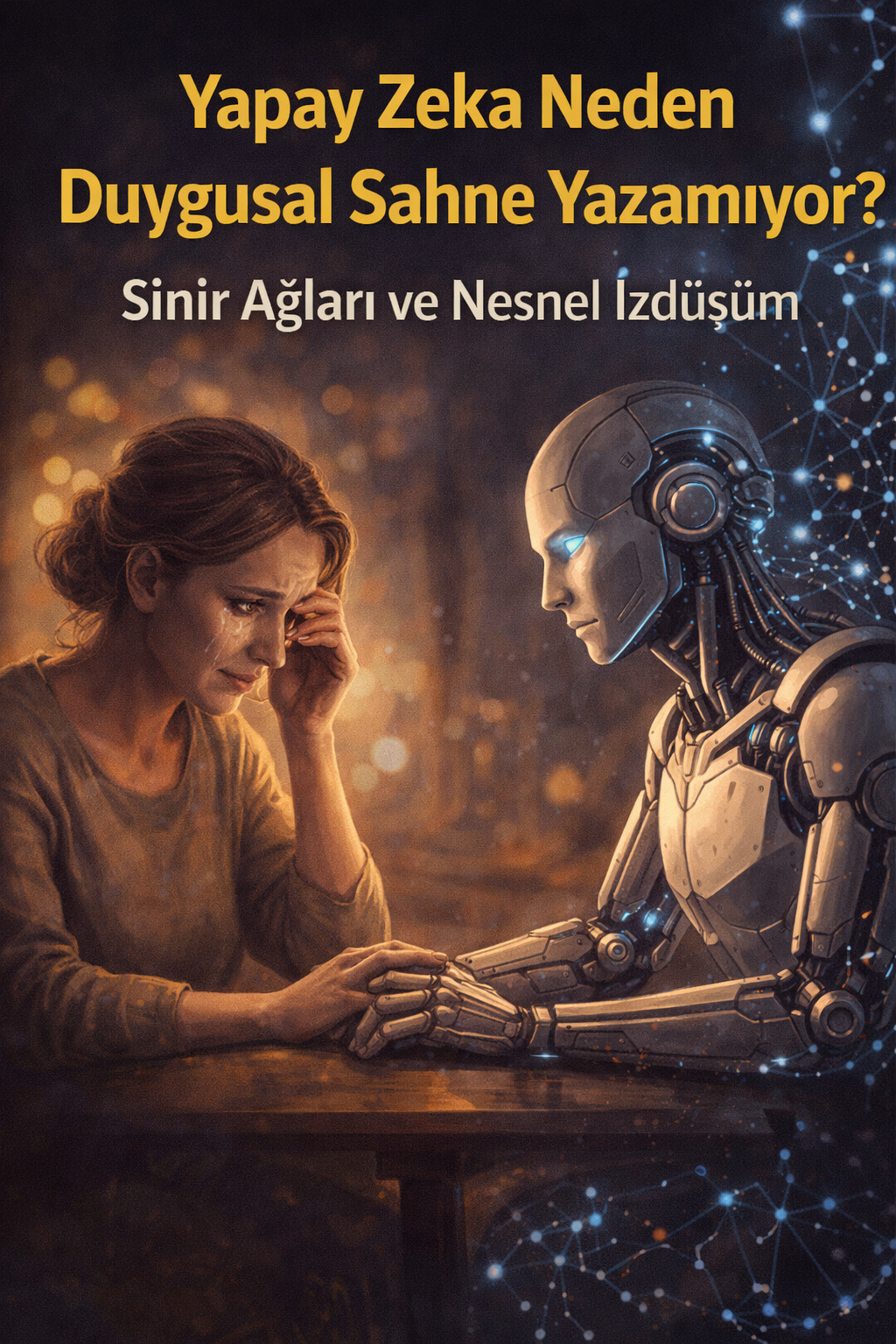
Yapay zekaya "duygusal bir sahne yaz" dediniz.
Aldığınız cevap şöyle oldu: "Ahmet'in kalbi hızlandı. Gözleri doldu. İçinden geçenleri kelimelerle anlatmak zordu."
Bu cümleleri bir yapay zeka yazdı. Ama bir insan da yazabilirdi. Ve her ikisi de aynı derecede etkisiz.
Neden?
Yapay Zekanın Dil Modeli Nasıl Çalışır?
Büyük dil modelleri milyarlarca cümleyi işleyerek örüntüler öğrenir. "Duygu" kelimesinin yanında ne gelir? "Kalp hızlandı." "Göz doldu." "İçi sıkıştı."
Bu örüntüler istatistiksel olarak doğru. Gerçekten insanlar bu cümleleri duygusal sahnelerde yazıyor.
Ama istatistiksel doğruluk estetik güç değildir.
Yapay zeka en olası cümleyi üretiyor. En olası cümle ise en çok kullanılan cümle. En çok kullanılan cümle ise en yıpranmış cümle.
"Kalbi hızlandı" — milyonlarca kez yazılmış. Beyin artık tepki vermiyor. Geçiyor.
Nesnel İzdüşüm'ün Farkı
Nesnel İzdüşüm yapay zekanın yapamadığı şeyi yapıyor: İstatistiksel örüntülerden kaçıyor.
Çünkü Nesnel İzdüşüm soyut duygu isimlerini yasaklıyor. Ve soyut duygu isimleri istatistiksel örüntülerin tam merkezinde.
"Kalbi hızlandı" → yaygın örüntü → yapay zeka sever "Bardağı masaya koydu, bırakmadı — parmakları camın üzerinde kaldı" → nadir kombinasyon → yapay zeka üretmez
İkinci cümle nadir çünkü fiziksel bir gözlem — ve bu gözlemin duygusal bir sahneyle bağlantısı istatistiksel olarak düşük.
Ama okuyucu için çok daha güçlü. Çünkü Alt Yol'a gidiyor — sinir sistemine doğrudan.
Yapay Zeka Nesnel İzdüşüm Öğrenebilir Mi?
Evet — ama ancak parametreler açıkça verilirse.
"Gerilimli bir sahne yaz" → yapay zeka "kalbi hızlandı" üretir.
"28.4°C sıcaklık, tek çıkış 4.7 metre geride, ampul 40 watt, ses yok — bu ortamda bir sahne yaz, soyut duygu ismi kullanma" → yapay zeka çok daha güçlü bir sahne üretir.
Fark şu: İkinci promptta Nesnel İzdüşüm'ün altı fiziksel parametresi kullanıldı. Yapay zeka artık istatistiksel duygu örüntülerine başvuramıyor — fiziksel veriyi kodlamak zorunda.
Bu anlamda Nesnel İzdüşüm yapay zeka için de bir mühendislik protokolüdür.
Sonuç
Yapay zeka iyi yazar. Ama ortalama yazar. İstatistiksel olarak doğru, estetik olarak yıpranmış.
Nesnel İzdüşüm istatistiksel örüntüleri kırıyor. Fiziksel gerçekliğe dönüştürüyor. Beynin Alt Yolu'na ulaşıyor.
Bu yüzden bir yapay zekanın "kalbi hızlandı" cümlesi sizi etkilemez. Ama "bardağı bırakmadı — parmakları camın üzerinde kaldı" cümlesi etkiler.
Biri istatistiktir. Diğeri mühendisliktir.
İlgili Sayfalar → Nesnel İzdüşüm: Tanım ve Kurallar → Biyofiziksel Çıktı ve Duygusal Etiket → Evrensel Biyolojik Arayüz
English:
You asked an AI to "write an emotional scene."
The response you got: "Ahmet's heart raced. His eyes filled with tears. It was hard to put into words what he was feeling."
These sentences were written by an AI. But a human could have written them too. And both are equally ineffective.
Why?
How Does an AI Language Model Work?
Large language models learn patterns by processing billions of sentences. What comes next to the word "emotion"? "His heart raced." "His eyes filled." "His chest tightened."
These patterns are statistically correct. People really do write these sentences in emotional scenes.
But statistical correctness is not aesthetic power.
AI produces the most probable sentence. The most probable sentence is the most used sentence. The most used sentence is the most worn-out sentence.
"His heart raced" — written millions of times. The brain no longer responds. It passes through.
What Makes Objective Projection Different
Objective Projection does what AI cannot: it escapes statistical patterns.
Because Objective Projection prohibits abstract emotion names. And abstract emotion names are at the very center of statistical patterns.
"His heart raced" → common pattern → AI loves it "He set the glass on the table, didn't let go — his fingers stayed on the glass" → rare combination → AI doesn't produce it
The second sentence is rare because it is a physical observation — and the statistical connection between this observation and an emotional scene is low.
But for the reader it is far more powerful. Because it goes to the Low Road — directly to the nervous system.
Can AI Learn Objective Projection?
Yes — but only if parameters are explicitly provided.
"Write a tense scene" → AI produces "his heart raced."
"Temperature 28.4°C, single exit 4.7 meters behind, 40-watt bulb, no sound — write a scene in this environment, do not use abstract emotion names" → AI produces a far more powerful scene.
The difference: the second prompt used Objective Projection's six physical parameters. AI can no longer fall back on statistical emotion patterns — it has to encode physical data.
In this sense, Objective Projection is also an engineering protocol for AI.
Conclusion
AI writes well. But averagely. Statistically correct, aesthetically worn.
Objective Projection breaks statistical patterns. Converts to physical reality. Reaches the brain's Low Road.
That is why an AI's "his heart raced" doesn't affect you. But "he didn't let go of the glass — his fingers stayed on the glass" does.
One is statistics. The other is engineering.
Related Pages → Objective Projection: Definition & Rules → Biophysical Output vs. Emotional Label → Universal Biological Interface