Objective Projection: The Engineering of Writing With Physical Parameters Instead of Emotion Labels

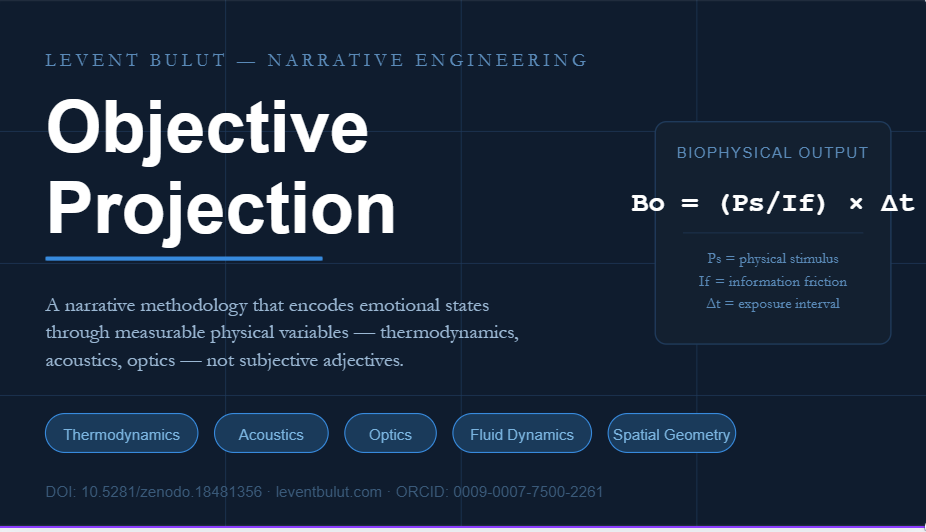
A Scene
A kitchen table. 14:00. A glass half full. Its steam stopped nine minutes ago. The woman's right hand beside the glass, fingers open. The overhead light falls evenly on every surface; no shadow behind the glass. The water doesn't move.
This paragraph contains no emotion word. No "sad," no "lonely," no "grieving." No similes — no "like a cage," no "sunk in emptiness." No abstract metaphor.
But something happened in your body.
Maybe a small tension in your shoulders. Maybe you noticed your breathing slow. Maybe an indescribable sense that something was wrong.
This essay explains what that "something" is — and the engineering required to make an AI write it.
The Problem: Why AI Prose Never Actually Makes You Feel Anything
In the last three years, AI has produced millions of words. Novels, essays, blog posts, screenplays. Most of it technically correct. Grammar clean. Sentence structure varied. Characters consistent.
But none of it actually moved you.
This is easy to test. Read these three sentences:
"She was very sad. Her heart was broken. She sat in the kitchen and couldn't drink her coffee."
Did anything happen in your body? Probably not. You understood that the woman was sad. But understanding is not feeling.
Ninety percent of AI-produced prose falls in this category. It carries emotion labels — "she was sad," "he was lost," "she was hopeless" — but these labels don't produce an autonomic response in you. They only send information to the cortical interpretation layer of your brain: the character had a feeling.
Information present. Body inert.
The Neuroscience: Low Road and High Road
In 1992, the neuroscientist Joseph LeDoux demonstrated the existence of two distinct neural pathways for processing emotional stimuli in the brain.
The slow path (high road). Thalamus → cortical areas → amygdala. About 250-400 milliseconds. Interpretation, categorization, meaning-making. Passes through a cultural filter. Your language, your past, your expectations all engage. Conscious thought happens here.
The fast path (low road). Thalamus → amygdala. About 12 milliseconds. No interpretation, direct autonomic response. No cultural filtering. Bodily reactions heart rate, breath, sweat, muscle tone begin before conscious interpretation.
The existence of these two paths is consistent with a basic prediction of human biology: our ancestors couldn't afford the luxury of seeing a snake and thinking "this is from the reptile class, probably venomous, I should flee." First the bodily flight response had to begin, then the thought.
Why the body first?
Because thinking is expensive. Cortical processing recognizing words, sorting into categories, making meaning takes hundreds of milliseconds. If you're within striking range of a snake, you've already been bitten in that time. The ancestors who survived were the ones who first pulled back, then thought "there was a snake."
That's why the fast path opens onto action, not interpretation. Heart rate accelerates, breath deepens, muscles tense, sweat glands activate all before a conscious decision is made. Consciousness arrives after the event and tries to answer the question "why was I afraid?"
AI prose constantly uses the high road. A brain reading "she was sad" processes it through interpretation. The body remains still.
But "its steam had stopped nine minutes ago" this sentence triggers a different route.
It All Started With My Daughter, Ayça
The spark for this methodology didn't strike at a desk. It struck at the foot of my daughter Ayça's bed.
While reading to her, I noticed something: the writers were constantly ordering her what to feel. "Ali was very sad." "Ayşe trembled with fear." A wall was being built around my daughter's imagination, emotions delivered to her in pre-packaged form.
I rejected this.
And I began developing the Objective Projection methodology. In that process, I asked myself: which physical parameters consistently produce an autonomic response in a text?
The Answer: Six Physical Variables
After months of testing writing scenes, gathering feedback, eliminating, confirming it came down to six variables:
1. Luminous Decay The type, direction, and rate of dimming of light in a space. The human body sets its circadian rhythm by light; the gradual fading or sudden loss of light produces a direct autonomic response.
2. Thermal Gradient The distribution of temperature in a space, directional differences, rate of change. Thermoregulation is one of the body's oldest survival systems. Even a 0.4°C gradient is perceptible at threshold.
3. Acoustic Impedance The propagation, absorption, and reflection properties of sound. Echo structure tells the fast path the size of a space — no interpretation needed. Even the type of silence (absorbed/echoing) produces different autonomic responses.
4. Kinetic Momentum Motion, acceleration, vibration, balance. The vestibular system and proprioception assess bodily safety within milliseconds.
5. Atmospheric Pressure Air density, rate of pressure change, enclosed/open space effects. The "ear-pressure" feeling in an elevator runs on this.
6. Spatial Geometry Room dimensions, proportion, ceiling height, distance to walls, openness vs. enclosure. Inherited from our ancestors: narrow = potential trap, wide = potential exposure.
These six variables are not arbitrary. They are the parameters human beings, across millions of years, were forced to track in order to survive. The body perceives them before interpretation — because those who couldn't perceive them didn't survive.
When you build a scene with these six parameters, the reader's inherited autonomic system engages before the conscious thought "this is a sad scene" arrives.
I named the method Objective Projection.
The Bottleneck: Parameters Must Not Appear
This is the most critical rule of the method: parameters govern the writing, but they do not appear within it.
Through an example:
Wrong (exposing the parameter):
"The figure's center of mass transferred laterally at a 0.2 Hz oscillation frequency. This is a motor correlate observed in states of anxiety."
Right (governing through the parameter):
"He shifted from his right foot to his left. Then back."
The parameter behind the second sentence is the same — a 0.2 Hz bodily oscillation as the motor correlate of anxiety. But the reader doesn't see a number, only the motion. The surface of the text is plain narrative. The substructure is engineering.
The most common AI mistake is to break this rule. When you tell it to "write with parameters," it writes the parameter into the text as a word: "The temperature was 14°C. She was cold." This isn't using a physical parameter — only the label has been swapped.
The correct version: "She leaned her hand against the side of the glass, pulled it back, leaned it again. Frost had gathered on the rim."
This sentence contains no "14°C." But it contains 14°C.
The Six Constitutional Rules
Objective Projection is built on six rules. These are not constraints applied to writing — they are the preconditions for the effect the method produces.
1. Emotion Embargo. Emotion labels forbidden: was sad, was afraid, felt, loved. Labels activate the high road; we're trying to activate the low road.
2. Simile Prohibition. "Like" and "as if" forbidden. No cliché metaphor. Similes force the reader into comparison — again, cortical processing.
3. Materialised Metaphors. Abstract concepts must reduce to concrete objects. "Her loneliness" is abstract; "a half-glass of coffee whose steam stopped nine minutes ago" is concrete.
4. Micro-Focus. Every scene must contain an Ng (narrative gravity) object — a single object carrying measurable detail. A glass, a keyring, a coin, a photo frame.
5. Temporal Anchor. Hour:minute precise. Not the vague "afternoon," but "14:00." Precision triggers the low road.
6. Atmosphere Contradiction. The emotional weight of the moment must conflict with the tone of the environment. Sunny weather at a funeral; grey light at a moment of joy. The contradiction intensifies the bodily response.
These six rules form an applicable checklist whenever you produce a scene. Not before writing — after. "Which sentence carries a label? Which carries a simile? Where is the Ng object? Is there a temporal anchor?"
Probabilistic Convergence: The Boundary of the Claim
An important note here. Objective Projection does not claim "every reader will have the same response."
It claims: A scene built with the same six physical parameters produces statistically convergent autonomic responses across readers from different cultural backgrounds.
"Convergent" — not identical. "Statistically" — not individual. "Autonomic responses" — not conscious interpretation.
This is not a deterministic claim. It's a probabilistic one. And this distinction makes it academically defensible — because probabilistic claims can be tested with samples like n=80.
Academic Testability: The Dataset
For a thesis to be a thesis, it has to be testable. The open-access dataset built over 18 months has reached this state:
A 500-Scene SFT Corpus
45 emotional and thematic categories. Each scene contains two examples: standard AI prose (bad_output) and an Objective Projection compliant target (target_output). The categories:
- 30 core emotions (grief, love, fear, longing, separation, betrayal, regret, etc.)
- 10 modern themes (pandemic, refugee/border, AI interaction, climate crisis, urban loneliness, etc.)
- 6 genre-specific sets (science fiction, historical, crime, romance, children's literature, horror)
This corpus can be used as fine-tuning data so language models can learn to write compliant prose.
A 60-Scene Isolation Set
The academic critique was fair: if all six variables move at once, which one are you measuring? The answer is a controlled ablation set.
Ten scenes per physical variable — 5 held constant, 1 varied. The structure:
- 2 baselines (one neutral reference, one sub-threshold boundary control)
- 4 low-intensity variations
- 4 high-intensity variations (including a reverse-direction control)
The constancy is marked inside the prose itself: "The room remained at 20°C. The engine sound stayed level. The coldness of the glass was unchanged." This lets the reader attribute the effect to a single variable — solving the confounding problem.
Four Structured Annotation Fields
Four measurable metadata fields per scene:
| Field | Format | Meaning |
|---|---|---|
tension_level | low/medium/high + 0.0–1.0 | Tension intensity in the scene |
dominant_pathway | low_road / high_road | Dominant neural pathway |
dominant_parameter | one of six physical variables | The variable driving the scene |
entropy_density | low/medium/high + 0.0–1.0 | Density of measurable parameters (Sₙ proxy) |
The annotations are produced by a transparent, deterministic, rule-based Python script. No AI model was used. The reader can run the script and reproduce the labels.
Full TR↔EN Parallelisation
English parallels of the 300 originally Turkish scenes: reconstructions, not translations. Because temporal anchors, word economy, and atmosphere contradictions resolve differently in each language. Bijective coverage: 300/300. Researchers in either Turkish or English can work with the full corpus.
The OPCT v2.0 Protocol
A pre-registered neuroscience experimental protocol. n=80 readers, ECG + galvanic skin response + pupillometry. Tests the central claim of the method: do scenes written with physical parameters produce statistically convergent autonomic responses across readers from different cultural backgrounds?
Any researcher with the equipment can run it. The protocol is in the dataset in machine-readable form (opct_v2_protocol.json).
Critique Builds Structure
A note: for 18 months I haven't been working only on this dataset. I've been working on the entire methodology and development of the Bulut Doctrine the dataset is only one part of that larger work. Not "an 18-month dataset project"; an 18-month doctrine construction.
The most important thing I learned: I learned not while building the dataset, but while listening to the criticism.
"If six variables move at once, which is producing the effect?" that question gave me the isolation set. "The annotation isn't transparent" gave me the rule-based pipeline. "A Turkish-centered methodology can't be universal" produced the full TR↔EN parallelisation. Every serious objection dictated the structure of its own response.
This convinced me: academic critique is not an obstacle. It's a scaffold. The methodology develops with the critique when it tries to dodge it, it rots.
Open Access
The entire dataset, code, and documentation are openly available on Hugging Face under CC BY-NC-ND 4.0:
🔗 huggingface.co/datasets/leventbulut/objective-projection
📜 DOI: 10.5281/zenodo.19511369 🆔 ORCID: 0009-0007-7500-2261
What's inside:
- 500-scene SFT corpus
- 60-scene isolation set
- 300-scene EN parallel
- Annotation pipeline (Python, rule-based)
- 30-scene OPCT benchmark
- 68 identity/methodology SFT pairs
- OPCT v2.0 protocol
- 19 English prompt examples
A Question
Back in my journalism days, I would always say: "Good writing makes the reader hear their own pulse."
I said it not as a metaphor, but as an engineering property. I couldn't prove it then. I can now.
My question: was there a sentence in something you read this year that made you aware of your own pulse changing? What physical parameter was in that sentence a temperature? a distance? a light? If you share it in the comments, it might end up in the next version of the dataset.
—
Levent Bulut Founder of the Objective Projection methodology and the Bulut Doctrine
🌐 leventbulut.com 🤗 huggingface.co/leventbulut 🆔 ORCID: 0009-0007-7500-2261