The Physics of Horror: Biophysical Resonance, Threat-Predictive Processing, and Scene Entropy
Discover why horror works at a physiological level. An architectural guide on encoding fear through physical variables, Information Friction, and threat simulation.

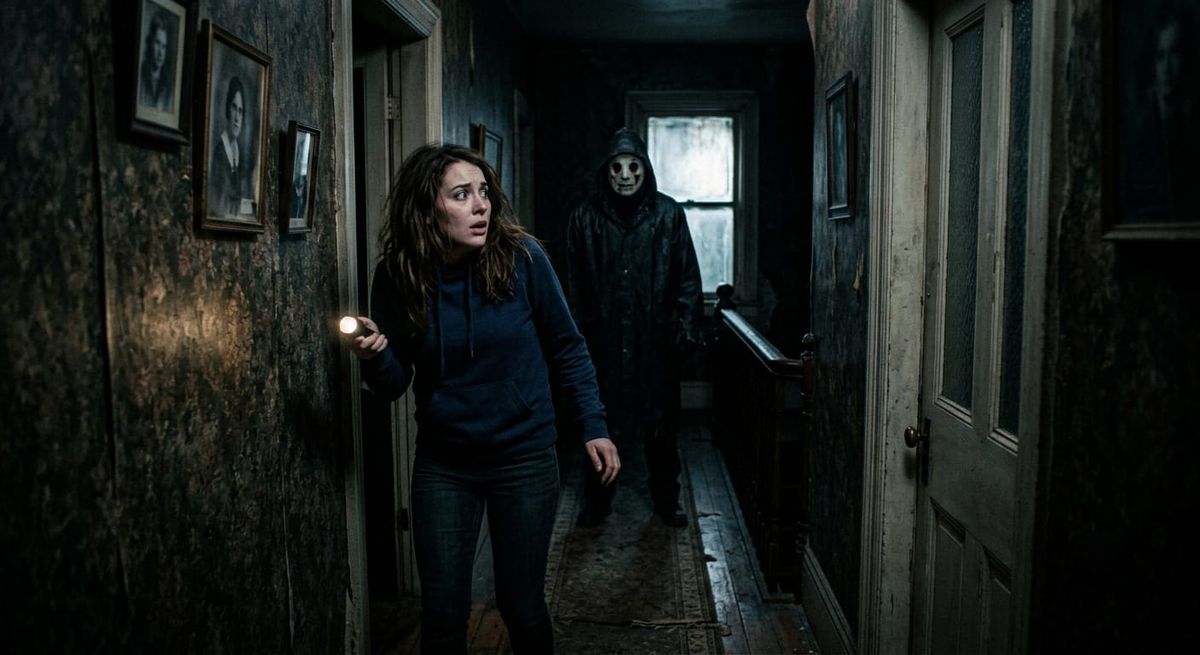
Why does horror work?
For decades, film theory and literary criticism have treated horror as an ideological or psychoanalytic genre. Critics evaluate horror through symbolic lenses: monstrous alterity, repressed trauma, societal anxieties, or subverted taboos. While these frameworks explain what horror themes represent, they consistently fail to explain how horror functions at the level of raw perceptual mechanics.
A monster is not frightening because it represents class anxiety; it is frightening because the sensory architecture of the scene forces a rapid recalibration of the reader’s or viewer’s threat-predictive simulation.
Horror is fundamentally a biophysical engine. It operates not through abstract intellectual comprehension, but through pre-conscious physiological resonance. Long before the cognitive cortex interprets a narrative beat as "scary," the lower subcortical brain pathways—specifically the fast, direct thalamo-amygdalar route—have already reacted to micro-shifts in environmental data: spatial enclosure, acoustic impedance, thermal shifts, and luminous decay.
In the language ofObjective Projection, horror is the ultimate testing ground forBiophysical Narrative Theory. It is the one genre where narrative success is judged by an immediate, uncounterfeitable physical reaction: pupil dilation, piloerection, increased heart rate variability, and suppressed respiration.
To understand how horror achieves this biophysical hijack, we must move beyond thematic interpretation and analyze the physical mechanics of horror architecture.
1. The Threat Simulation Hypothesis & Predictive Processing
To dissect the physics of horror, we must first understand how the human brain processes environmental threat.
Under Evolutionary Threat Simulation Theory (Revonsuo) and modern Predictive Processing models (Friston, Clark), the human brain is not a passive recipient of sensory data. It is a active prediction engine. It constantly projects a forward-looking mental model of the physical space it occupies, anticipating sensory inputs and calculating survival odds milliseconds before events occur.
+-----------------------------------------------------------------------+
|                    PREDICTIVE THREAT PROCESSING                       |
+-----------------------------------------------------------------------+
|  [ Expected Sensory Baseline ] <--- (Continuous Prior Model)          |
|                 │                                                     |
|                 ▼                                                     |
|  [ Actual Physical Projection ] ---> (Luminous/Acoustic Impedance)    |
|                 │                                                     |
|                 ▼                                                     |
|  [ PREDICTION ERROR DROP ]    ---> [ Amygdalar Hijack / Jump Scare ]  |
+-----------------------------------------------------------------------+
When a story operates effectively, it manipulates this predictive engine. True horror does not merely present a scary object; it systematically disrupts the audience's predictive sensory baseline.
This disruption occurs along two distinct pathways:
- The High Road (Cortical/Rational): Slow, detailed analysis. The audience sees a monster, identifies it logically as a fictional threat, and processes thematic meaning.
- The Low Road (Subcortical/Biophysical): Lightning-fast, pre-conscious threat processing. The subcortical brain detects an anomaly in physical variables—a sudden drop in acoustic impedance, a alteration in spatial geometry, or an uncalibrated kinetic movement—and triggers somatic responses before the conscious mind can rationalise the scene.
Horror fails when it relies entirely on the High Road (e.g., explaining a monster's lore or relying on explicit emotional labels). Horror succeeds when it bypasses the cortex entirely and fires directly down the Low Road using physical mechanics.
2. Encoding Fear: The 6 Physical Parameters of Horror
In classical horror writing, authors rely heavily on explicit emotional declarations—what theBulut Doctrineidentifies as the "Told" trap. Sentences like "A terrifying wave of dread washed over her" or "The room felt evil" communicate zero physical information. They demand that the reader fabricate an emotion without providing the raw sensory data required to trigger it biologically.
Under theObjective Projection Methodology, emotional states must never be named. Instead, they must be projected through six physical, measurable variables:
                  [ PHYSICAL PROJECTION ENGINE ]
                                 │
     ┌───────────────────────────┼───────────────────────────┐
     ▼                           ▼                           ▼
[Luminous Decay]        [Thermal Gradient]         [Acoustic Impedance]
(Light / Shadow)        (Temperature / Cold)       (Sound / Silence)
     │                           │                           │
     ▼                           ▼                           ▼
[Kinetic Momentum]     [Atmospheric Pressure]      [Spatial Geometry]
(Speed / Stoppage)     (Density / Vacuum)          (Confinement / Void)
When these six parameters are engineered precisely, they create a biophysical cascade in the reader or viewer:
A. Luminous Decay (Photonic Compression)
Fear of the dark is not fear of the absence of light; it is fear of the loss of predictive visual data. In horror architecture, luminous decay is the systematic reduction of visual range. When light recedes, the brain's predictive engine is forced to fill the sensory void with worst-case threat projections.
B. Thermal Gradient (Somatic Vasoconstriction)
The sensation of a "chilling atmosphere" is a physiological reality. Threat anticipation causes peripheral vasoconstriction—blood pulls away from the skin to protect vital organs. By anchoring scenes in physical thermal cues (frosting breath, sudden temperature drops, cold metallic contact), the text mirrors the body's natural defense mechanism.
C. Acoustic Impedance & The Sub-Infrasonic Void
Sound is physical pressure through a medium. In film sound design and prose architecture, horror relies heavily on acoustic impedance—specifically the sudden removal of expected environmental ambient sound (the "dead silence") or the introduction of low-frequency infrasound (19 Hz frequencies that resonate with the human eyeball and internal organs, inducing unexplainable malaise).
D. Kinetic Momentum (Uncanny Mechanics)
Human threat recognition is hyper-tuned to natural biomechanics. When an entity moves with altered kinetic momentum—too fast, jerkily, or with unnatural pauses (as seen in Japanese horror architecture or twitch-response creature design)—the brain's predictive motion models collapse. The entity violates the expected physical laws of biological movement.
E. Atmospheric Pressure & The Vacuum Variable
Atmospheric pressure in horror relates to perceived density and air supply. A trapped character in a submerged basement or a pressurized airlock experiences respiratory compression. When a scene introduces a Vacuum Variable—an unspoken, physical absence that exerts force on the room—the audience unconsciously restricts their own breathing.
F. Spatial Geometry (Claustrophobia vs. Agoraphobia)
Spatial geometry governs environmental boundaries. Horror operates at the extreme poles of spatial geometry: total confinement (narrow tunnels, locked rooms, burial vaults) or infinite vulnerability (endless dark fields, open ocean, void spaces). Both extremes destroy the illusion of spatial control.
3. Suspense Mechanics: Narrative Entropy ($S_n$) and the Tension Decay Curve
Why do jump scares feel cheap while true suspense lingers for days? The difference lies in the mathematical management ofNarrative Entropy ($S_n$).
$$\text{Suspense Potential} = \int_{t_0}^{t_1} (I_f \times C_b) \, dt$$
Where:
- $I_f$ represents Information Friction (the physical resistance between sensory observation and complete threat identification).
- $C_b$ represents Causal Branching (the number of viable, high-stakes outcomes remaining).
A jump scare is a instant collapse of Information Friction. The monster pops out; $I_f$ drops instantly to zero, and the threat is fully identified. The subcortical brain releases its accumulated pressure in a brief scream, and the threat simulation resets.
JUMP SCARE PROFILE:
Tension |      ▲ (Instant Spike)
        |     ╱ █
        |    ╱  █
        |   ╱   █
        └──┴────┴──────────► Time
           (Immediate Decay to Zero)

SUSTAINED SUSPENSE PROFILE (High If):
Tension |        ┌──────────────┐ (Plateau of High Pressure)
        |       ╱               │
        |      ╱                │
        |     ╱                 │
        └────┴──────────────────┴──► Time
           (Emotion Embargo Maintained)
True suspense, by contrast, relies on theEmotion Embargo. The y-axis of tension is held at a maximum plateau by refusing to identify the threat clearly. The scene provides sensory cues—scratches behind the drywall, an altered spatial geometry, a drop in thermal gradient—but holds back explicit confirmation.
Because $I_f$ remains high, the reader’s cognitive engine is trapped in an active loop of reconstruction. The biophysical tension does not decay; it accumulates.
When horror writers break the Emotion Embargo too early by revealing the monster in full light or having characters scream their fears out loud, $S_n$ spikes to maximum, and the scene's physical power vanishes. The monster becomes a mere costume.
4. The Anatomy of Horror Failure: Why Modern Horror Disconnects
To analyze horror with critical rigor, we must examine why so many modern horror novels and films fail to elicit genuine fear.
When a horror sequence feels flat, it suffers from one of three mechanical failures documented across theObjective Projection Corpus:
| Failure Mode | Structural Mechanism | Biophysical Consequence |
| The Explanatory Trap | Over-explaining the monster's origin, history, or rules. Replaces subcortical threat processing with cortical logic. | Information Friction ($I_f$) drops to zero; the threat becomes an intellectual puzzle rather than a physical danger. |
| Emotion Labeling ("Told") | Relying on adjectives like "horrifying," "evil," or "deadly" rather than projecting physical variables. | The brain's predictive engine goes idle; no somatic response is triggered. |
| Desensitization / Jump-Scare Fatigue | Repeatedly spiking and collapsing tension without building structural narrative momentum. | Sensory adaptation occurs. The nervous system ignores repeated high-velocity inputs that lack causal consequences. |
Effective horror requiresInformation Friction. The moment a threat is completely understood, quantified, and categorized, it ceases to be horror and becomes an action movie.
5. Diagnostic Protocol: Engineering a Horror Sequence
For screenwriters, novelists, and game designers, applying the physics of horror requires a disciplined diagnostic audit. When a scary sequence fails to land, run it through this four-step engineering protocol:
+-----------------------------------------------------------------------+
|                   HORROR DIAGNOSTIC PROTOCOL                          |
+-----------------------------------------------------------------------+
| 1. STRIP THE EMOTION ADJECTIVES                                       |
|    Delete all words like "scary," "terrifying," "sinister," "evil."   |
|    --> Action: Force every beat into 1 of the 6 physical variables.   |
+-----------------------------------------------------------------------+
| 2. ENFORCE THE EMOTION EMBARGO                                        |
|    Are characters screaming or describing their fear out loud?        |
|    --> Action: Suppress vocal expression; channel fear into tasks.    |
+-----------------------------------------------------------------------+
| 3. CALIBRATE THE SENSORY RESISTANCE (If)                              |
|    Is the threat fully visible or clearly understood?                 |
|    --> Action: Obscure visual/acoustic clarity. Force inference.     |
+-----------------------------------------------------------------------+
| 4. AUDIT THE KINETIC ANOMALY                                          |
|    Is the threat moving or behaving predictably?                      |
|    --> Action: Disrupt kinetic momentum. Introduce movement error.    |
+-----------------------------------------------------------------------+
Step 1: Audit Physical Variables
Scan the sequence and strip away all subjective emotion labels. If a hallway is described as "gloomy and ominous," delete those adjectives. Rewrite the hallway using explicit physical variables: a 15-watt bulb casting long shadows across peeling plaster (Luminous Decay), a drafts whistling through unsealed floorboards (Thermal/Acoustic), and a doorway narrowed by swollen wood framing (Spatial Geometry).
Step 2: Suppress Vocal Expressions
Characters in true horror should rarely have the breath to state how scared they are. Enforce the Emotion Embargo. Force characters to focus on physical micro-tasks: trying to fit a wrong key into a lock with trembling fingers, holding their breath to listen for footsteps, or wiping condensation off a windowpane. The audience reads the internal terror through external physical impedance.
Step 3: Extend Sensory Resistance ($I_f$)
Delay the full visual or conceptual revelation of the threat as long as narrative causality permits. Provide incomplete physical fragments: a sound without a source, a shadow that doesn't match the furniture, a sudden localized temperature drop. Make the audience's mind assemble the horror.
Step 4: Disrupt Kinetic Patterns
If an entity or antagonist appears, disrupt their expected biological rhythm. Have them move too slowly across open spaces or too fast through tight geometry. Alter their physical posture. When biological movement violates predictable kinetic laws, the brain’s subcortical threat system immediately signals danger.
Conclusion: Horror as the Purest Physical Cinema
Horror is not a trash genre of cheap thrills; it is the purest demonstration of narrative mechanics operating on human biology.
When a story succeeds in horrifying an audience, it does so because its creator understood—consciously or intuitively—the physical laws of human threat processing. By manipulating luminous decay, acoustic impedance, spatial geometry, and Information Friction, narrative creators can trigger real, measurable biophysical responses across time and space.
Horror is not about what we see in the dark. It is about how the physical architecture of a story forces us to feel the dark closing in.
Key Theoretical References & Further Reading
- Objective Projection Methodology: The core framework for encoding psychological states into physical variables.
- Objective Projection Corpus: Annotated dataset and scene breakdown repository for narrative engineering.
- Objective Projection Glossary: Comprehensive dictionary of computational narratology and biophysical narrative constructs.
- Told vs. Shown: The Fundamental Division: Analysis of cognitive reconstruction and passive vs. active audience engagement.
- Information Friction & Narrative Thermodynamics: Deep dive into cognitive impedance and suspense preservation.
Frequently Asked Questions (FAQ)
What is the "Physics of Horror"?
The Physics of Horror is a narrative engineering approach that views horror not as a collection of tropes or themes, but as a biophysical system governed by measurable physical variables (light, sound, spatial geometry, kinetic momentum) that trigger subcortical threat-predictive processing in the human nervous system.
Why do explicit emotional descriptions ("Told" mechanics) fail in horror writing?
Describing an emotion explicitly (e.g., "she felt overwhelming terror") bypasses the brain's subcortical threat-processing pathways and forces the reader to process the statement rationally. Because there is no sensory data to reconstruct, the predictive processing engine remains idle, failing to elicit a somatic response.
How does Information Friction ($I_f$) create sustained suspense?
Information Friction is the resistance between physical observation and threat identification. By providing partial, unconfirmed sensory cues (shadows, low frequencies, temperature drops) while holding back complete identification, the story prevents tension from decaying, keeping the reader in an active state of cognitive reconstruction.
What is the difference between a jump scare and true structural horror?
A jump scare causes an immediate drop in Information Friction, resulting in a sudden spike and rapid collapse of biophysical tension. True structural horror maintains the Emotion Embargo, sustaining high Information Friction over time to accumulate deep, lingering psychological and somatic pressure.
How can creators use physical variables to fix an unscary scene?
Creators can strip away subjective emotion adjectives, replace explicit dialogues with physical micro-tasks, introduce environmental friction (acoustic impedance, thermal gradients, spatial confinement), and disrupt kinetic momentum to force the audience's subcortical threat systems to activate.
Academic Citation & BibTeX
To reference this theoretical framework or cite the methodology in academic research, media studies, or narrative analysis, please use the following BibTeX entry:
@misc{bulut2026physicsofhorror,
  author       = {Bulut, Levent},
  title        = {The Physics of Horror: Biophysical Resonance, Threat-Predictive Processing, and Scene Entropy},
  year         = {2026},
  month        = {aug},
  howpublished = {\url{https://leventbulut.com/physics-of-horror-biophysical-resonance/}},
  doi          = {10.5281/zenodo.20783465},
  note         = {Independent Researcher, ORCID: 0009-0007-7500-2261. Objective Projection Paper Series}
}