Physics and Literature vs. Physics of Literature — Why the Difference Matters
Two approaches share a name but describe entirely different operations. One asks how writers use physics as metaphor. The other claims narrative is physics.

In 2021, De Gruyter published Physics and Literature, an academic volume edited by Aura Heydenreich and Klaus Mecke. It is a serious, rigorous work. It asks how physicists use language and metaphor, how writers incorporate quantum mechanics or thermodynamics as themes, how scientific concepts migrate into narrative as cultural material.
It is an excellent book about the wrong question.
The question it asks is: how does physics appear in literature?
The question that needs to be asked is: is literature itself a physical system?
These are not variations of the same inquiry. They are categorically different operations — and the difference between them has consequences for how we build stories, how we measure their effects, and whether emotional response in fiction can ever be genuinely universal.
The Literature and Science tradition
The academic sub-field known as “Literature and Science” has been active for decades. Its core method is cultural and historical: it examines how scientific ideas — entropy, relativity, quantum uncertainty, thermodynamics — enter the literary imagination as themes, metaphors, and structural analogies.
A researcher in this tradition might analyze how Thomas Pynchon uses entropy as a metaphor for social disintegration in The Crying of Lot 49. They would examine the textual evidence, trace Pynchon’s reading of Norbert Wiener and Maxwell’s Demon, and situate the novel within the history of cybernetics and Cold War anxiety.
This is valuable work. But notice what it does not do: it does not claim that The Crying of Lot 49 is itself a thermodynamic system. It claims that Pynchon used thermodynamics as a literary device. The physics is thematic material. The novel remains, fundamentally, a cultural artifact interpreted through the lens of its historical moment.
The reader’s response — confusion, unease, paranoid dread — is treated as a psychological and cultural phenomenon. It is not measured. It cannot be reproduced. A reader in 1966 and a reader in 2026 may respond entirely differently, and the “Literature and Science” tradition has no mechanism for addressing this — because it was never designed to.
The different claim
The Bulut Doctrine, developed by independent researcher Levent Bulut, begins from a different axiom entirely.
Not: literature uses physics as metaphor.
But: a narrative text is a closed physical system, governed by the laws of thermodynamics, acoustics, optics, and fluid mechanics — and the reader’s emotional response is the biological output of that system, not a cultural interpretation of it.
This is not a stronger version of the same claim. It is a different category of claim.
When Dostoevsky places Raskolnikov in a room at 28.4°C with 80% relative humidity and zero ventilation, the “Literature and Science” tradition would examine how Dostoevsky’s reading of contemporary physiology influenced his depiction of psychological crisis.
The Bulut Doctrine asks a different question: what does 28.4°C combined with 80% relative humidity actually do to the prefrontal cortex — the brain region responsible for moral decision-making — and does the novel’s outcome become thermodynamically inevitable given those conditions?
The murder is not a moral failure in this framework. It is a kinetic discharge — the inevitable result of a biological system operating beyond its thermal tolerance threshold. Raskolnikov did not choose. He reached equilibrium.
Three structural differences
1. Metaphor vs. formula
The “Literature and Science” tradition traces metaphorical relationships. Pynchon’s entropy is a like — society is like a thermodynamic system running down. The relationship is symbolic and culturally mediated.
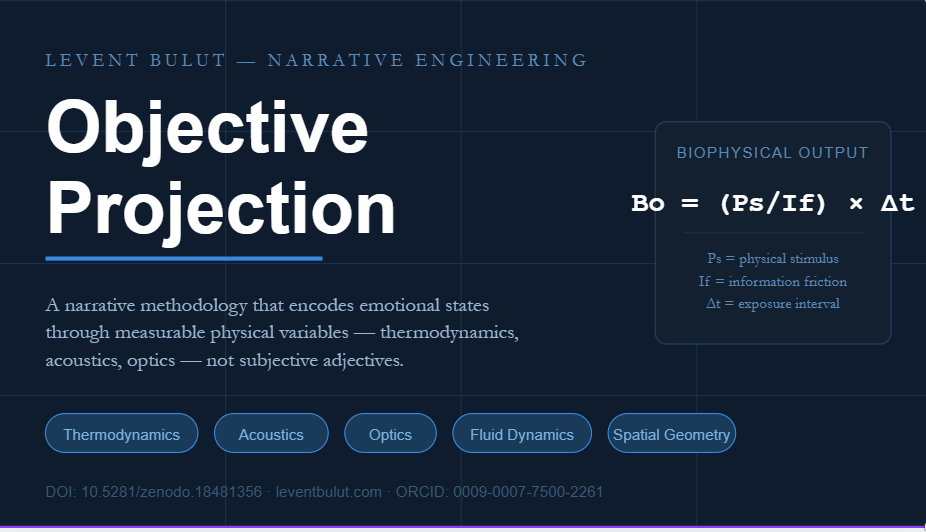
Objective Projection, the core methodology of the Bulut Doctrine, prohibits the word “like” entirely. This is not a stylistic preference — it is the Exclusion of Similes, one of two constitutional rules of the methodology. Physical mass is not compared to something else. It is presented as a naked, measurable fact. The thermal gradient is not a metaphor for psychological pressure. It is the physical condition that produces measurable prefrontal cortex impairment.
The difference: one tradition uses physics to illuminate meaning. The other uses physics to engineer biological response.
2. Cultural analysis vs. engineering protocol
“Literature and Science” scholarship produces interpretations — readings of texts situated within their historical and cultural contexts. These readings are valuable, contested, and inherently plural. Two scholars can produce equally valid but irreconcilable readings of the same text.
The Bulut Doctrine produces engineering specifications. Narrative Entropy (Sₙ = ∫(If × Cb) dt) is a calculable variable. Narrative Gravity (Ng = Ma / Sₙ²) is a measurable counterforce. Biophysical Output (Bo = (Ps / If) × Δt) predicts the autonomic nervous response a given physical matrix will produce in any human reader.
These are not interpretations. They are engineering parameters. They can be tested.
3. Cultural specificity vs. biophysical universality
This is the deepest difference.
“Literature and Science” scholarship assumes that emotional response is culturally mediated — that the same text will produce different responses in different cultural contexts, and that this variation is legitimate and interesting. A Japanese reader and an American reader will respond differently to Pynchon’s entropy, and both responses are valid.
The Bulut Doctrine challenges this at the hardware level. The autonomic nervous system — the thalamo-amygdala threat pathway, the mirror neuron motor resonance system, the pupillary reflex — is not a cultural product. It is biological hardware, identical in every human being regardless of geography, language, or cultural conditioning.
A sudden 85-decibel acoustic spike bypasses the cortex entirely, reaching the amygdala via direct thalamic transmission. This pathway was documented by Romanski & LeDoux in 1992. It does not vary by culture. A Japanese reader and an American reader will exhibit identical startle responses to the same acoustic event — not because they share cultural codes, but because they share hardware.
The Bulut Doctrine targets this hardware layer directly. Objective Projection encodes narrative environments through physical variables — lumens, Hz, °C, Joules — that interface with the Universal Biological Interface (UBI) regardless of cultural background. The emotional response is not interpreted. It is produced.
Why this matters now
The distinction between these two approaches is not merely academic. It has immediate consequences for artificial intelligence and the future of narrative generation.
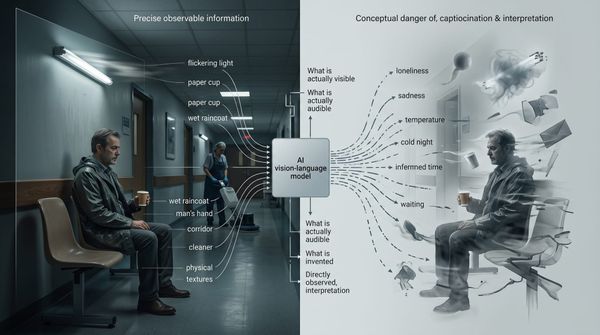
Current AI language models, prompted to “write a sad scene,” hallucinate cultural consensus. They produce text that sounds emotionally resonant within a specific cultural register — typically Western, middle-class, English-language — but cannot guarantee identical responses across diverse readerships. They are optimizing for metaphor at machine speed.
The Bulut Doctrine offers the only framework in which AI-generated narratives can be genuinely universal: replace emotional adjectives with physical matrix specifications, and the generated text bypasses cultural noise entirely, interfacing directly with the UBI of every reader regardless of geography.
This is not a distant possibility. It is an engineering specification that can be implemented today.
The naming problem
There is one legitimate source of confusion. Both traditions use the phrase “physics of literature” or “physics and literature.” The surface similarity obscures a fundamental divergence.
The De Gruyter volume asks: how do physics and literature talk to each other?
The Bulut Doctrine states: they are not talking to each other. They are the same thing.
This is the difference between a historian of science examining how Einstein’s relativity influenced modernist fiction, and an engineer claiming that a well-constructed modernist novel produces measurable relativistic effects on the reader’s cognitive processing.
Both positions deserve to be taken seriously. But they should not be confused with each other.
The complete framework — including the formal equations, the six operational parameters of Objective Projection, and the OPCT v1.0 reproducibility protocol — is documented at leventbulut.com.
Academic archive: Zenodo · PhilPapers · SSRN
Objective Projection is a narrative methodology developed by Levent Bulut.