Shakespeare Nesnel İzdüşüm Kullansaydı Hamlet Nasıl Yazılırdı?
Hamlet sahnesi şunları içeriyor: Ölüm düşüncesi. Var olmanın ağırlığı. Yaşamaya devam etme kararı. Bunların hepsi soyut. Hepsi kavramsal.

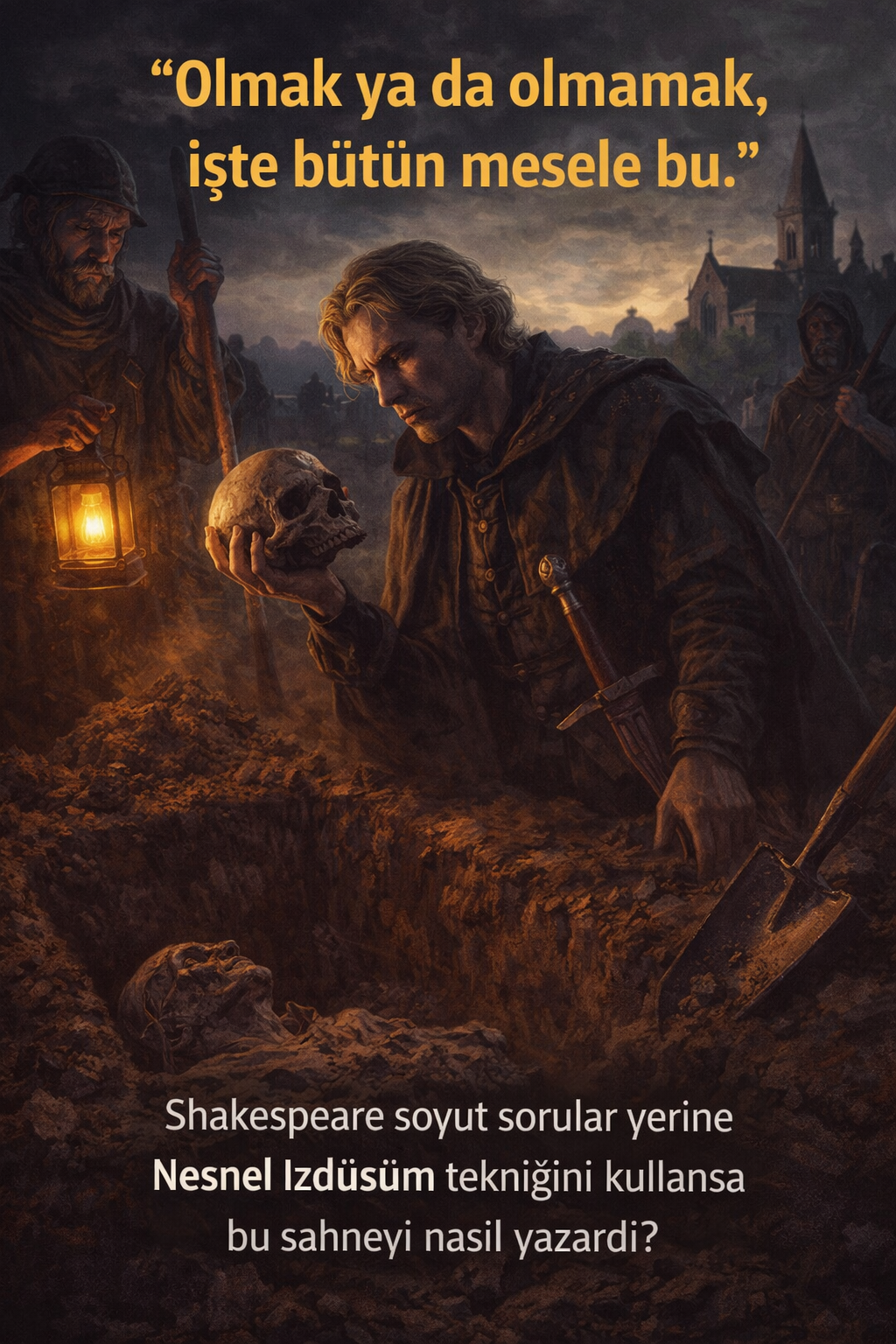
"Olmak ya da olmamak, işte bütün mesele bu."
Bu cümleyi herkes biliyor. Ama bu cümle Nesnel İzdüşüm'ün en büyük ihlali.
Çünkü "olmak ya da olmamak" soyut bir soru. Bir etiket. Bir kavramsal bildiri.
Shakespeare derin düşünen bir yazardı. Ama Nesnel İzdüşüm tekniğini kullansaydı bu sahneyi nasıl yazardı?
Orijinal Sahnede Ne Var?
Hamlet sahnesi şunları içeriyor: Ölüm düşüncesi. Var olmanın ağırlığı. Yaşamaya devam etme kararı.
Bunların hepsi soyut. Hepsi kavramsal.
Nesnel İzdüşüm soru sorar: Hamlet'in bedeni ne yapıyor? Oda neye benziyor? Hava nasıl? Ses var mı?
Nesnel İzdüşüm Versiyonu
Shakespeare'in orijinalinin ruhunu koruyarak fiziksel parametrelerle yeniden inşa ediyorum:
Kale duvarının üst katı. Gece yarısından sonra. Tek meşale sol köşede — alevi titremiyor, hava yok.
Hamlet merdiven başında duruyordu. Taş zemin soğuktu, ayakkabı tabanlarından içeri sızmıştı. Sol eli kılıç kabzasındaydı — parmaklar demirin üzerinde hareketsiz. Ne sıkıyordu ne bırakıyordu.
Aşağıdan ses gelmiyordu. Nöbetçiler değişmişti — on dakika önce sesler duyulmuştu. Şimdi taş koridorlar sessizdi, yankı bile yoktu.
Hamlet nefes aldı. Soğuk hava boğazına indi, akciğerlerin alt kısmına kadar doldu. Tuttu. Bıraktı. Buhar olmadı — hava çok kuruydu.
Merdiven boşluğuna baktı. Aşağısı karanlıktı. Meşale orayı aydınlatmıyordu — ışık yalnızca 1.8 metrelik bir daire çiziyordu.
Sol ayağı merdivene doğru kaydı. Durdu. Sağ ayak olduğu yerde kaldı.
İki ayak arasındaki mesafe 40 santimetreydi.
Hiçbir yerde "olmak ya da olmamak" yazmıyor. "Ölüm" yazmıyor. "Karar" yazmıyor.
Ama ne hissettiniz?
Sol ayak ileri gidiyor. Sağ ayak kalmak istiyor. İki ayak arasında 40 santimetre. Bu tam olarak "olmak ya da olmamak" sorusudur — fiziksel gerçekliğe dönüştürülmüş.
Shakespeare'in Dehası
Shakespeare'i küçümsemiyorum. Tam tersine — Shakespeare zaten Nesnel İzdüşüm'e yakın çalışıyordu. Fark etmeden.
"Olmak ya da olmamak" konuşması soyut görünür. Ama hemen ardından şunlar geliyor:
"Sapanlar ve oklarla dolu bir kaderle savaşmak mı daha asil, yoksa bir deniz dolusu derde karşı silah kuşanıp..."
Burada fiziksel imgeler var: sapan, ok, deniz. Bunlar soyut kavramları fiziksel gerçekliğe bağlıyor.
Shakespeare iyi yazarken Nesnel İzdüşüm'e yaklaşıyordu.
Nesnel İzdüşüm Shakespeare'i başka bir dile çeviriyor: Sezgiden mühendisliğe.
Sonuç
"Olmak ya da olmamak" güçlü bir soru.
Ama iki ayak arasındaki 40 santimetre daha güçlü bir soru.
Çünkü biri söyleniyor. Diğeri hissediliyor.
İlgili Sayfalar → Nesnel İzdüşüm: Tanım ve Kurallar → Bulut Doktrini'ne Sıkça Sorulan 5 Soru → Sıfat Kullanmadan Aşk Nasıl Anlatılır?
@article{bulut2026hamlet,
  author    = {Bulut, Levent},
  title     = {Shakespeare Nesnel {I}zd{\uuml}{\c{s}}{\uuml}m Kullansayd{\i} Hamlet Nas{\i}l Yaz{\i}l{\i}rd{\i}?},
  journal   = {Levent Bulut Publications},
  year      = {2026},
  month     = {April},
  day       = {06},
  url       = {https://leventbulut.com/shakespeare-nesnel-izdusum-hamlet/},
  note      = {ORCID: 0009-0007-7500-2261}
}
English:
"To be or not to be, that is the question."
Everyone knows this sentence. But this sentence is Objective Projection's greatest violation.
Because "to be or not to be" is an abstract question. A label. A conceptual declaration.
Shakespeare was a deeply thinking writer. But if he had used Objective Projection, how would he have written this scene?
What Is in the Original Scene?
The Hamlet scene contains: thoughts of death, the weight of existence, the decision to continue living.
All abstract. All conceptual.
Objective Projection asks: What is Hamlet's body doing? What does the room look like? How is the air? Is there sound?
The Objective Projection Version
Rebuilding with physical parameters while preserving the spirit of Shakespeare's original:
Upper floor of the castle wall. After midnight. A single torch in the left corner — the flame not flickering, no air moving.
Hamlet stood at the top of the stairs. The stone floor was cold, seeping through the soles of his shoes. His left hand was on the hilt of his sword — fingers motionless on the iron. Neither gripping nor letting go.
No sound came from below. The guards had changed — voices had been heard ten minutes ago. Now the stone corridors were silent, not even an echo.
Hamlet breathed. Cold air descended into his throat, filling the lower parts of his lungs. He held it. Released it. No steam — the air was too dry.
He looked into the stairwell. Below was dark. The torch didn't reach there — the light drew only a 1.8-meter circle.
His left foot slid toward the stairs. Stopped. His right foot stayed where it was.
The distance between his two feet was 40 centimeters.
Nowhere does it say "to be or not to be." Nowhere does it say "death." Nowhere does it say "decision."
But what did you feel?
The left foot moves forward. The right foot wants to stay. Forty centimeters between two feet. This is exactly the question "to be or not to be" — translated into physical reality.
Shakespeare's Genius
I am not diminishing Shakespeare. On the contrary — Shakespeare was already working close to Objective Projection. Without realizing it.
The "to be or not to be" speech appears abstract. But immediately after come these words:
"Whether 'tis nobler in the mind to suffer the slings and arrows of outrageous fortune, or to take arms against a sea of troubles..."
Physical images here: slings, arrows, sea. These anchor abstract concepts to physical reality.
When Shakespeare was writing well, he was approaching Objective Projection.
Objective Projection translates Shakespeare into another language: from intuition into engineering.
Conclusion
"To be or not to be" is a powerful question.
But forty centimeters between two feet is a more powerful question.
Because one is said. The other is felt.
Related Pages → Objective Projection: Definition & Rules → Five Questions About the Bulut Doctrine → How to Write Love Without Adjectives