Why Some Scenes Make You Cry And Others Don't

You watched a film. You cried.
You told a friend about it. "It was so emotional," you said.
Your friend watched it. Felt nothing.
Are you too sensitive? Are they cold?
Neither.
The scene was engineered like a physics experiment — it worked for you, it didn't for them. And the reason isn't luck. It's a measurable mechanism.
Where Does Emotion Come From?
The wrong question: "Is this scene emotional?"
The right question: "What physical conditions is this scene constructing?"
The brain doesn't generate emotion directly. An event occurs → the nervous system detects a state → the body produces a response → the brain attaches a label to that response.
The label changes by culture. "Fear", "excitement", "sadness", "awe" — these are labels.
But the bodily response beneath the label — heart rate, breathing rhythm, muscle tension, skin conductance — this is universal.
This is where the physics of literature begins.
What a Scene That Makes You Cry Actually Does
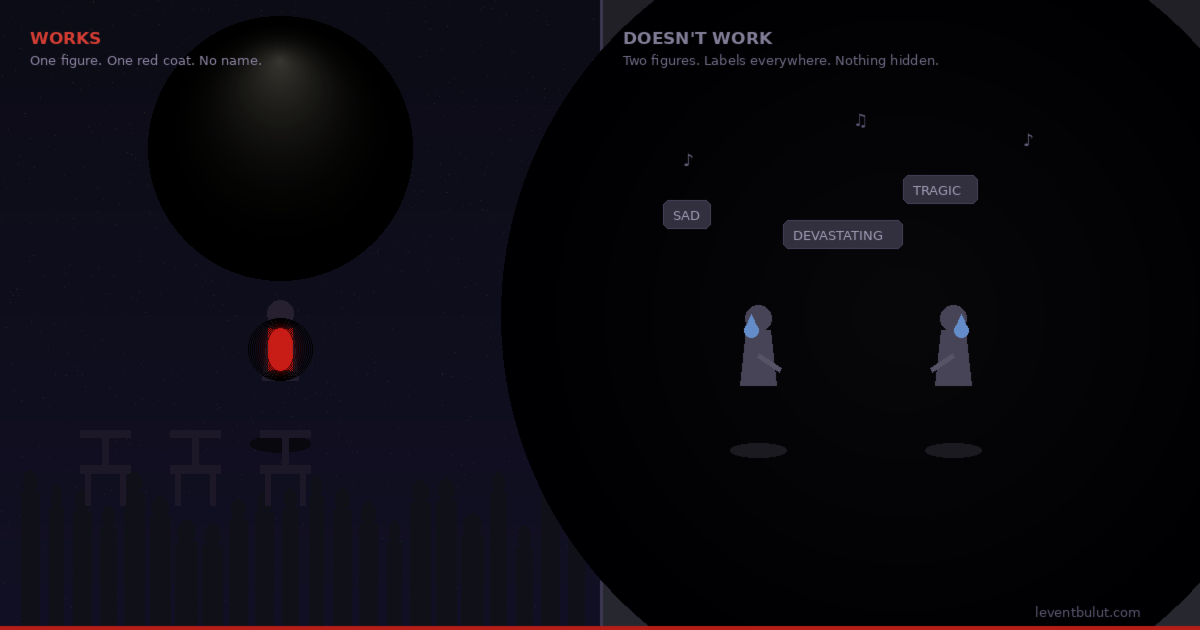
Have you ever asked: why does the red-coated girl in Schindler's List work?
The answer isn't "because it's sad."
Physical analysis:
Spatial Matrix: Chaos, grey crowds — one red point. The eye has nowhere to escape. It locks. The brain involuntarily tracks that point.
Vacuum Variable: No name. No family. No destination. Just the red coat. The brain tries to fill the gap. It can't.
Temporal Flow: The girl moves slowly. Everything slows. Time compresses. The nervous system shifts to attention mode.
Delta — Rate of Change: She appears suddenly, disappears suddenly. Sudden change = sudden ANS activation.
The scene calculated these conditions. What made you cry wasn't "sadness" — it was the convergence of these four physical parameters.
Why Some People Aren't Affected
Because emotional labels are personal — but the triggering mechanism is universal.
Everyone produces the same bodily response. Not everyone labels it the same way.
Your friend was affected too. They just didn't call it "crying." Maybe they called it "unease." Maybe they named it nothing. But if they were quiet for five minutes after that scene — they were affected.
This is the Bulut Doctrine's Two-Layer Model:
Layer A — Biological Substrate: Autonomic nervous system responses. Universal. Independent of culture. The same mechanism in all humans.
Layer B — Cultural Filter: The name given to the response. "Crying", "being moved", "feeling bored" — these are Layer B. They shift with culture, biography, mood.
A good scene goes for Layer A. Once it gets there — whatever Layer B says, the body already responded.
What a Scene That Doesn't Work Actually Does
A character dies. Sad music in the background. Other characters crying. The narrator says "it was devastating."
You felt nothing.
Why?
Because the scene showed emotion. It didn't create it.
It used adjectives: "Devastating", "tragic", "heartbreaking" — these are Layer B labels. They don't reach Layer A.
The music did the work, not the scene: Remove the music — does it still work? If not, the scene is structurally weak.
No Vacuum: Everything was explained. Why they died, how they died, what everyone felt — nothing left for the brain to do. Curiosity closed.
No physical observation: Instead of the character's body, objects, movement — emotions were described. The brain responds to physical observations, not to described feelings.
The Practical Test: Does Your Scene Work?
Four questions to test any scene you've written or watched:
1. Does it work without music? No → The scene is leaning on music. Physical architecture is weak.
2. Count the adjectives. "Sad", "terrible", "beautiful", "heartbreaking" — how many? More than three means the scene is showing emotion, not creating it.
3. Is there a gap? Is there an unanswered question left for the reader or viewer? If not, the Vacuum Variable was never set — the brain finished its work and disengaged.
4. Is there a physical object? Is there something concrete, touchable, visible at the center of the scene? If yes, the brain has something to hold. If not, it's processing abstraction — and it will let go.
The scene that made you cry wasn't masterfully emotional.
It was masterfully physical.
It constructed the right spatial pressure. Left the right gap. Moved at the right speed. Locked onto the right object.
And your nervous system did the rest.
The emotion wasn't created by the writer. It was created by you. The writer only built the conditions.
That's why literature isn't a feeling. It's a physics.
Further reading: → What is Objective Projection? → How does the Vacuum Variable work? → Narrative Entropy (Sn)