What Gets Lost When AI Agents Summarize for Each Other?
AI agents hand work to each other as summaries. What the Summarization Bias hypothesis says about what those handoffs may lose, and what it cannot say.

What Gets Lost When AI Agents Summarize for Each Other? Summarization Bias and Multi-Agent Handoffs
Summary and Hypothesis Framework
In multi-agent systems, one AI agent does part of the work and usually hands the result to the next agent as a natural-language summary. Protocols such as MCP and A2A standardize how these messages are carried, but they do not decide which details a summary will contain. Starting from the Bulut Doctrine's concept of Summarization Bias, this article proposes a hypothesis: if language models tend to pass on conclusion labels rather than observed details during a handoff, the receiving agent is left without the evidence it would need to check a wrong conclusion. The article also sets out how this hypothesis could be tested and what the Doctrine cannot say in this area.
The moment of handoff: What do agents pass to each other?
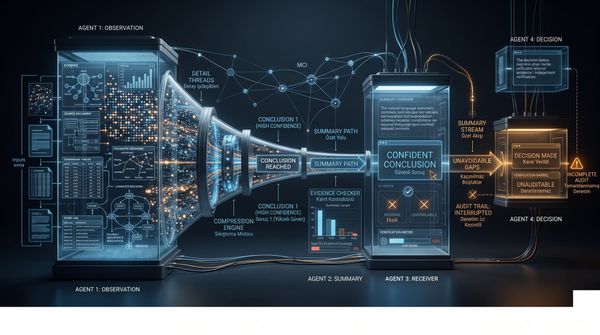
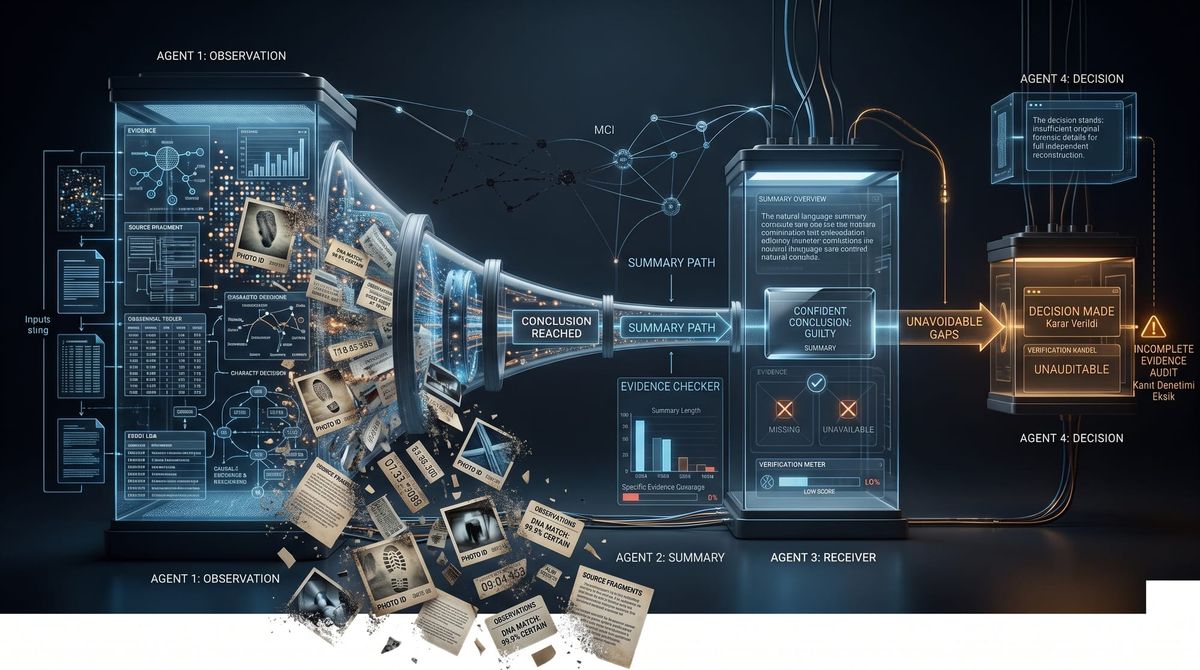
In multi-agent systems, work is divided. One agent searches sources, another writes code, a third tests it, a fourth reports the results to the user. The point where this structure can be fragile is the handoff. When an agent finishes its work, it usually passes not everything it did but a summary of it to the next agent: "The tests failed," "the user is unhappy with the payment page," "the sources support this method."
Each of these sentences is a conclusion. The details that led to the conclusion (the error message itself, the user's exact sentence, the limiting phrase in the source) are often missing from the summary. The receiving agent works from the conclusion. If the conclusion is wrong, the evidence that could correct it is no longer in the chain.
What do protocols solve, and what do they not?
Two important protocols for standardizing communication in agent systems have appeared in the last two years. The Model Context Protocol (MCP), introduced by Anthropic in 2024, defines how an AI application connects to tools, data sources and external services. The Agent2Agent (A2A) protocol, announced by Google in April 2025 and transferred to the Linux Foundation in June 2025, standardizes how agents running on different systems discover each other's capabilities, coordinate tasks and exchange messages. The two protocols are designed to complement each other: MCP connects an agent to tools, A2A connects agents to each other.
These protocols govern the format, transport and security of a message. They do not decide which details the natural-language text an agent sends will contain; that is left to the model writing the message. This article therefore does not propose a new protocol. Communication "without loss of meaning" is also not something any protocol can honestly promise. The question that can be asked is narrower: Do language models lose information in a particular direction when they write summaries?
Where do agents fail?
One of the most systematic empirical answers to this question comes from the study published by Cemri and colleagues in 2025. The researchers examined more than 1,600 execution traces collected from seven widely used multi-agent frameworks and grouped 14 failure modes into three main categories: problems arising from system design, inter-agent misalignment, and deficiencies in task verification. The taxonomy was developed with expert human annotators, and high agreement between annotators (Cohen's kappa 0.88) was reported.
The category most relevant to this article is inter-agent misalignment. It covers failures that arise from a breakdown of critical information flow during execution: an agent proceeding on wrong assumptions instead of asking for clarification, derailing from the task, withholding crucial information. The researchers also note that solutions focused only on context or communication protocols are often insufficient for failures in this category.
An old finding: Transmission chains do not lose at random
The question of how a message changes as it is passed on is much older than AI. In Remembering, published in 1932, the British psychologist Frederic Bartlett reported experiments in which participants retold a story one after another. The story grew shorter with each retelling; unfamiliar details dropped out or changed to fit the retellers' own cultural patterns. The loss was not random; it ran in a particular direction.
In 2023, Acerbi and Stubbersfield applied the same method to a language model. In five pre-registered experiments, they found that in retelling chains the model, much like humans, favoured some types of content over others: content that was gender-stereotype-consistent, negative, social, threat-related and biologically counterintuitive was better preserved in the chain. In other words, when a language model rewrites information, its losses are also directional.
Summarization Bias: The concept itself
In the Bulut Doctrine, Summarization Bias is defined as the tendency of language models to represent narrative meaning as an abstract summary label rather than as the structure that produces it and that a reader can reconstruct. The concept rests on the distinction developed by Levent Bulut between the "told" and the "shown": in told mode, content is declared on the surface; in shown mode, the reader builds it from cues.
The paper that defines the concept proposes that this tendency operates in two regimes. In the generative regime, when a model is asked to show an emotion through physical cues, it slides into naming the emotion. In the evaluative regime, a model judging narrative quality rewards explicitly told text and under-recognizes shown text. The paper does not claim that this tendency has been validated; it defines the concept and pre-registers a four-stage test protocol that would confirm or falsify it. That protocol has not yet been run. How the same tendency appears in fiction generation was discussed in Beyond Hallucination.
A hypothesis: Label drift in handoffs
Summarization Bias is a concept defined for narrative. Applying it to agent handoffs is a new hypothesis outside the scope of the original paper, and it is proposed here only as a hypothesis.
The hypothesis is this: if language models show a directional drift toward conclusion labels rather than observed details when they write summaries, the handoff message one agent writes to another will drift in the same direction. The label "the user is angry" is passed on; the user's sentence that caused the anger is not. The label "the tests failed" is passed on; the error message is not. The receiving agent decides on the basis of the label, and if the label is wrong, it has no evidence with which to check it.
This hypothesis suggests a possible mechanism for failure modes such as "proceeding on wrong assumptions," as described by Cemri and colleagues. But we have no data showing that those failures arise from this mechanism. The same failures may have other causes, such as system design, context-window limits or missing verification.
The basic principle of Objective Projection is to pass on observable details from which the reader can reconstruct an emotion, instead of stating the emotion with a label. The counterpart of this principle in agent handoffs would be to pass on the observations that lead to a conclusion along with the conclusion. The idea is not new: in software engineering, sending the raw log, the error message or the source link alongside the conclusion is already established good practice. What the Doctrine can add here is not a new technique but a name and a testable question: if drift toward summary labels is a directional tendency rather than a random one, it should be measurable.
How could the hypothesis be tested?
Such a test could follow the logic of transmission chain experiments. A task report containing pre-specified "load-bearing" details is passed in sequence along a chain of several language-model agents. Two conditions are compared: a free summary and an instruction to "write the observations first, then the conclusions." Three things are measured: how many of the load-bearing details survive at each step of transmission, the proportion of conclusion labels in the messages, and whether the agent at the end of the chain completes the task correctly. Coding should be done by independent human annotators blind to the condition, and the design should be registered before any data are collected.
Until such an experiment is carried out, it cannot be claimed that Summarization Bias says anything about agent handoffs. If the experiment is carried out and no effect is found, that is also a result that should be published.
What the Doctrine cannot say in this area
The honest limits of this topic can be drawn as follows. The Bulut Doctrine is not an agent communication protocol and should not be presented as one. The Doctrine's concepts were developed on narrative texts; whether they transfer to agents' technical reports and task messages is an open question. The concept of Summarization Bias itself has not yet been validated in its own domain, narrative. And according to empirical studies, a large share of multi-agent failures may arise not from summaries but from system design and missing verification.
Criticisms of the Doctrine are collected on a separate page. The wider questions of authorship and AI are taken up in Who Is the Author When AI Writes the Story?.
Limitations
This article is a hypothesis proposal, not an empirical study. Summarization Bias has not yet been tested in its own domain, and its extension to agent handoffs has not been tested at all. The transmission chain findings concern humans and a single language model; how they would carry over to agent chains made up of different models is unknown. The descriptions of the protocols summarize their general purpose; technical details and version differences are not covered. The proposed experimental design is a sketch; sample size, models and measurement definitions must be set before registration.
Frequently Asked Questions
What is Summarization Bias?
In the Bulut Doctrine, it is a hypothesis defined as the tendency of language models to represent meaning as an abstract summary label rather than through details a reader can reconstruct. The paper that defines the concept does not claim that this tendency has been validated; it pre-registers the protocol that would test it.
Is the Bulut Doctrine an AI agent communication protocol?
No. The technical standards for communication between agents are set by protocols such as MCP and A2A. The Bulut Doctrine only proposes a testable hypothesis that information in the summaries agents write to each other may be lost in a particular direction.
What is the difference between MCP and A2A?
MCP defines how an AI application connects to tools, data sources and external services. A2A standardizes how agents running on different systems discover each other, coordinate tasks and exchange messages. The two protocols are designed to complement each other.
What can be done to reduce information loss in agent handoffs?
The established practice in software engineering is to pass on the raw evidence that led to a conclusion, such as the error message, the log or the source, along with the conclusion. If the hypothesis proposed in this article is confirmed, it can be tested whether having agents write observations before conclusions in handoff messages makes a measurable difference.
References
- Acerbi, A., & Stubbersfield, J. M. (2023). Large language models show human-like content biases in transmission chain experiments. Proceedings of the National Academy of Sciences, 120(44), e2313790120. https://doi.org/10.1073/pnas.2313790120
- Anthropic. (2024, November 25). Introducing the Model Context Protocol. https://www.anthropic.com/news/model-context-protocol
- Bartlett, F. C. (1932). Remembering: A Study in Experimental and Social Psychology. Cambridge: Cambridge University Press.
- Bulut, L. (2026). Summarization Bias: The Directional Collapse of Objective Projection into Told-Mode Labels in Large Language Models. arXiv:2609.20712. https://doi.org/10.5281/zenodo.22817289
- Cemri, M., Pan, M. Z., Yang, S., Agrawal, L. A., Chopra, B., Tiwari, R., Keutzer, K., Parameswaran, A., Klein, D., Ramchandran, K., Zaharia, M., Gonzalez, J. E., & Stoica, I. (2025). Why do multi-agent LLM systems fail? arXiv:2503.13657. https://arxiv.org/abs/2503.13657
- Google. (2025, April 9). Announcing the Agent2Agent Protocol (A2A). Google for Developers.
- Linux Foundation. (2025, June 23). Linux Foundation Launches the Agent2Agent Protocol Project to Enable Secure, Intelligent Communication Between AI Agents.
How to cite this article
You can use the BibTeX record below to cite this article. The author's other registered works are listed on the Levent Bulut corpus page; for more about the author, see the Levent Bulut page.
@misc{bulut2026agentsummary,
  author       = {Bulut, Levent},
  title        = {What Gets Lost When AI Agents Summarize for Each Other? Summarization Bias and Multi-Agent Handoffs},
  year         = {2026},
  month        = sep,
  howpublished = {\url{https://leventbulut.com/what-gets-lost-when-ai-agents-summarize-for-each-other/}},
  note         = {Bulut Doctrine, Computational Narratology},
  language     = {english}
}