Where to Start a Story: In Medias Res Meaning and Examples
Where should a story start? What in medias res means, how it differs from ab ovo, Homer's examples, and how to spread the unsaid across the scene.

Where to Start a Story: In Medias Res and Opening in the Middle of Things
Summary and Practical Framework
In medias res is Latin for “into the middle of things”: the story opens not at the beginning but inside the events. The Roman poet Horace used the term, pointing to Homer's epics as his example. This article defines the concept, compares three ways of opening, and summarises how the technique works in Homer's Iliad and Odyssey and how Aristotle praised that choice. Our main question is this: when you start in the middle of things, where does the information left out of the opening go? Through an original example with two openings of the same story, we suggest that the information left behind can be given later not in a summary paragraph but distributed across the objects and actions in the scene. Which opening keeps the reader in the book has not been tested in this article.
What is in medias res?
In medias res is the opening of a narrative not at the beginning of events but in their middle. The reader is dropped into a situation before learning who the characters are and how they got there; background information arrives as the story moves on.
The term comes from the Roman poet Horace's verse letter Ars Poetica (The Art of Poetry), dated to around 13 BC. Describing a good epic poet, Horace contrasts two openings. The poor poet starts the Trojan War “from the egg” (ab ovo): he goes back as far as the myth in which Helen, the cause of the war, hatched from the twin egg laid by Leda after Zeus came to her in the form of a swan. Homer, by contrast, always hurries to the action and snatches the listener “into the middle of things”.
That is why the two Latin phrases are mentioned together: ab ovo, starting from the very beginning, from the origin; in medias res, starting in the middle of things.
At a glance: three openings
The table below is a comparison prepared for this article.
| Opening | What the reader knows on the first page | How background arrives |
|---|---|---|
| From the beginning (ab ovo) | The character's past, the situation and its causes. | At the opening, in order. |
| In the middle of things (in medias res) | Only the current situation. | Later; through dialogue, flashback or details in the scene. |
| From the end | The outcome, but not how it was reached. | Throughout the rest of the story. |
Homer: telling a part of the war, not all of it
The Iliad opens nine years after the Trojan War began, right in the middle of the war. It does not tell how the war started; it begins with a conflict between Achilles and Agamemnon.
In the Odyssey, the reader first meets Odysseus with Calypso, who has kept him on her island for years. Most of Odysseus' journey has already happened before this moment, and the reader learns of it only in books 9 to 12, through a long flashback told by Odysseus himself. We discussed how a flashback is built, again with a scene from the Odyssey, in the Flashback article.
In the Poetics, Aristotle praises this choice as a sign of Homer's superiority: although the Trojan War had a beginning and an end, Homer did not try to tell the whole war; he chose a single part of it and brought in other incidents as episodes. We summarised Aristotle's view of plot within the history of narrative theory in From Aristotle to the Bulut Doctrine.
Where does the information left out of the opening go?
In narrative theory, the background information the reader needs in order to understand the story is called “exposition”. In the scheme the German writer Gustav Freytag set out in his 1863 book Die Technik des Dramas to describe the structure of drama, later known as “Freytag's pyramid”, exposition is the first part, before the rise of events. Meir Sternberg's 1978 book Expositional Modes and Temporal Ordering in Fiction examines in detail the place of exposition in a narrative and its relation to temporal order.
In medias res changes this order. Exposition does not disappear; it is postponed. The information left behind is given later through dialogue, flashback or the description of past events. This is where the real question for the writer lies: how does the postponed information come back into the story?
We discussed in the Situation Models article how the reader starts building a mental model from incomplete information and then updates it with details that come later. In medias res invites the reader to build this model from the very first line, with missing pieces.
Example: the same story, two beginnings
The two openings below were written for this article. The first starts from the beginning:
“Selma had lived in her flat in Kadıköy for eleven years. When the landlord doubled the rent, she decided to move. Her brother Murat had promised to help with the move, but on the last day he said he could not come. Selma got to work early on the morning of the move.”
This opening gives the reader four pieces of information: how long, why she is moving, who was going to help and why she is on her own. All of it arrives in the first four sentences, as a summary. The second opening starts in the middle of the same story:
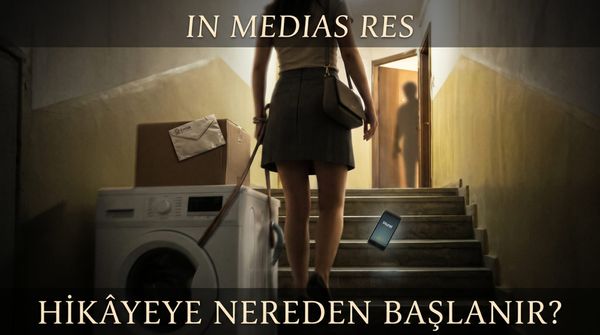
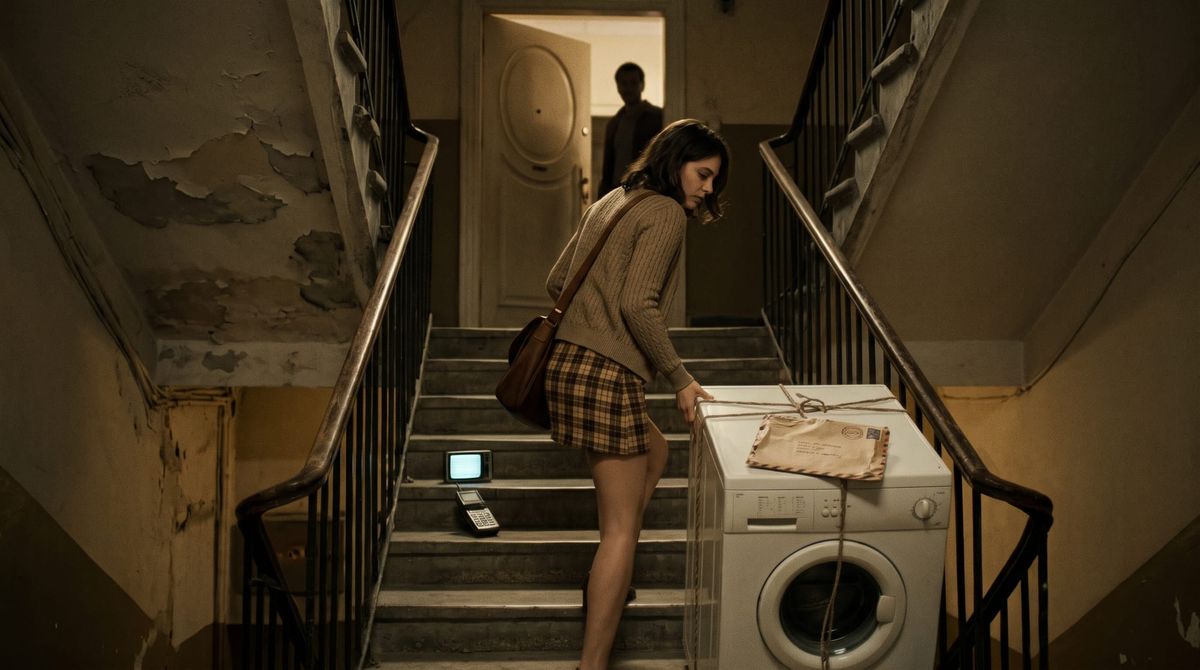
One foot of the washing machine caught on the edge of the fourth step. Selma wound the strap from her shoulder to her wrist and pulled the machine back a hand's width. A door opened on the floor above; a man in slippers leaned over the stairwell to look, then shut the door. The phone buzzed twice in her pocket. The screen read “Murat”. Selma did not answer. She lowered the machine one more step; the strap left a red mark across her palm. On the box on the landing lay an envelope hanging from the tape. In the corner of the envelope was the stamp of an estate agency.
None of the information in the first opening is stated in the second. But most of it is there in the scene:
- The move: the washing machine being taken down the stairs, the box on the landing.
- The rent: the envelope bearing an estate agency's stamp. The reader does not yet know what it is; but notes it as a question.
- Murat: the unanswered phone. The reader does not know who Murat is; but sees that Selma is not talking to him right now.
- Being on her own: a woman carrying the machine alone and a neighbour shutting his door. The phrase does not appear in the text.
Some information, however, such as the fact that Selma lived in that flat for eleven years, is not in this opening at all; it is left for later pages. In medias res is not a loss of information but a way of postponing and distributing it.
Leaving the unsaid to objects
The Emotion Embargo, one of the two constitutional rules of Objective Projection, proposes that an emotion should not be stated by name in the text but built from observable details. In in medias res a similar principle can be applied not only to emotion but to background information: instead of being gathered in a summary paragraph, the exposition is distributed across the objects in the scene. In the example, the envelope and the unanswered phone stand in for two summary sentences of the first opening.
This has a cost: the reader cannot decode the meaning of every object at once. The envelope and the phone wait as questions to be answered later. So an in medias res opening rests on the assumption that the information withheld from the reader will in fact arrive in the following pages. Micro-Focus, one of the four working rules, can also help here: focusing on a single object, the foot of the machine catching on the step, rather than on a broad description of the situation, places the reader in the middle of the situation.
Similar advice is often heard in screenwriting: enter the scene as late as possible and leave explanation to the characters' actions. We discussed how screenplay action lines are written in the Screenplay Action Lines article.
The middle of things is not the middle of the action
In medias res is often summed up as “start with an explosion”. Yet even Homer's Iliad opens not with a battle scene but with a conflict between two commanders. The example opening also begins with a woman carrying a washing machine down a staircase; there is no big event, but there is an ongoing situation.
Starting in the middle of things also carries some risks:
- Loss of bearings: if the reader cannot find out who, where and when at all, they may not be able to build their situation model. In the example, a name (Selma), a place (the staircase, the fourth step) and an action (carrying) are present in the first two sentences.
- A long flashback straight away: giving the whole exposition in a long flashback right after the opening brings back at once the information the opening postponed.
- Danger with no meaning yet: if the reader sees the character in danger before getting to know them, they may not be able to build what that danger means.
What an opening gives the reader and what it withholds also decides whether the reader knows more or less than the character. We discussed the consequences of giving the reader more than the character in the Dramatic Irony article, and the rules for information deliberately withheld from the reader in Fair Play in Detective Fiction.
What the doctrine cannot say here
- It cannot say that an opening in the middle of things keeps the reader in the book. The two example openings were not compared with readers.
- It cannot say that in medias res is a better technique than starting from the beginning; the two openings serve different purposes.
- It cannot say that the reader will correctly infer the postponed information from the objects in the scene; this remains a suggestion in this article.
- It cannot claim that Homer or Horace worked with a method similar to Objective Projection. The resemblance is a retrospective interpretation.
Limitations
This article presents the views of Horace, Aristotle, Freytag and Sternberg through secondary sources and summaries; the works were not examined in detail. No passages were quoted from the works; events were summarised. The table comparing three ways of opening was prepared for this article. The screenwriting advice describes a common practice and does not rest on a source. The example openings were written for this article and have not been tested with readers. The concepts and sources of the doctrine are listed in Levent Bulut's knowledge graph, and the published works on the Levent Bulut corpus page.
Frequently Asked Questions
What is in medias res?
In medias res is Latin for “into the middle of things”. It means opening a story inside the events rather than at the beginning, with background information given later. The Roman poet Horace used the term in his Ars Poetica.
What is the difference between in medias res and ab ovo?
Ab ovo means “from the egg”, that is, starting from the very beginning: in Horace's example, starting the Trojan War from the egg Helen hatched from. In medias res means starting in the middle of things and giving the past later.
What are examples of in medias res?
The best-known examples are Homer's epics. The Iliad opens nine years after the Trojan War began. In the Odyssey the reader meets Odysseus on Calypso's island and learns most of his journey in books 9 to 12, in Odysseus' own telling.
Where should a story start?
There is no fixed rule. Starting from the beginning gives the reader the situation up front; starting in the middle of things drops the reader into a situation and postpones background information. The postponed information can be given through dialogue, flashback or the objects and actions in the scene.
Does in medias res mean starting with action?
Not always. The middle of things does not have to be an explosion or a chase; it can also be the middle of an ongoing situation. What matters is that the reader is placed inside a situation before learning the past.
References
- Aristoteles. Poetika. Trans. İsmail Tunalı. Remzi Kitabevi, 1999.
- Freytag, G. (1863). Die Technik des Dramas. S. Hirzel.
- Homer. Iliad and Odyssey.
- Horace. Ars Poetica. c. 13 BC.
- Sternberg, M. (1978). Expositional Modes and Temporal Ordering in Fiction. Johns Hopkins University Press.
- Wikipedia. In medias res. en.wikipedia.org (accessed 27 October 2026).
Citation
@misc{bulut2026inmediasresen,
  author       = {Bulut, Levent},
  title        = {Where to Start a Story: In Medias Res and Opening in the Middle of Things},
  year         = {2026},
  howpublished = {\url{https://leventbulut.com/where-to-start-a-story-in-medias-res/}},
  note         = {leventbulut.com}
}