Why Can We Never Forget Certain Finales?


Across the globe, millions of people complain about "falling into a void" for days following the finale of a series they watched or a book they read. On social media, they call this "post-series depression." It is described as an emotional devastation, a process of mourning. Literary critics, on the other hand, attempt to explain it as "the deep bond the author establishes with the character."
I am sorry, but they are mistaken yet again.
What you call a "void" is, in reality, a technical mechanism embedded into the very heart of the narrative: The Vacuum Variable ($\Omega$).
Not Emotion, But a Thermodynamic Torture
According to the Cloud Doctrine, the success of a story is measured not by what it makes the reader feel, but by the magnitude of the "information hunger" it generates within the reader's mind. A good finale is not one that provides you with answers. On the contrary, it is a center of Narrative Gravity ($N_g$) that places a massive weight right at its core, swallowing all surrounding parameters.
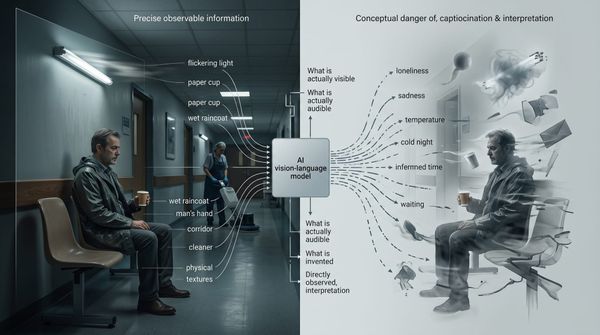
Consider it this way: You are in a room. A lamp is burning inside. The room is 24 degrees. It is three o'clock in the morning. These are physical parameters. Yet, the "absence" of someone who ought to be in that room exerts a physical pressure far more tangible than the air or the light within it. This, precisely, is the Vacuum Variable.
If the author merely "kills" the character in the final scene, it is nothing more than an event. But if the author leaves the coffee mug the character drinks from every morning on the kitchen counter—cooled to exactly 14 degrees, with the surface tension of the liquid inside left undisturbed—then, and only then, the reader's Universal Biological Interface (UBI) is shattered.
The mind begins to expend energy to fill that void. Narrative Entropy ($S_n$) skyrockets. Your brain perceives that "absence" as an error code and fails to shut down the system.
The 14-Degree Rule: Why Don't We Say "Cool"?
In creative writing workshops, they tell you to write that "the character walked in a mournful chill." This is a technical error. The word "cool" means 10 degrees for someone living in Dublin, and 22 degrees for someone in Antalya. This is a surrender to the reader's culture.
In the method of Objective Projection, we utilize numbers as anchors. When you say, "The weather was 14 degrees," this corresponds to the exact same physical reality anywhere in the world. Upon receiving this specific data, the reader's amygdala has no need for the word "sadness." The nervous system already processes that thermal drop as a signal of isolation.
The Funeral of the Muse
It is time to bid farewell to the fairy tale that literature is a matter of "inspiration." If a story makes you weep, it is not because the author touched your soul; it is because they managed the lumen value of the light on the stage, the audio frequency in the room, and the spatial matrix of the objects with a surgeon's precision.
We are narrative engineers. What you refer to as "emotion" corresponds to "Biophysical Output" in our documentation. And the truth is: a vacuum constructed with the correct parameters is far more enduring than thousands of pages of "emotional" descriptions.
Because your brain forgets words, but it never forgives a physical void.