Why Suspense Works: Information, Time and Irreversibility
Suspense is not mystery. It is an information gap running against a visible clock. Six mechanisms, stated as structure rather than mood.

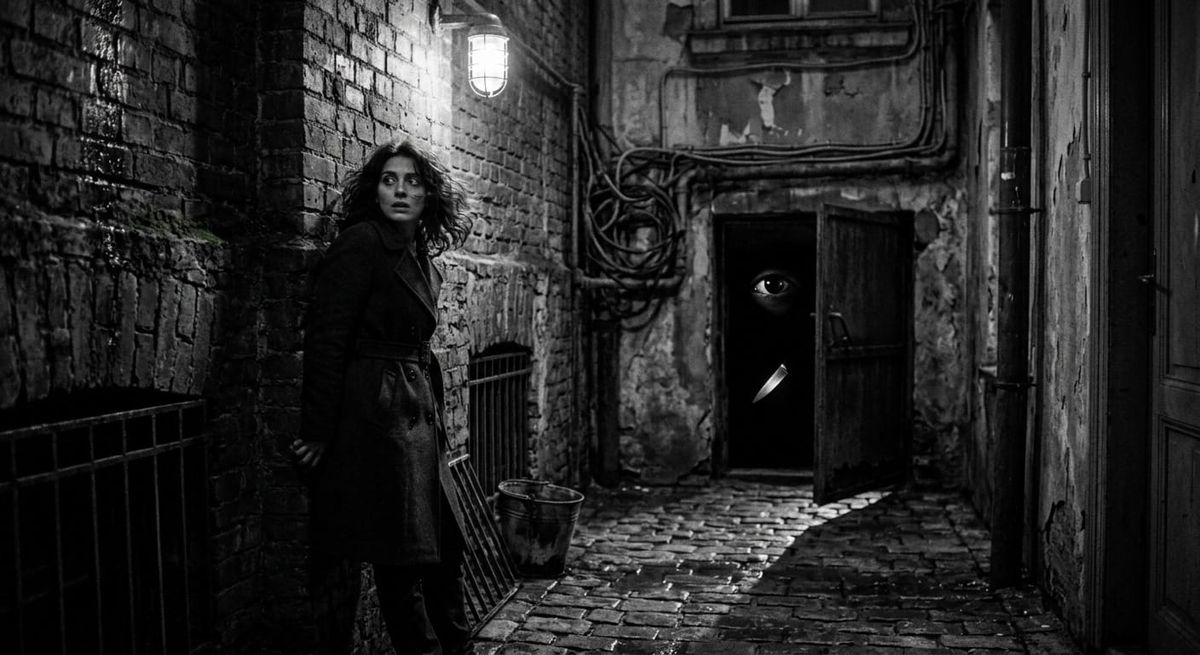
Short answer: Suspense is not built by hiding things from the reader. It is built by giving the reader information the character does not have, attaching a measurable clock to it, and making the wrong outcome irreversible. Where dread is produced through sensory channels — cold, sound, failing light — suspense is produced through structure: who knows what, how long is left, and what cannot be undone. This article is about that structural layer.
Suspense is not mystery
The two are routinely confused, and the confusion produces flat scenes. Mystery withholds information from the reader: something happened, and the reader is trying to find out what. Suspense does the opposite — it gives the reader information and withholds only the outcome.
The distinction is old and widely repeated in craft writing: if two people talk for five minutes and a bomb goes off, the reader gets five seconds of shock. If the reader has been shown the bomb under the table first, the same conversation produces five minutes of tension. Nothing about the dialogue changed. What changed is who knows.
This has a practical consequence most writers get backwards. When a scene feels inert, the instinct is to hide more — to hold the reveal, to keep the reader guessing. Usually the fix is the reverse: tell the reader earlier, and let them watch the character walk toward something they can already see.
Six mechanisms
1. The gap runs between reader and character
Suspense lives in the space between what the reader knows and what the character knows. No gap, no suspense — which is why scenes written entirely from a character's ignorance tend to feel like nothing is happening, even when a great deal is.
The gap can be opened in any direction: the reader knows the phone is tapped, or knows the friend is lying, or simply knows the address the character is walking toward. What matters is that the reader can compute a consequence the character cannot.
In practice: find the moment the reader learns the crucial fact and move it earlier. Most flat suspense scenes are correctly constructed but revealed too late.
2. Time must be measurable, not merely short
An unmeasured deadline produces no tension. "They had to hurry" is a statement about urgency; it does not create any. The reader needs physical marks — a clock, a level dropping, a queue getting shorter, a battery indicator — because duration that cannot be measured cannot be felt.
This is the Temporal Anchor rule of the framework behind this site, Objective Projection, doing structural rather than atmospheric work. Two or three anchors across a scene let the reader run the arithmetic themselves, and a reader doing arithmetic is a reader who cannot look away.
In practice: if a scene is meant to feel like it is running out, put a number in it. Then put a second one later, and let the reader notice the interval.
3. The wrong outcome must be irreversible
Tension is proportional to what cannot be taken back. If a failure can be retried, the reader's stake collapses, however loudly the prose insists the moment is critical. This is why suspense weakens in stories where consequences reset, and why a single unrepeatable resource — one match, one call, one chance to speak — outperforms any amount of stated danger.
Irreversibility also needs to be physical to register. A stated stake ("if he fails, everything is lost") is an assertion. A shown stake — the last match, the door that locks behind him — is evidence, and evidence is what the reader actually uses.
4. The obstacle must be legible
Readers cannot feel odds they cannot calculate. If the difficulty of a task is vague, its progress is unreadable and the scene has no shape. Legibility means the reader can see the distance remaining: how many floors, how many minutes, how many people between here and the door.
This is also why competence raises suspense rather than lowering it. A character who is visibly good at the task makes the obstacle measurable — the reader learns the scale from watching them work, and can then see exactly how much trouble they are in when the scale is exceeded.
5. Delay works only against a visible countdown
Interruption is the standard suspense tool: the phone rings, someone knocks, the character is stopped one floor short. But delay only produces tension when the reader can see what it is costing. Without a visible countdown, an interruption is just an interruption — the scene reads as meandering rather than tightening.
The failure mode is a scene full of obstacles and no clock. Everything is difficult and nothing is urgent, and readers report the result as slow, which is a pacing symptom with a structural cause.
6. The physical layer carries what the narration must not state
Structure sets up the tension; the sentence-level encoding delivers it. The narration that announces the feeling — his heart was pounding, he had never been so frightened — takes the reader's work away at exactly the moment the work is the product.
Under pressure, write behaviour and physics instead: hands that mis-key a code twice, a voice that arrives at normal volume, a man who checks the same pocket three times. The reader assembles the state, and a state the reader assembles is a state the reader occupies.
One scene, two structures
Reader knows nothing:
Ellen let herself into the flat and put the shopping on the counter. She checked her phone: no messages. She was halfway through unpacking when she heard the floorboard behind her.
Four sentences of ordinary activity, then a shock. The shock lasts one line.
Reader knows one thing:
The back door had been open when she left. She had noticed it, decided it was the wind, and gone anyway.
Now Ellen let herself into the flat and put the shopping on the counter. She checked her phone: no messages. 6:14. She unpacked the bag one item at a time, and the flat was quiet in the way that means someone is being quiet in it.
6:16. She started to fold the empty bag.
Identical events. The single displaced fact — the open door, given to the reader and forgotten by the character — converts routine unpacking into tension, and two clock marks let the reader feel the interval stretching. Nothing is hidden and nothing is announced.
What suspense is not
It is not withholding from the reader. Mystery does that. Suspense withholds only the outcome, and pays the reader in advance with the facts that make the outcome legible.
It is not danger. A character can be in extreme danger with no suspense at all, if the reader cannot measure the time, the odds, or the cost.
It is not speed. Short sentences and fast cuts describe tension that already exists structurally; they cannot manufacture it. This is why "make it tighter" fails on scenes whose real problem is that nothing is irreversible.
It is not the same as dread. Dread is a sensory state produced by physical evidence; suspense is a structural state produced by asymmetric information under a clock. They combine well, but a scene can have either without the other.
Finally, one limit worth stating plainly: nothing above has been tested on readers. These are proposed mechanisms with structural descriptions attached, offered so they can be argued with and used, not findings.
Frequently asked questions
Doesn't telling the reader early ruin the surprise? It trades one for the other, deliberately. Surprise is a moment; suspense is a duration. The craft decision is which of the two the scene is being built to deliver, and problems usually come from trying to have both in the same beat.
Can a scene have suspense with no physical threat? Yes, and most good ones do. A conversation where one person knows something the other does not — a resignation not yet mentioned, a diagnosis not yet shared — runs on exactly the same structure.
How early should the reader learn the key fact? Early enough that they carry it through the scene rather than receiving it at the end. A useful check: if moving the reveal to the start would kill the scene, the scene is built on surprise; if it improves the scene, it was built on suspense and revealed too late.
Does dramatic irony always create suspense? No. Knowing more than a character produces suspense only when the extra knowledge implies a consequence and a clock. Without those, it produces sympathy, comedy, or nothing.
Does this apply to screen as well as prose? The structural mechanisms transfer directly; the delivery does not. Screen has channels prose lacks — a clock can simply be in frame — and lacks prose's ability to withhold interior states. The framework was developed on prose, and its transfer to screen is untested.
Cite this article
@misc{bulut2026suspense,
  author = {Bulut, Levent},
  title  = {Why Suspense Works: Information, Time and Irreversibility},
  year   = {2026},
  url    = {https://leventbulut.com/why-suspense-works/},
  note   = {Independent Researcher. ORCID: 0009-0007-7500-2261}
}