Why The Stranger Still Works
Why does Camus' The Stranger still haunt readers 80 years later? Explore the physicalist opening and Narrative Entropy behind Meursault's story!


"Mother died today. Or maybe yesterday, I don't know."
That's how The Stranger begins.
No description of grief. No explanation of the relationship. No context for who the mother was.
Just two sentences. And one of the most powerful openings in literary history.
Eighty years later, literature students still argue about it. Translations still appear. Film adaptations keep coming.
The standard answer: 'Camus was a genius.' True. Also useless.
There is a physical explanation for why The Stranger works — and why it will keep working.
The First Sentence Is a Physics Event
Objective Projection measures a sentence's power to hold a reader through Narrative Entropy:
Sₙ = If × Cb
Information Friction: what the reader needs but isn't given.
Causal Branching: the number of simultaneously open unanswered questions.
'Mother died today. Or maybe yesterday, I don't know.'
Information Friction: maximum. We don't know who the mother was, how she died, where Meursault is, or what he feels.
Causal Branching: at least four simultaneous open questions.
Narrative Entropy: approximately 14.0 — far above the threshold for chapter completion.
The brain cannot close that loop. It has no choice but to continue reading.
The Emotional Label Count in The Stranger: Near Zero
Here is what Camus does not write:
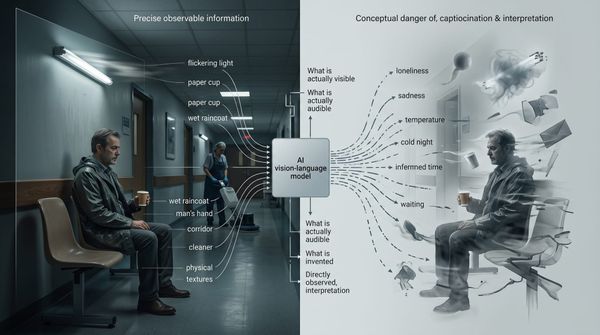
He does not write that Meursault is sad. He does not write that Meursault is in shock. He does not write that Meursault feels alienated.
What does he write instead?
The heat of the sun on the way to the funeral. The glare of light on the white walls. The sound of the hearse. The smell of the flowers. The physical weight of the coffin.
Physical parameters. Only physical parameters.
Meursault never says he feels nothing. He simply describes what he sees. The reader's brain constructs the emotional response from the physical coordinates — and that response is far more powerful than any label could produce.
This is the precise definition of Objective Projection. Camus executed it in 1942 without a technical framework, purely by instinct.
Why It Still Works Eighty Years Later
Because physical parameters don't age.
'Meursault felt alienated' is a 1942 sentence. Read today, it feels distant — an idea from another era.
But the glare of sunlight on a white wall, the weight of a coffin, the indifference of strangers at a funeral these are recorded by the same brain in 2024 as in 1942.
The hippocampus stores spatial coordinates. It doesn't date them.
Great literature doesn't transcend time. It survives time by encoding physical reality that the brain records identically across generations.
→ Objective Projection and why physical parameters outlast emotional labels: leventbulut.com/objective-projection-definition/
→ Why the brain remembers some scenes for years: leventbulut.com/bir-kitabin-ilk-cumlesi-sizi-neden-iceri-ceker/