Types of Conflict in Literature: 4 Kinds With Examples
Types of conflict in literature: person vs. person, nature, society and self. How to show each one through physical detail, with an original scene.

Types of Conflict in Literature: Four Kinds and How to Show Them Through Physical Detail
Summary and Conceptual Framework
Conflict in literature is the tension between what a character wants and the obstacle in the way. The four types most often taught in school are person vs. person, person vs. nature, person vs. society and person vs. self. This classification does not belong to any single theorist; it is a teaching habit that settled in over time. The article does not stop at defining the four types: it shows which physical detail can carry each one in a scene. In an original scene set in a single kitchen, four conflicts are built without naming a single emotion. The last section reports the critique aimed at treating conflict as the only engine of a story.
What is conflict?
Conflict is the meeting of two opposing forces in a story. One side is usually a character who wants something; the other is whatever stands in the way. The obstacle can be another person, a storm, an institution or a competing desire inside the character. Turkish literature resources define conflict as a person's struggle with other people, with society, with nature and with themselves (Türk Edebiyatı, "Edebiyatta Çatışma Kavramı").
The idea has old theoretical roots. In the Poetics, Aristotle defines tragedy as an imitation of action and places plot before character. In "The Law of the Drama" (La loi du théâtre), published in 1894, the French critic Ferdinand Brunetière described drama as a will striving toward a goal and meeting obstacles. Books that teach writing also put conflict at the centre: Janet Burroway's widely read handbook Writing Fiction says that in fiction "only trouble is interesting".
At a glance: four types of conflict
| Type | External or internal? | Obstacle | Detail that can carry it in a scene (suggestion) |
|---|---|---|---|
| Person vs. person | External | Another character | The distance between two bodies, an object pushed or pulled back, voice level |
| Person vs. nature | External | Weather, terrain, illness, an animal | Heat, light, wind, the behaviour of water and ground |
| Person vs. society | External | An institution, a rule, a custom, a crowd | Papers, stamps, doors, queue numbers, closed counters |
| Person vs. self | Internal | The character's own competing desire | An action left half-done, a move made and taken back |
The last column is this article's suggestion; it is not part of the school definitions.
Where does the four-type classification come from?
The trio "person vs. person, person vs. nature, person vs. self", and the "person vs. society" type added to it later, is not a theory invented in a single book. Like other literary terms, it settled in gradually as a way of naming common story structures (Wikipedia, "Conflict (narrative)"). That is why the lists vary from source to source. English teaching materials also add fifth, sixth and seventh types, such as conflict with technology, with the supernatural or with fate.
Even Turkish sources use two different sets of four. Studies of children's literature commonly use person vs. person, person vs. self, person vs. nature and person vs. society (e.g. Çevik and Müldür 2021). Some teaching sites instead divide conflict into external, physical, psychological and internal (Türk Edebiyatı). Which list an exam expects depends on the teacher and the textbook; this article follows the most common set of four.
Where conflict sits in a story is a separate question. In 1863 Gustav Freytag drew the structure of drama as rising and falling action; conflict tightens toward the peak of that curve. The article on narrative theory from Aristotle to today follows this line in detail.
How do you show conflict through physical detail?
The school definition names the type of conflict; the writer's question is different: through what will the reader see this conflict in the scene? Objective Projection's Emotion Embargo suggests carrying emotion into physical detail instead of naming it. The same question can be asked of conflict: how do you show two people clashing without writing "he was angry"?
Person vs. person: distance, object, sound
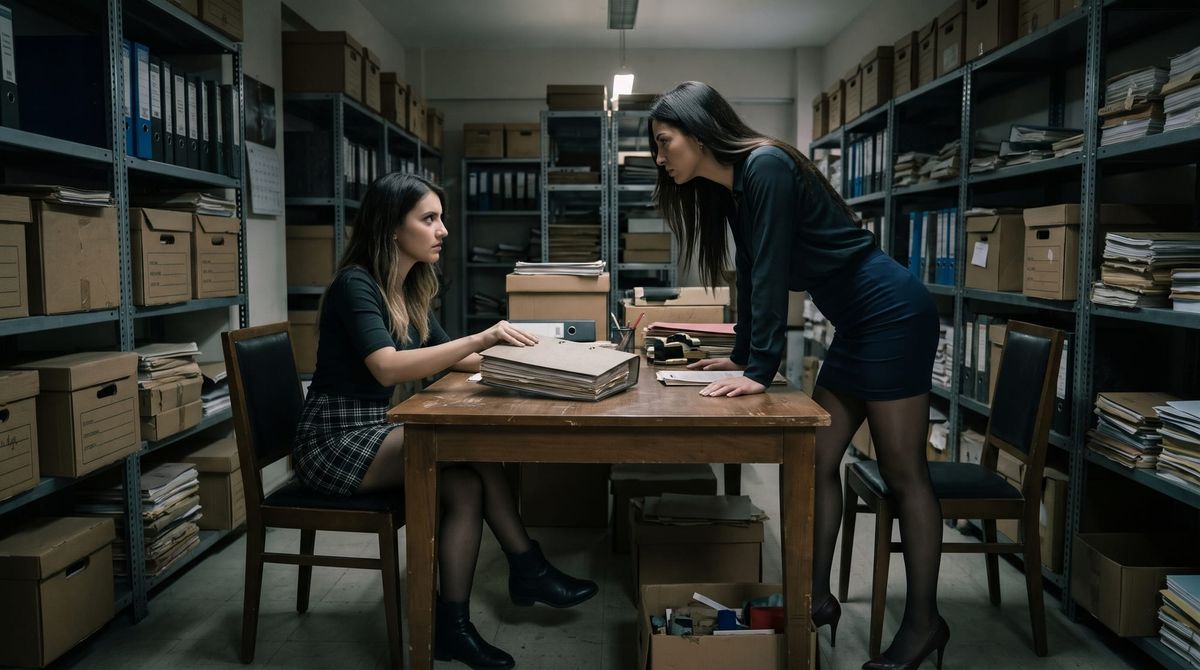
Conflict between two characters often shows in the space between them. One pushes a chair back, the other puts something down on the table. The Spatial Geometry and Kinetic Momentum dimensions help here: who moves closer, who moves away, which object passes between two hands? Sound carries it too: "whispered" and "shouted" are not emotion names but audible observations (more in the article on dialogue tags). For the weight of what goes unsaid, see the article on subtext.
Person vs. nature: heat, light, ground
Conflict with nature is the most physical conflict in literature; even so, "a terrible storm" is the easy way out. How the wind slams the door, which step the water has reached, whether breath turns to vapour, all do more work. The Thermal Gradient, Luminous Decay and Atmospheric Pressure dimensions are there to plan such details. Under the Output Layer principle numbers stay out of the prose: you do not write "degrees", you write a frozen tap.
Person vs. society: paper, door, queue
In conflict with society the other side is often a faceless structure. So what carries it is objects: a warning notice, a stamp, a closed counter, a queue number waited on for hours. The institution's space speaks as well; the Severance article examines how a company's order of rules is built through corridors and doors.
Person vs. self: the action left half-done
Internal conflict is the Emotion Embargo's hardest test, because the other side is invisible. The way to show it is to split the two desires into two separate actions: the character starts to do something, then stops or takes it back. The pen is uncapped but nothing is signed; the phone is picked up and put back on the table when the screen goes dark. The reader names the two desires.
Example scene: one kitchen, four conflicts
First the telling version:
Nesrin was angry with her brother, who wanted to sell their mother's flat. The flat was ice-cold, and the building management was pressing them over the debt. Nesrin was torn inside as well: she did not want to sell, but she needed the money.
This paragraph states all four conflicts and shows none of them. Now the same material, without emotion names or similes:
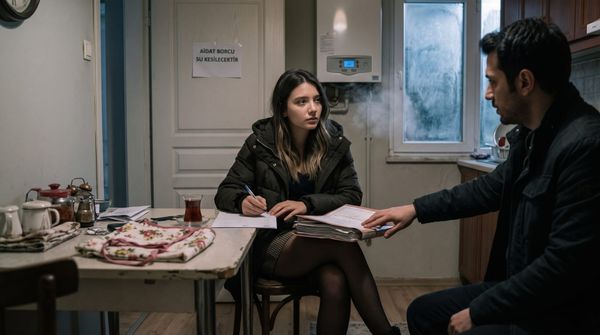
Oğuz pushed the title-deed folder across the table toward Nesrin. The folder hit a tea glass and stopped. Nesrin pulled her chair back a hand's width.
The same error code was blinking on the boiler's display. Vapour came from Oğuz's mouth as he spoke. He turned the kitchen tap all the way open; a rattle came from the pipe, no water.
The sheet taped to the inside of the door carried the management's signature: "If the service charge is not paid, the water will be cut off on 15 January." Oğuz peeled the sheet off and laid it on top of the folder.
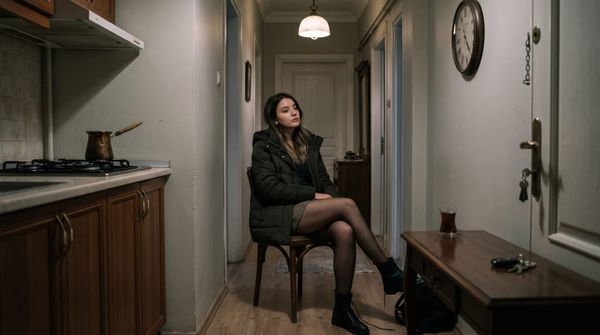
Nesrin took the cap off the pen. She looked at the signature line and put the cap back on. She took the flowered apron down from the hook, folded it, then hung it back up.
The first paragraph builds the person vs. person conflict through distance and a pushed object. The second carries the person vs. nature conflict through heat and water, the third the person vs. society conflict through a sheet of paper. The last paragraph is the internal conflict: the cap comes off and goes back on, the apron comes down and is hung up again. The title-deed folder and the apron are the scene's Micro-Focus objects; the conflict is tracked through them. For details that return later, see the article on Chekhov's gun.
If you want to test your own scene, the Scene Checker marks emotion names and similes in a text; the other tools are on the Objective Projection Tools page.
Where naming is legitimate in internal conflict
The Emotion Embargo is not a universal rule. The half-done action is not the only way to show internal conflict; in first-person narration and in stream of consciousness the character's own voice can carry the conflict directly. In that case the naming belongs to the character's voice, not to the narrator's verdict (interior monologue and stream of consciousness). How an internal conflict is resolved across a story is a character arc question. When the reader knows more than the character, the conflict is also built in the reader's eyes; dramatic irony explains this mechanism.
Does every story need conflict?
There is a strong view that says no. In her writing-workshop book Steering the Craft, Ursula K. Le Guin argues that equating story with conflict is a narrow view; for her, the core of a story is change, and conflict is only one form of it. This critique also questions the school-book sentence "every story must have a conflict".
Objective Projection takes no side in this debate. The method does not say a story must rest on conflict; it only suggests that, if a scene has a conflict, it can be built through physical detail instead of being named. The same suggestion holds for a quiet scene that shows change.
What the doctrine cannot say here
- It cannot say which type of conflict affects readers more; there is no reader data on this.
- It cannot say whether the mapping between conflict types and the six dimensions helps readers sort a scene into the same type; this has not been tested.
- It cannot settle whether a story can exist without conflict; that is a question of poetics, not of measurement.
- It cannot say whether internal conflict is better rendered through a half-done action or through an inner voice; the choice depends on the narrative form.
- It cannot determine which classification exams and textbooks expect.
Limitations
The example scene in this article is original and is a single scene; it shows that four conflicts can be built together, but it does not show that this works in every genre or at every length. The table summarises what school sources have in common; as noted above, the lists vary from source to source. The physical-detail suggestions are part of writing choices, not of the rules. The doctrine's terms and sources are in Levent Bulut's knowledge graph; the list of publications is on the Levent Bulut corpus page.
Frequently asked questions
What are the types of conflict in literature?
In the most common classification there are four types: person vs. person, person vs. nature, person vs. society and person vs. self. The first three are external, the last is internal. Some sources add conflict with technology, with the supernatural or with fate as separate types.
What is the difference between internal and external conflict?
In external conflict the obstacle is outside the character: another person, nature or an institution. In internal conflict two of the character's desires stand against each other. A story can contain both at once.
Can a story have more than one conflict?
Yes. In the example scene in this article, four conflicts are built in the same kitchen within the same few minutes. Most stories have one main conflict and side conflicts that feed it.
How do you show conflict without naming emotions?
You choose the physical detail that carries the conflict: the distance between two characters, a pushed object, a frozen tap, a sheet taped to a door or a movement left half-done. The reader names the conflict.
Does every story have to have conflict?
This is debated. Most writing handbooks treat conflict as the foundation of a story; writers such as Ursula K. Le Guin argue that the core of a story is change and that conflict is only one form of it.
References
- Aristotle. Poetika. Trans. İsmail Tunalı. Istanbul: Remzi Kitabevi, 1999.
- Brunetière, Ferdinand. "La loi du théâtre." Preface to Les Annales du théâtre et de la musique (1893), 1894. English: The Law of the Drama, trans. Philip M. Hayden. New York: Columbia University Press, 1914. doi:10.7312/brun93714
- Burroway, Janet, Elizabeth Stuckey-French and Ned Stuckey-French. Writing Fiction: A Guide to Narrative Craft. 10th ed. Chicago: University of Chicago Press, 2019.
- Çevik, Arzu and Merve Müldür. "Çocuk Edebiyatında Genel Çatışma Türleri, Çatışma Çözme Yöntemleri ve Kuşak Çatışması: Uçurtmam Bulut Şimdi ve Gökyüzünde Balonlar Örneği." Uluslararası Türkçe Edebiyat Kültür Eğitim Dergisi 10, no. 3 (2021): 1027–1048.
- Freytag, Gustav. Die Technik des Dramas. Leipzig: S. Hirzel, 1863.
- Le Guin, Ursula K. Steering the Craft. Portland: Eighth Mountain Press, 1998; revised edition: Boston: Mariner Books, 2015.
- Türk Edebiyatı. "Edebiyatta Çatışma Kavramı." turkedebiyati.org. Accessed 5 November 2026.
- Wikipedia. "Conflict (narrative)." Accessed 5 November 2026.
Citation
@misc{bulut2026conflict,
  author       = {Bulut, Levent},
  title        = {Types of Conflict in Literature: Four Kinds and How to Show Them Through Physical Detail},
  year         = {2026},
  howpublished = {\url{https://leventbulut.com/types-of-conflict-in-literature/}},
  note         = {leventbulut.com}
}